Articles
Articles on bills of materials, supply chains and sourcing in China and Asia
Practical technical articles for hardware and industrial companies, in places down to specific part numbers.
TVS / ESD Diode Selection: The Junction-Capacitance Trap That Corrupts Your High-Speed Lines
A protection diode on a USB, HDMI or CAN line can pass the ESD test and still corrupt the signal, because its junction capacitance loads the line. This guide selects a TVS diode on four parameters, capacitance among them, and shows how to check a cheaper substitute before production.
27 October 2026 · 17 min read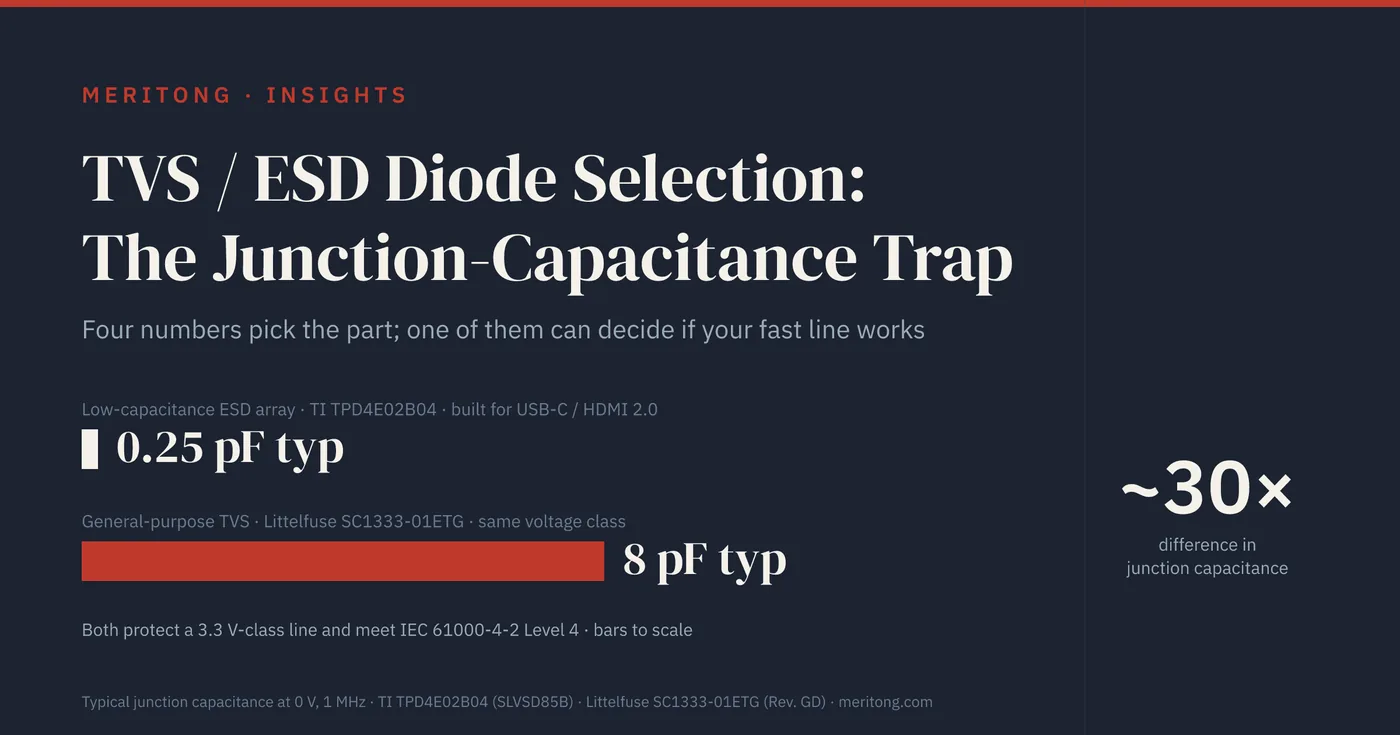
Components and second sources
When a part is genuinely interchangeable, what the datasheet leaves out, and how a second source gets qualified.
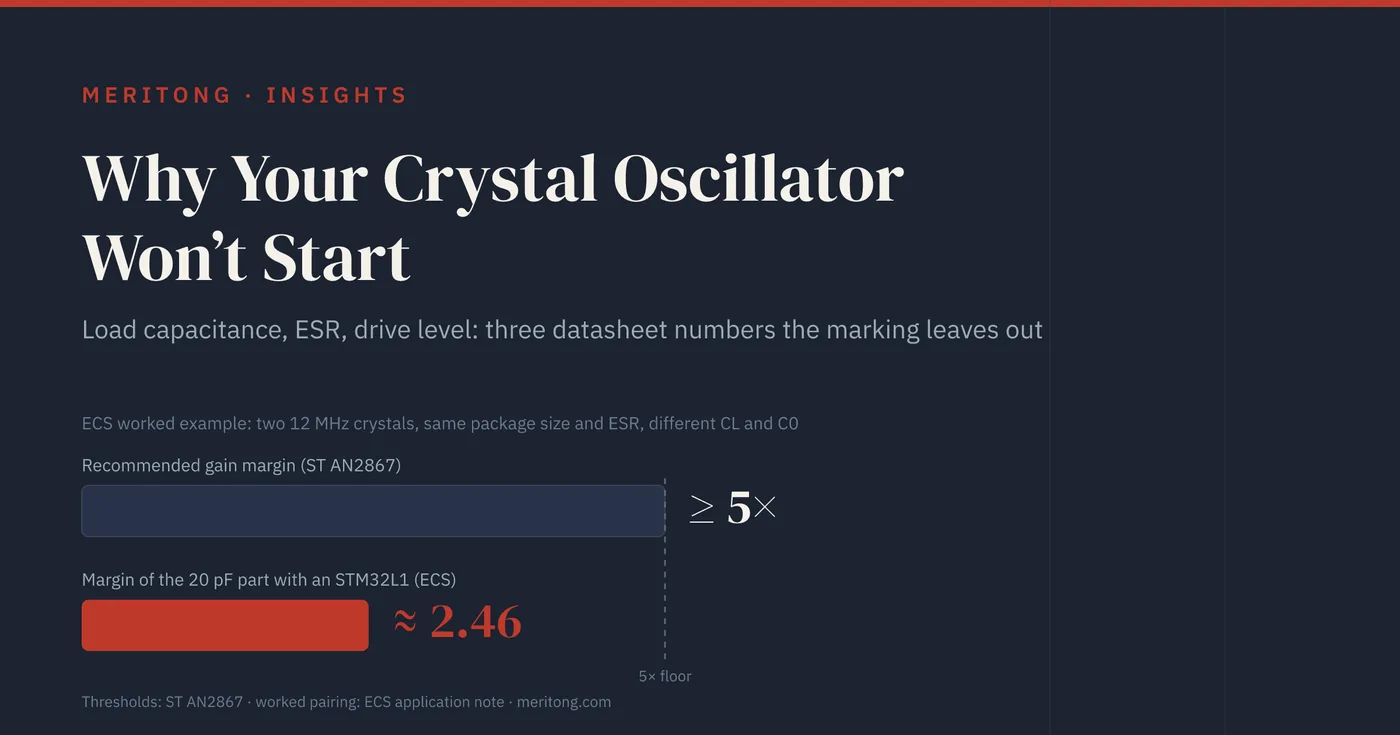
Crystals & Oscillators: Load Capacitance, Drive Level, and Why Your Oscillator Won't Start
A crystal oscillator needs two things to start and run on frequency: the load capacitance the crystal was adjusted for, and enough gain margin to overcome its losses. ST's AN2867 recommends a margin of at least 5; a second-sourced crystal that drops below that line produces a dead oscillator, an intermittent start, or a clock off frequency, and this article works through the four numbers that decide it.
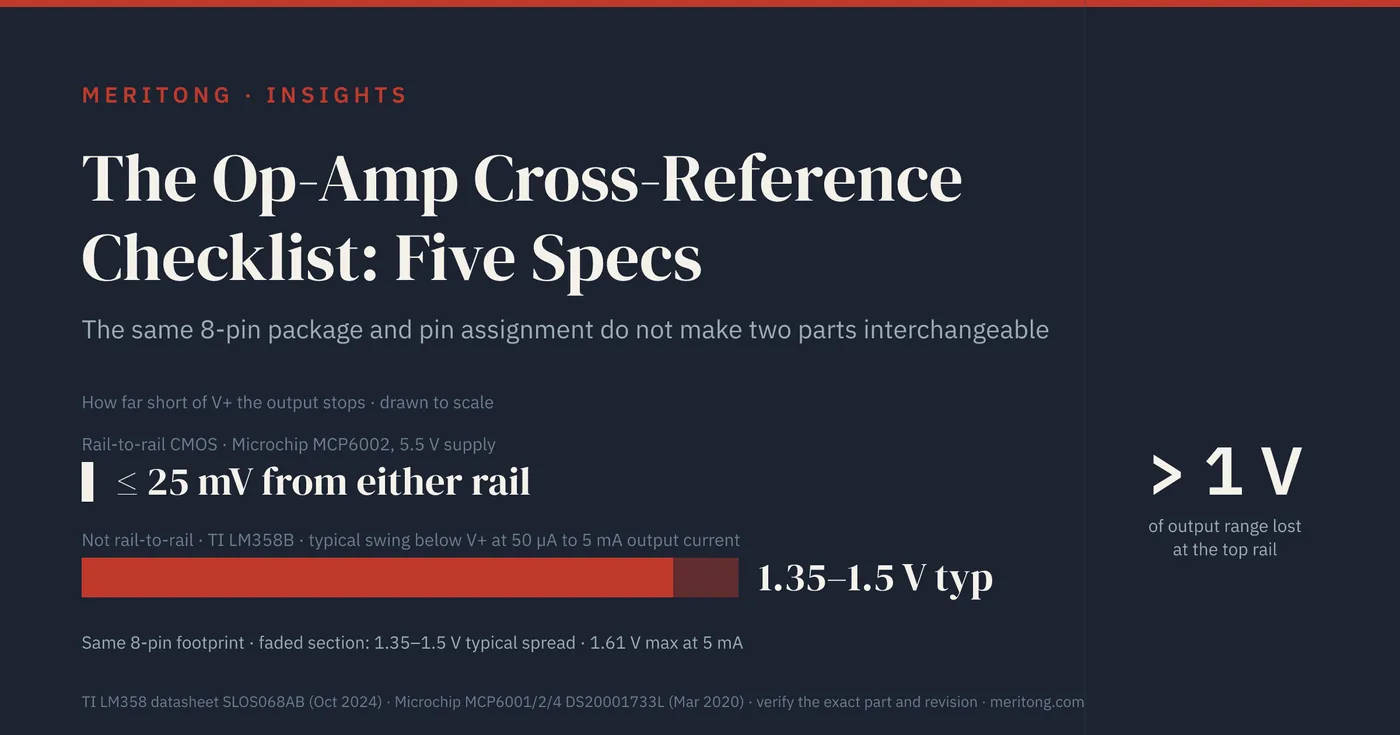
The Op-Amp Cross-Reference Checklist: Five Specs to Check Before a "Jellybean" Swap
Two dual op-amps can share an 8-pin package and the same pin assignment and still differ by orders of magnitude on the specifications a circuit depends on. Supply range and quiescent current can disqualify a part outright; five further specifications then decide whether the swap holds up, and this checklist works through all five before you approve an op-amp second source.
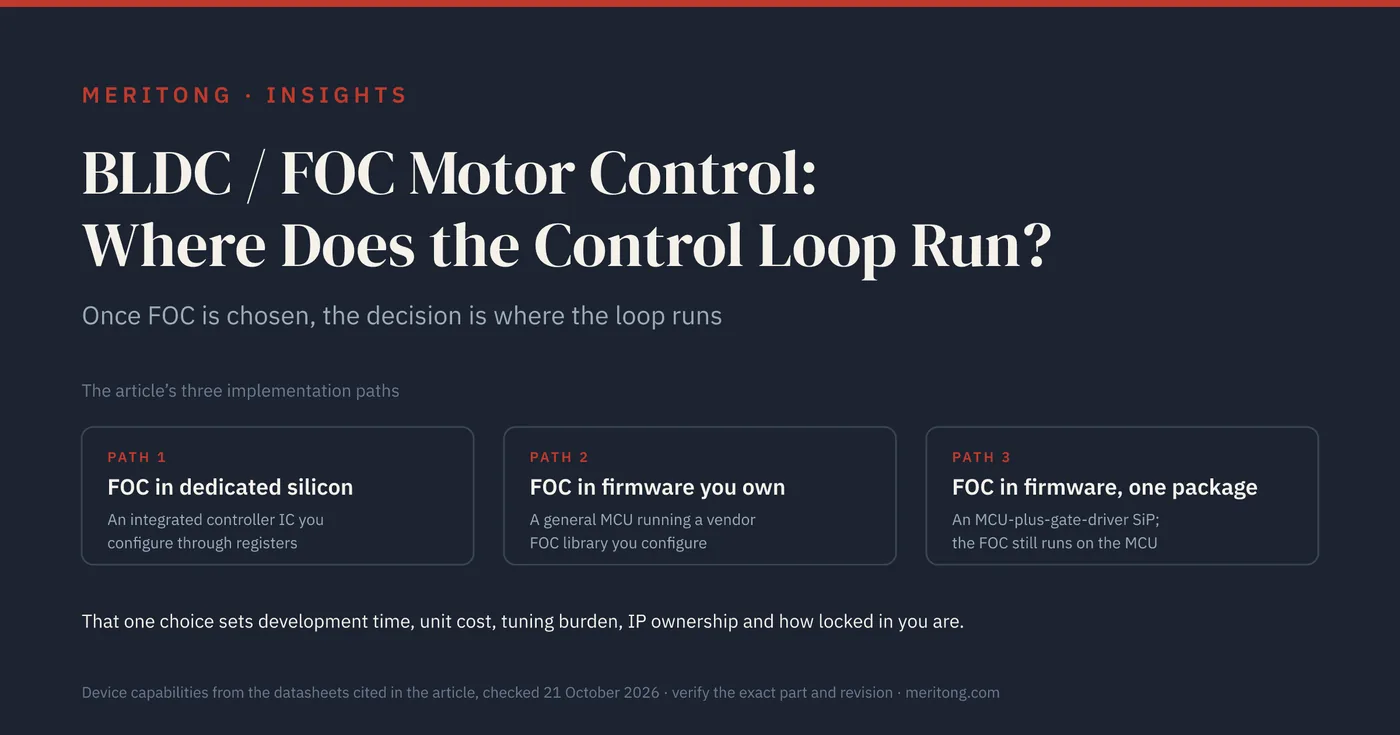
Choosing a BLDC / FOC Motor-Control IC: Integrated Controller vs MCU-Plus-Library, and What Actually Drives the Decision
Once you choose field-oriented control for a brushless motor, the decision that shapes the project is where the FOC loop runs: in a controller IC you configure, or as firmware on a general-purpose MCU. This guide shows how that choice sets development time, unit cost, tuning burden and vendor lock-in.
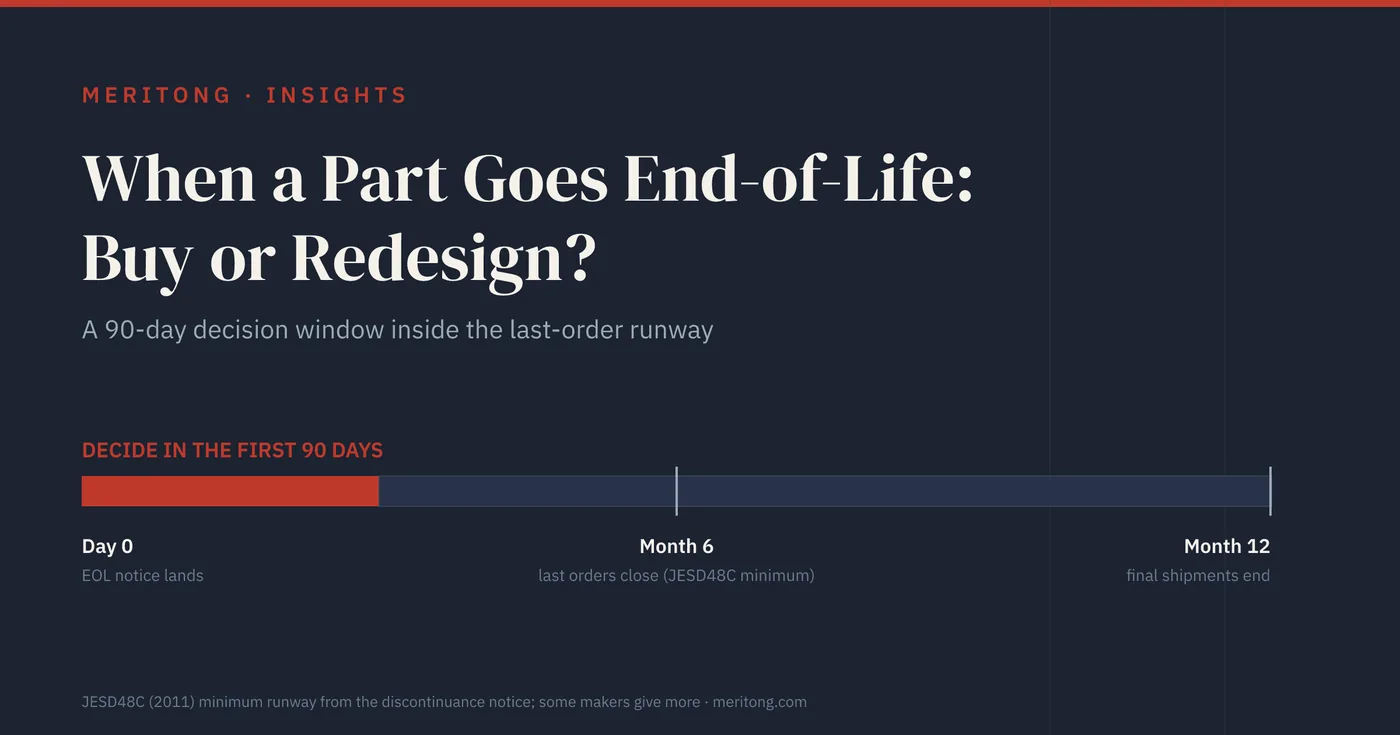
When a Part Goes End-of-Life: Buy or Redesign? A 90-Day Decision Tree
When a component goes end-of-life, you have three options: a bridge buy, a drop-in or second source, or a redesign. This 90-day decision tree shows how to compare their real costs, including carrying cost and requalification, and when to commit to each.
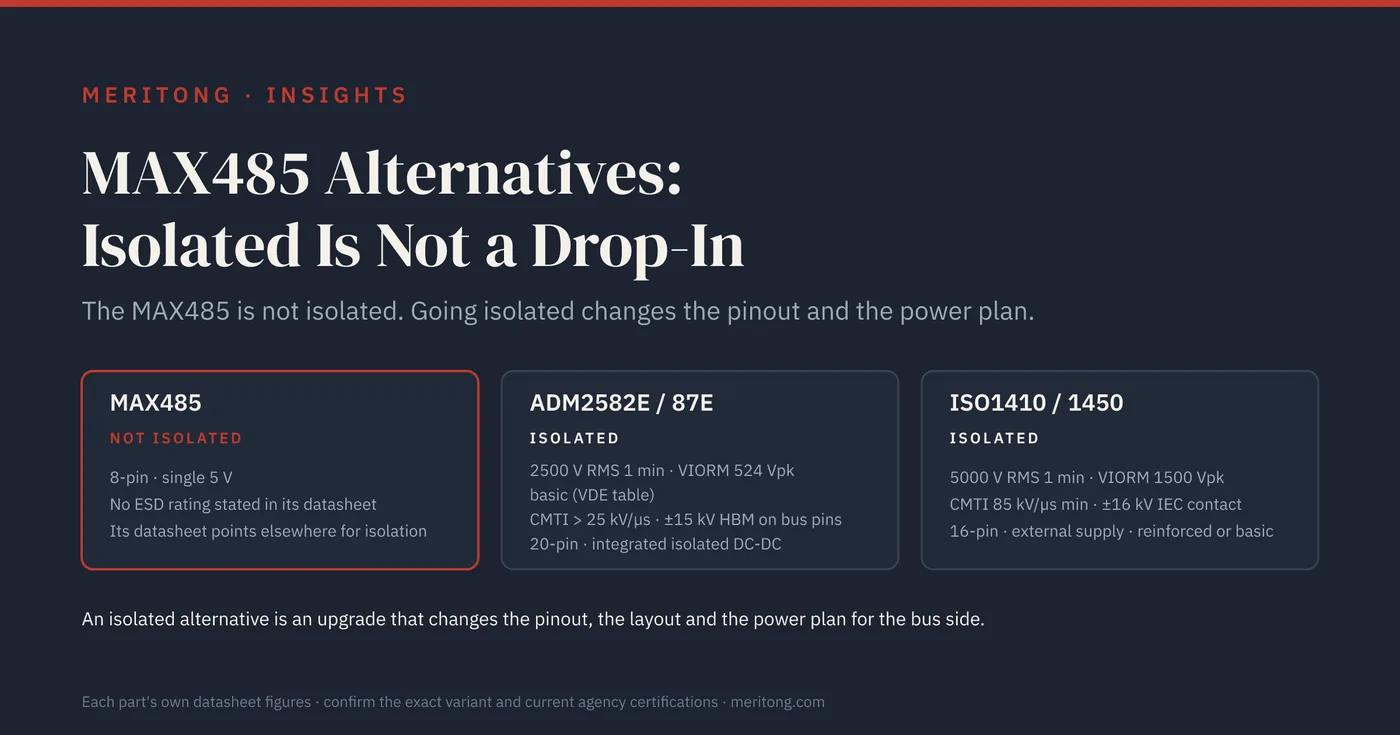
MAX485 Alternatives: Robust and Isolated RS-485 Transceivers, Chosen Before the EMC Lab
A MAX485 alternative can mean a more robust non-isolated transceiver or a galvanically isolated one, and the MAX485 itself has no isolation barrier. This guide compares the TI THVD1450, ADI ADM2582E/87E and TI ISO1410/50 on isolation, CMTI, ESD and surge, from each part's datasheet.
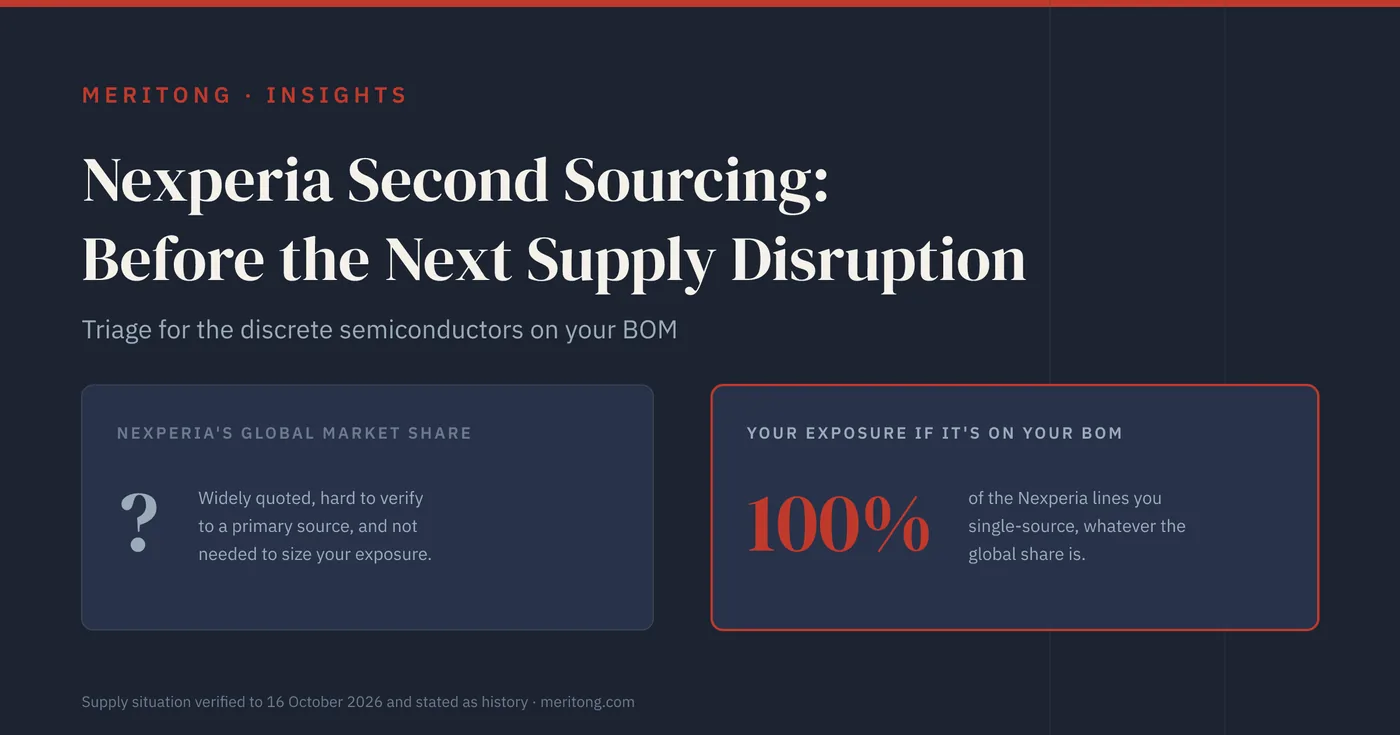
Nexperia Second Sourcing: De-Risking Your Discrete-Semiconductor Lines Before the Next Supply Disruption
Nexperia parts that have an industry-standard number can be second-sourced on the same number, while the Nexperia-specific PMEG, PESD and PMV parts need a qualified functional equivalent. With a dated record of the Nexperia case and a four-step triage for your BOM.
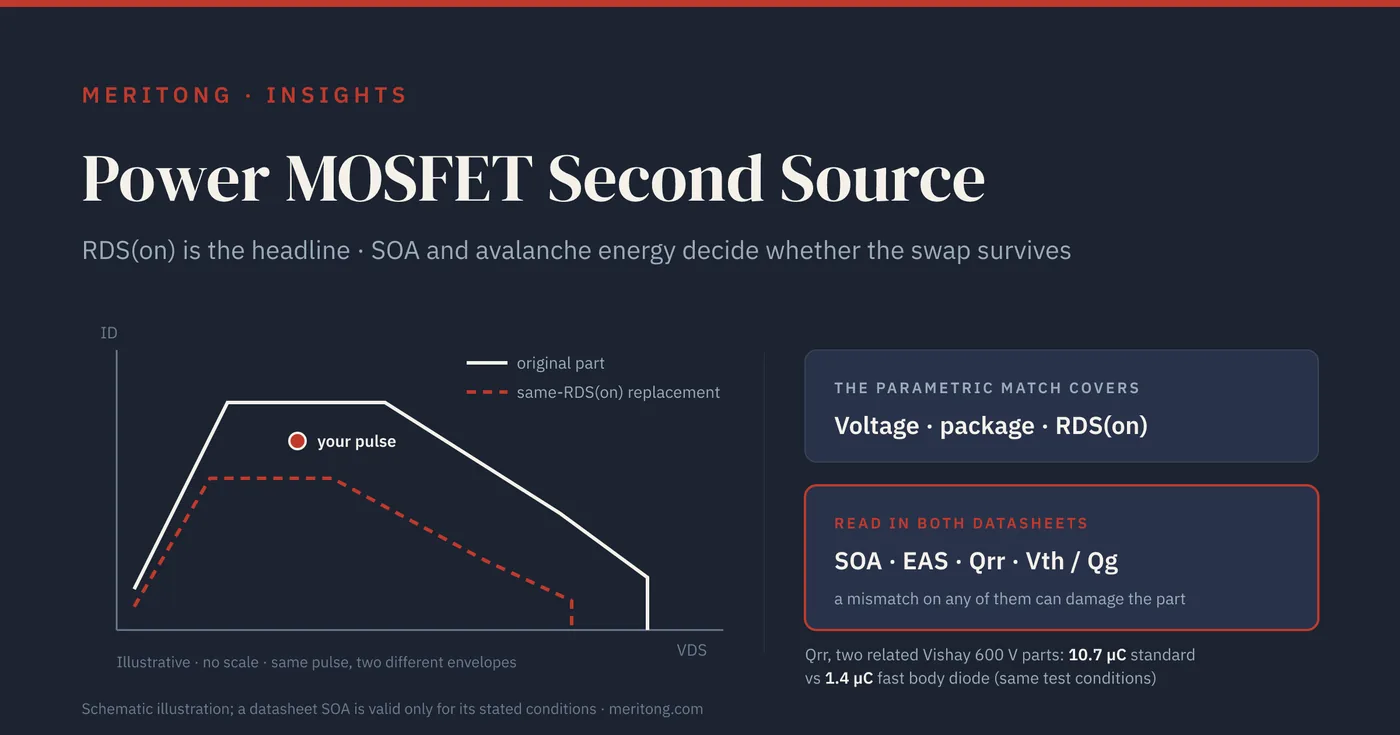
Power MOSFET Second Source: RDS(on) Is the Headline; SOA and Avalanche Energy Decide Whether the Swap Survives
Two 600 V MOSFETs from Vishay list a maximum RDS(on) of 64 mΩ and 65 mΩ, yet a typical reverse-recovery charge of 10.7 µC and 1.4 µC under the same test conditions. Whether a power MOSFET swap survives the circuit turns on the safe operating area, the avalanche rating, the body diode and the gate, judged for one topology at a time.
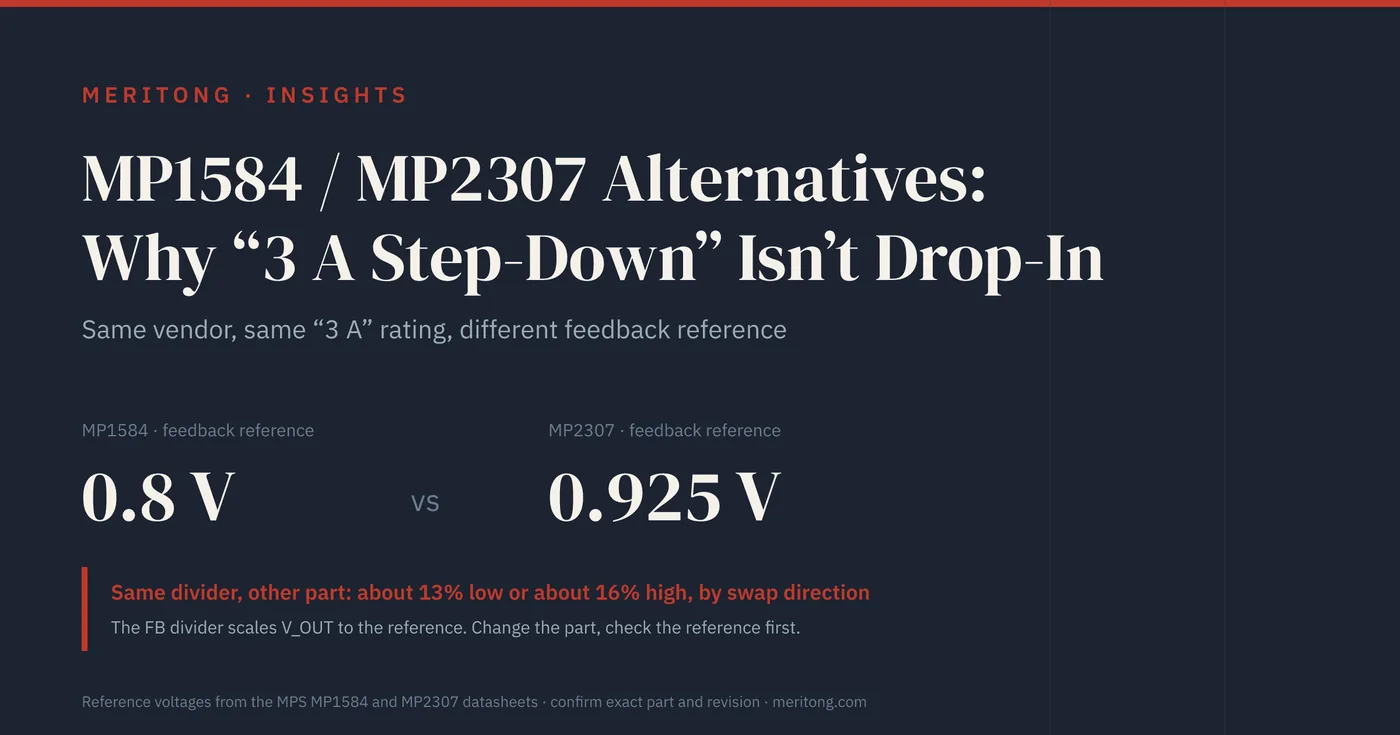
MP1584 / MP2307 Alternatives: Second-Sourcing the Buck on Every Cheap Module (and Why "3 A Step-Down" Isn't Drop-In)
The MP1584 and the MP2307, two 3 A step-down converters from the same manufacturer, regulate their feedback pins to 0.8 V and 0.925 V, so the same resistor divider gives a different output voltage on each. Whether a buck-converter swap works turns on the feedback reference, the switching frequency, the control scheme and the input range.
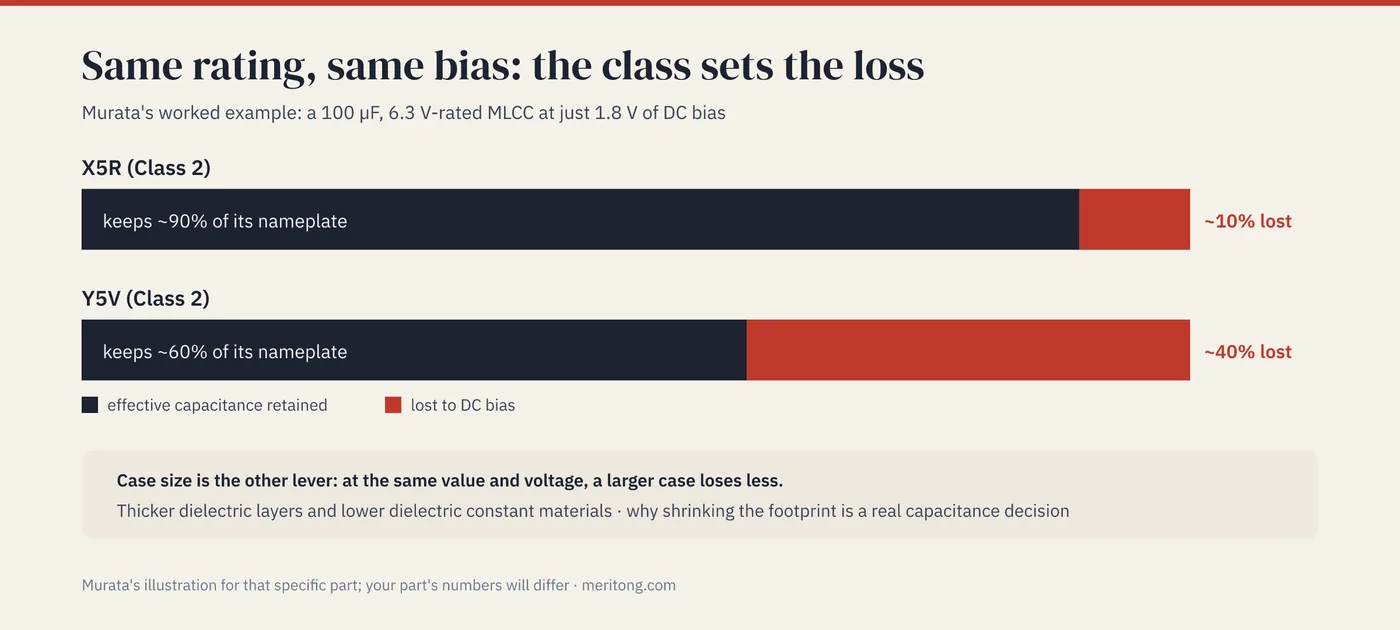
MLCC Capacitor Cross-Reference & the DC-Bias Derating Trap That Makes Your 10 µF Cap Deliver 3 µF
Two properties that a parametric search does not expose govern how much of the marked value an MLCC actually delivers: the dielectric class, and the effective capacitance the part still holds at the DC voltage the circuit applies across it.
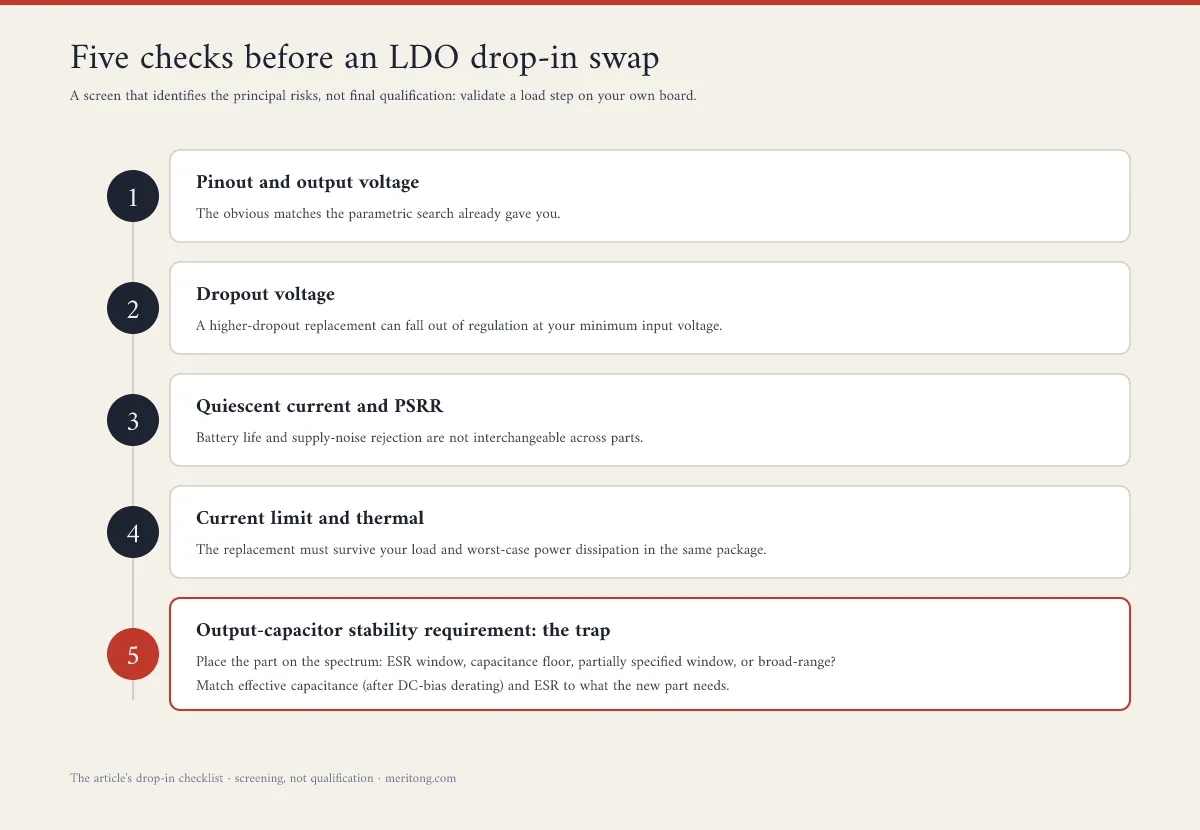
LDO Drop-In Replacement: The Output-Cap ESR Stability Trap That Turns a Regulator Into an Oscillator
You swap one LDO for a pin-compatible one and the rail that used to be quiet starts oscillating. One common and easily missed cause is the output-capacitor requirement — the spec that isn't in the comparison table.
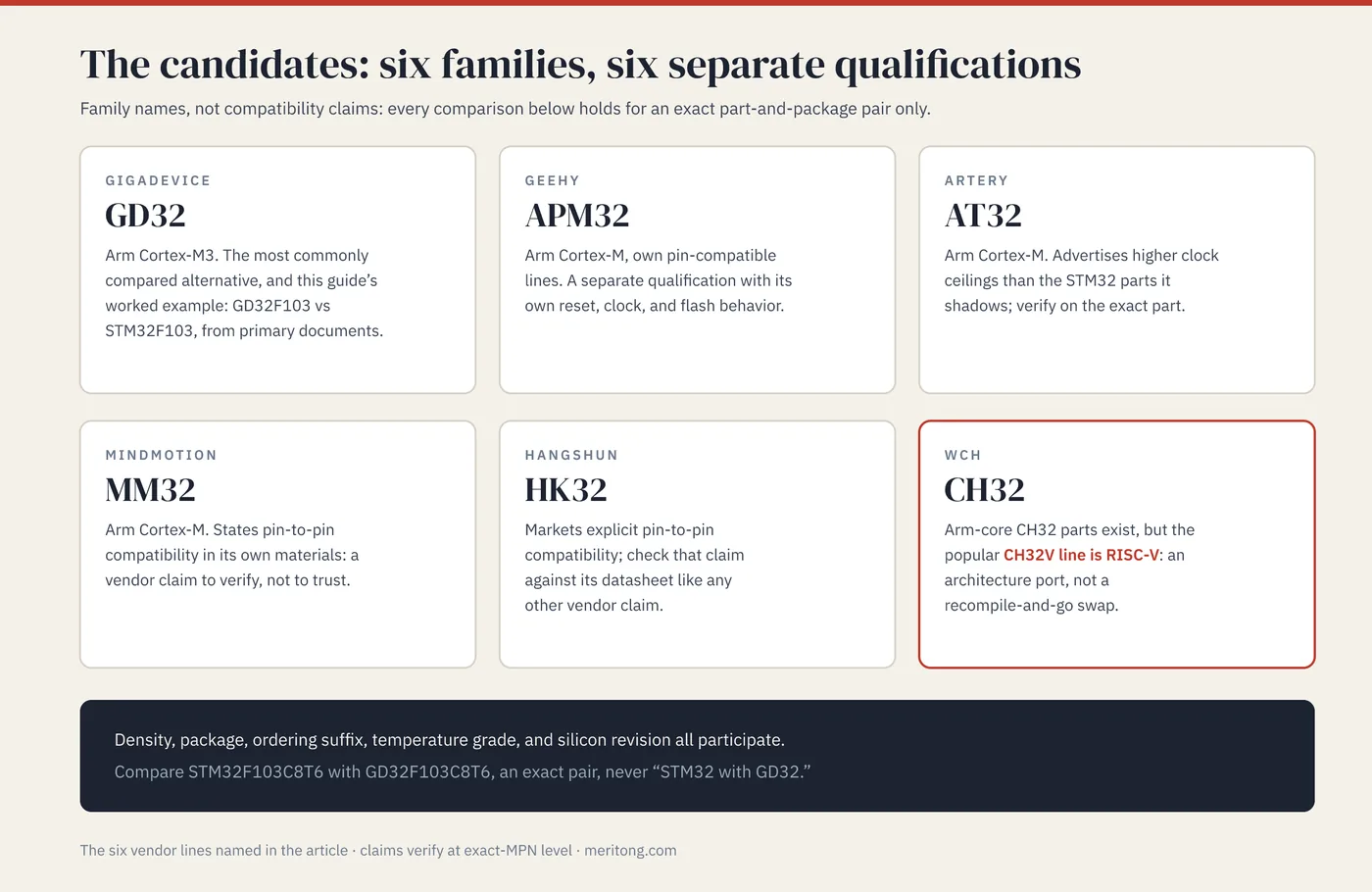
STM32 Alternatives: The Verified Chinese Second-Source Guide (and the Deltas That Break a "Compatible" Swap)
When STM32 supply tightened, Chinese alternatives like GD32, APM32, and AT32 became real options. But "pin-compatible" hides specific deltas — reset threshold, flash latency, USB clocking — that turn a swap into a board that won't start.
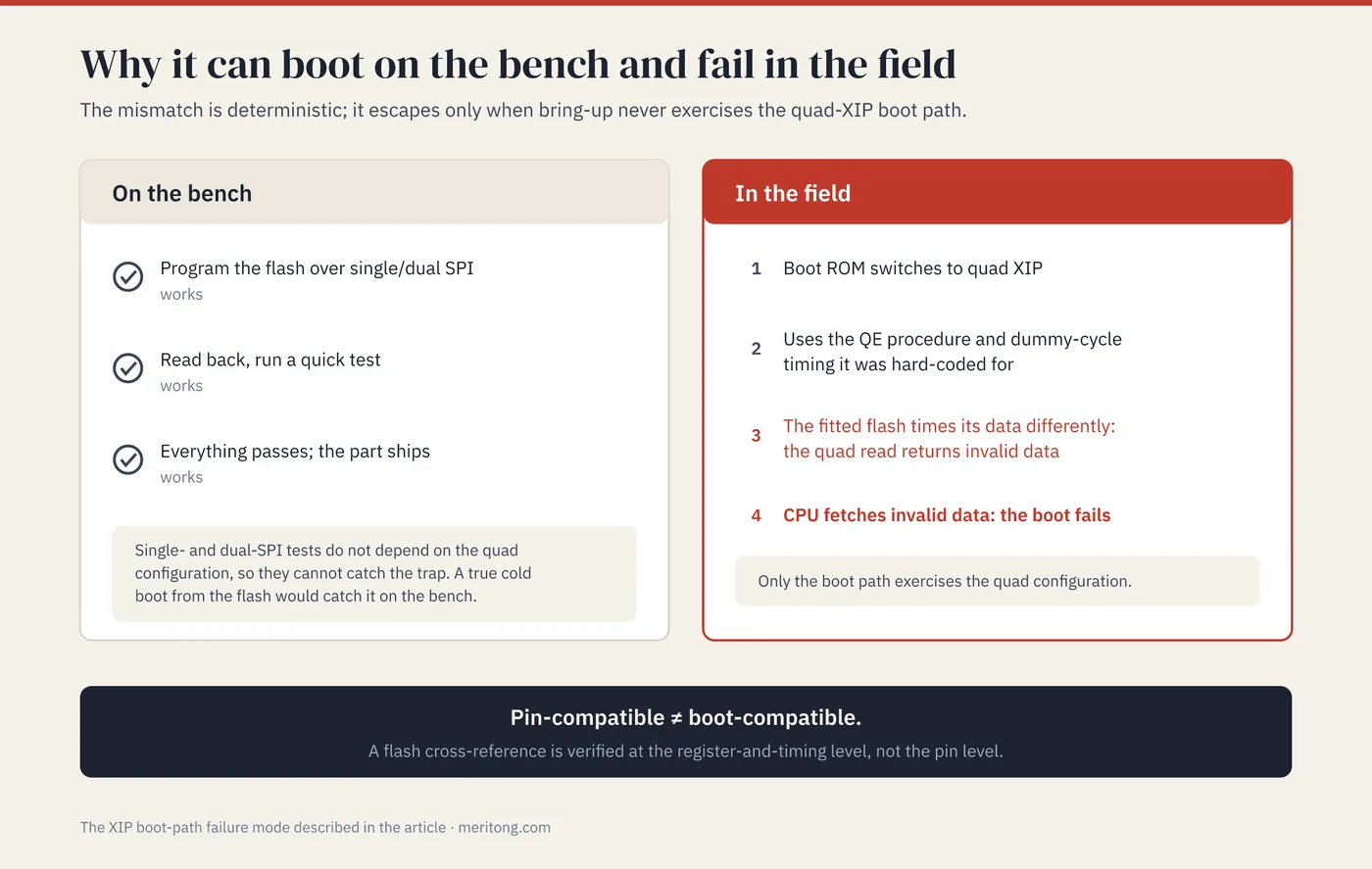
W25Q128 Alternatives & Cross-Reference: The Verified Second Source — Without the XIP Boot Surprise
A pin-compatible W25Q128 alternative can pass every bench test and still fail to boot in production — the trap is in the QE default and dummy-cycle count, not the pinout.
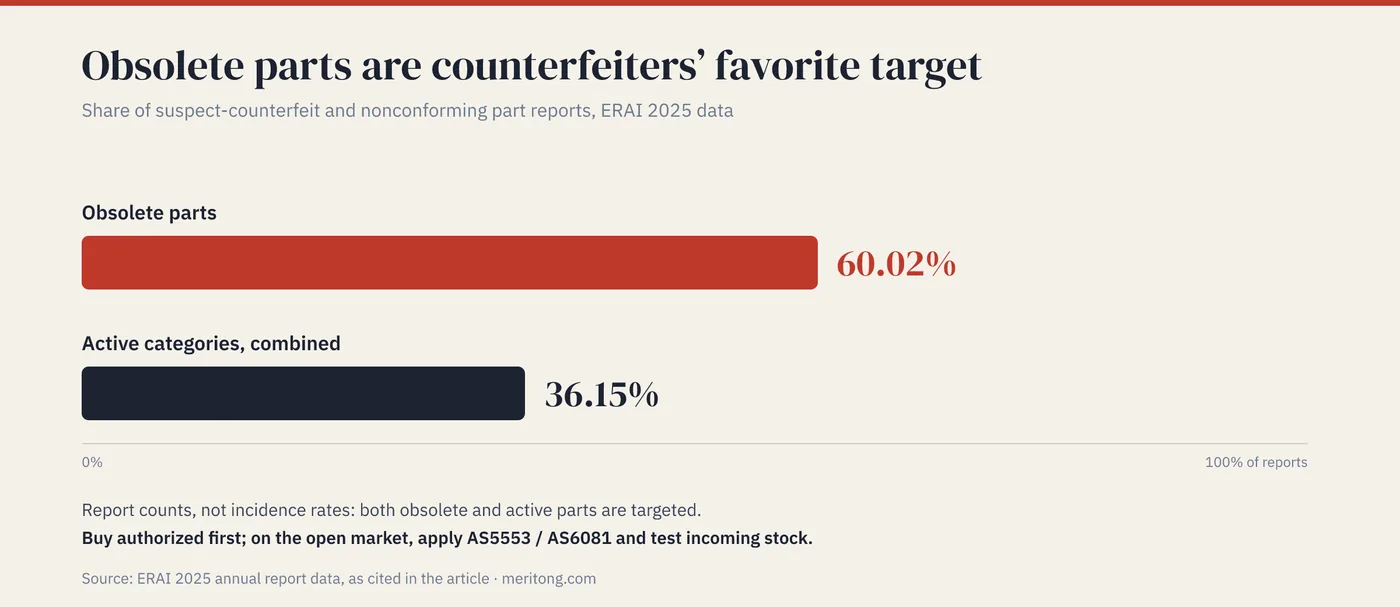
“Pin-Compatible” Isn’t “Drop-In”: How to Find and Verify a Replacement for a Discontinued Part
When a part goes obsolete, "pin-compatible" is the phrase that gets people into trouble. Whether a replacement actually works on your board depends on three separate things: form, fit, and function — and "pin-compatible" only guarantees two of them.
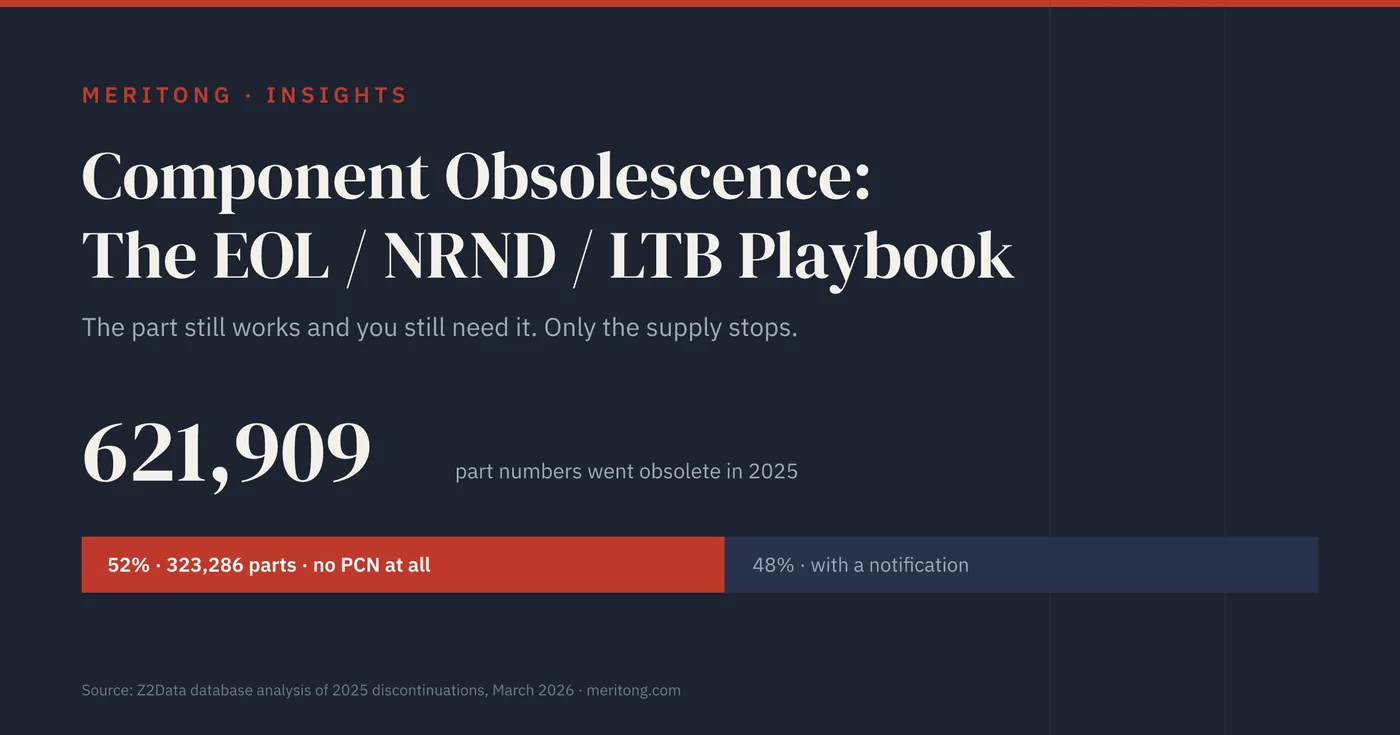
Component Obsolescence Management: The 2026 EOL / NRND / Last-Time-Buy Playbook
More than 620,000 electronic part numbers went obsolete in 2025, and about half of them were discontinued without a product change notification. If your product ships for seven years and carries three hundred components, discontinuation is not a risk — it is a schedule.
Architecture and dependency
Why supplier dependency is created long before purchasing gets involved — in the system architecture, in the firmware and in the documentation.
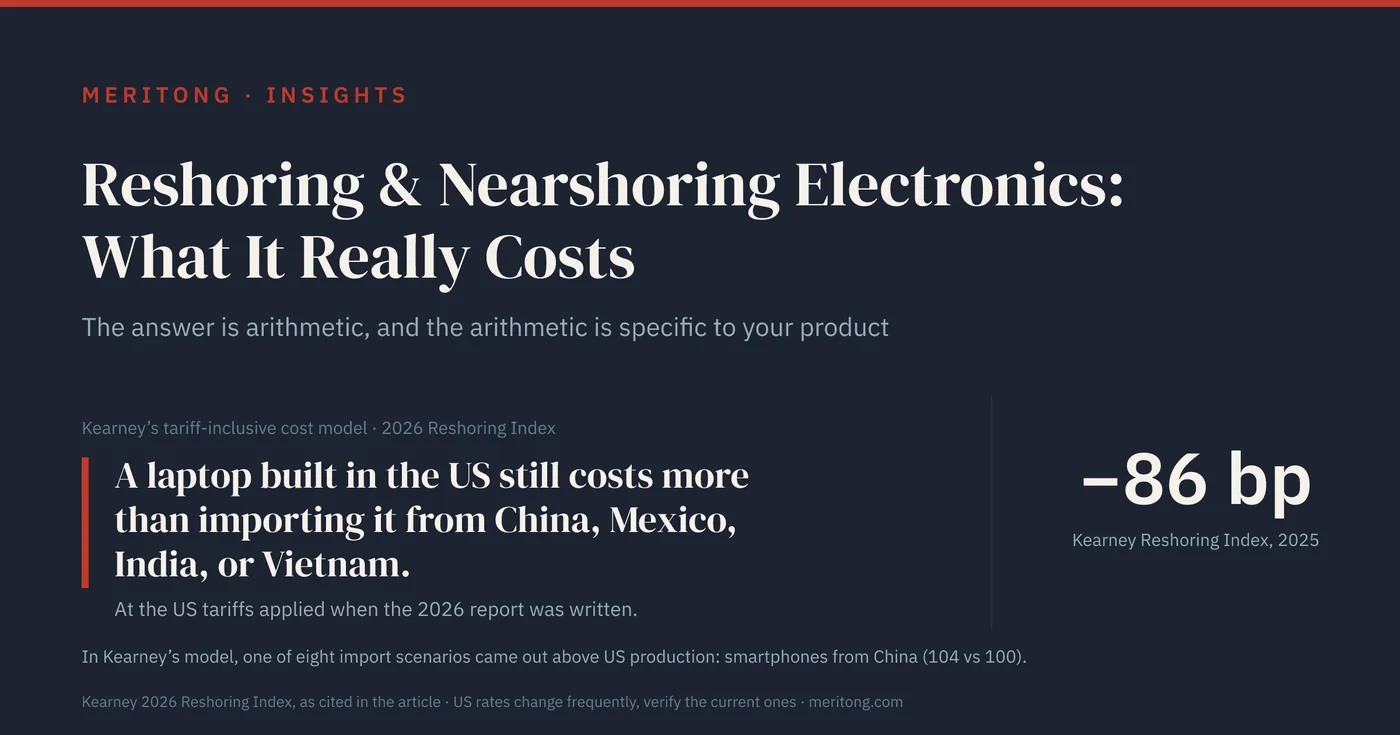
Reshoring & Nearshoring Electronics: What It Really Costs, and When It Actually Pays
Whether reshoring or nearshoring electronics pays is a cost-model question that differs from product to product. Using Kearney's tariff-inclusive model, Eurostat labor costs and IFR robot data, this article sets out when moving production closer pays and when importing stays cheaper.
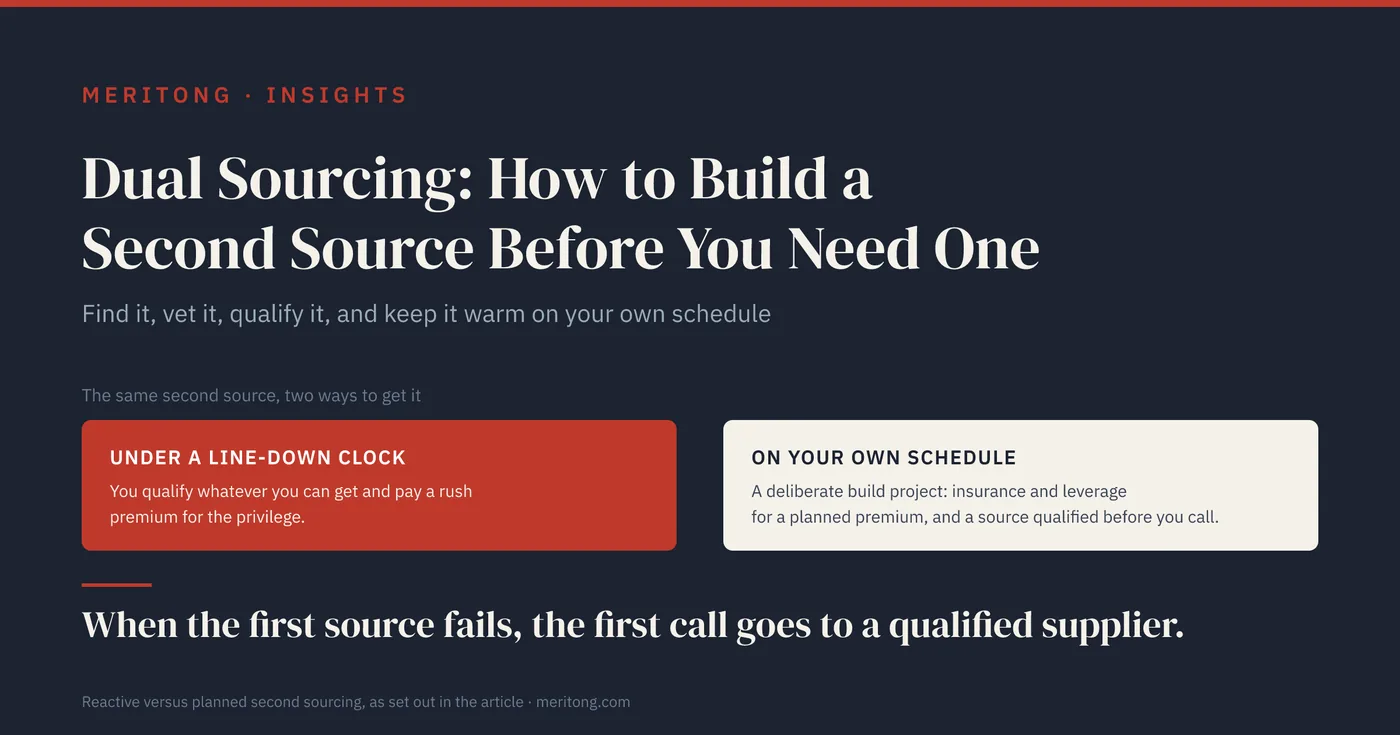
Dual-Sourcing Strategy: How to Build a Second Source Before You Need One
A second source built the week the first one fails is built at the most expensive moment to do it and the one with the fewest options. A dual-sourcing strategy reverses that order: you build the second source while you do not need it. Done properly, it is a deliberate build project with four parts: find a genuine alternate, vet the supplier behind it, qualify it properly, and keep it warm with a real share of the volume.
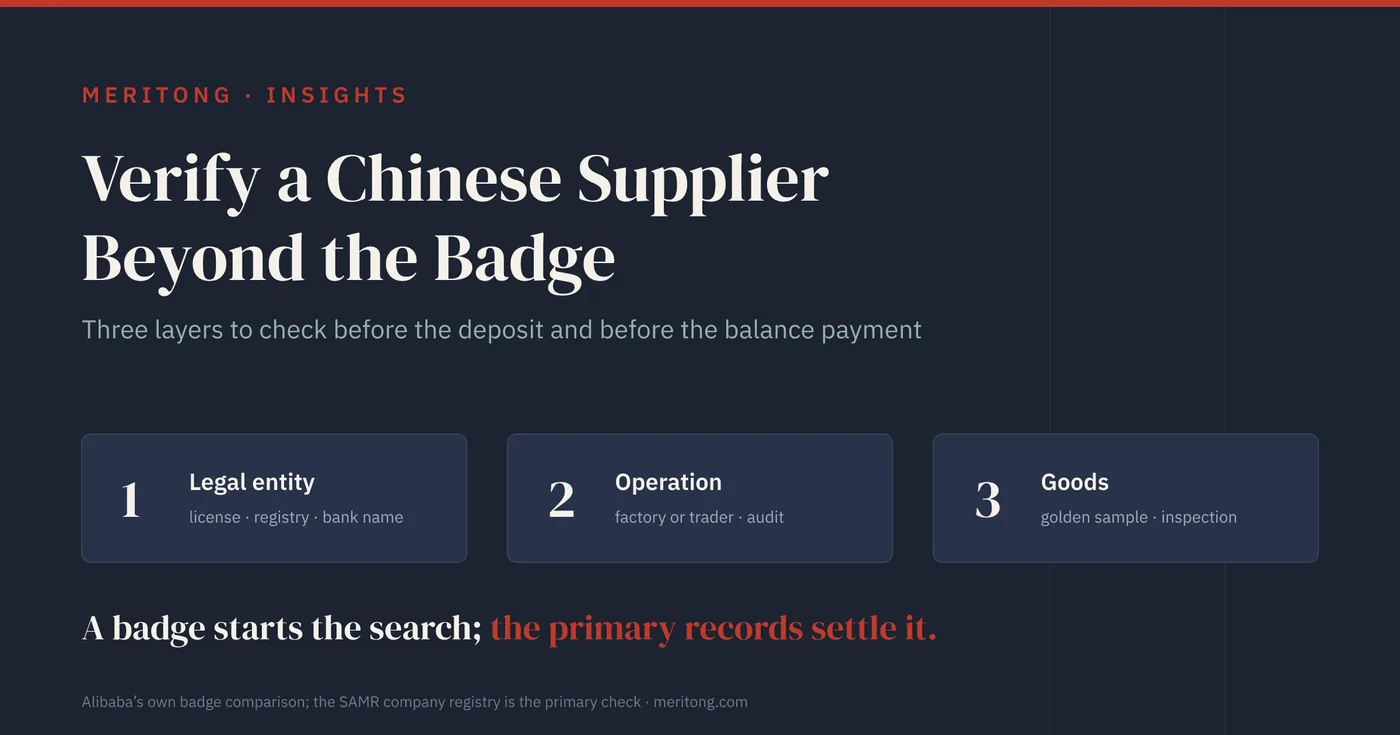
How to Verify a Chinese Supplier (Beyond the "Verified Supplier" Badge)
The "Verified Supplier" badge confirms less than its name suggests. Real verification has three layers, and each has its moment: the legal entity and the operation before you wire a deposit, and the goods at sample approval and again before you pay the balance.
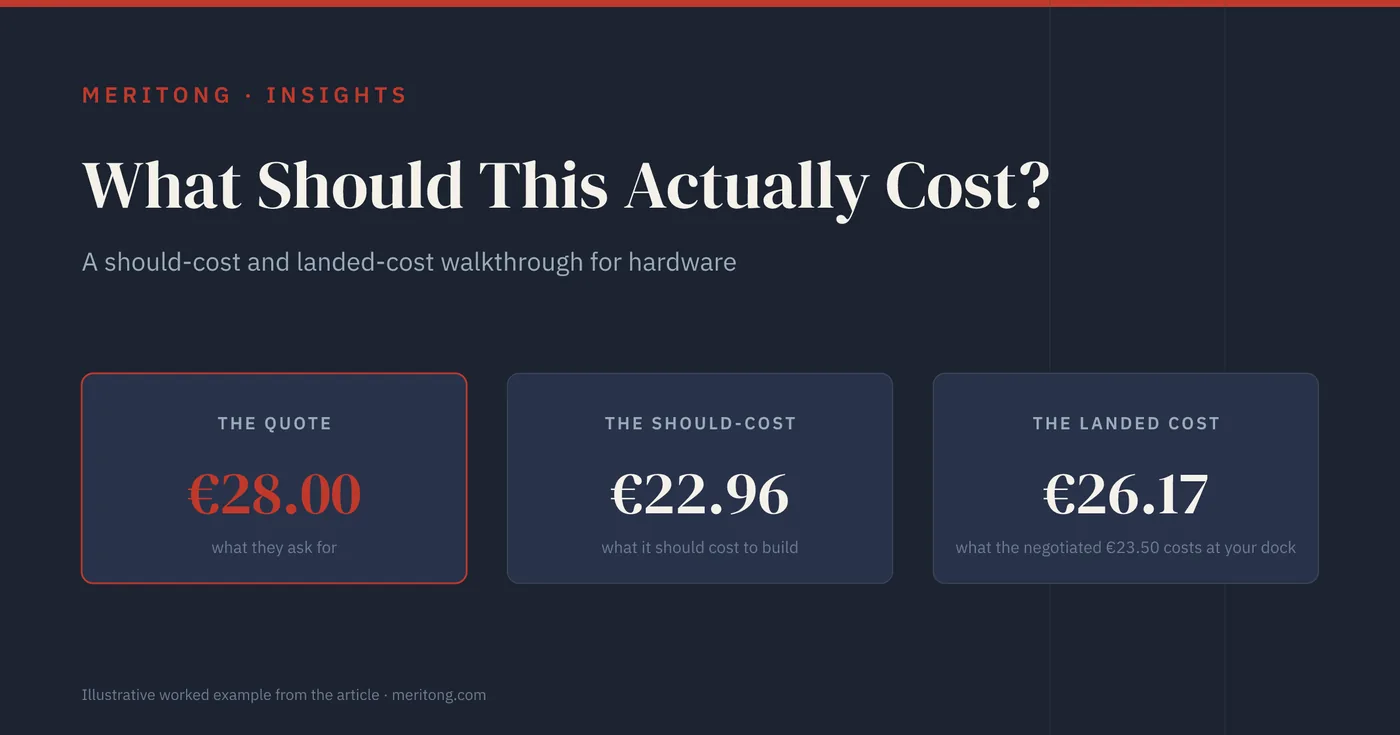
"What Should This Actually Cost?": A Should-Cost & Landed-Cost Walkthrough for Hardware
A supplier quote answers one question: what the supplier wants to charge. Should-cost tells you whether that price is fair; landed cost tells you what the part costs once it reaches your dock. Duty is charged on neither, and its base depends on where you import.
 AI
AIThe Hidden Documentation Gap in Chinese Electronics
Chinese component vendors operate a two-tier documentation system. The English datasheet is the marketing version. The real technical reference — the one with the register maps, the undocumented features, and the application notes — is in Mandarin.
 AI
AIAI in Industrial Systems: Bounded, Not Magical
German Mittelstand companies hear about AI constantly. Most are sceptical — and rightly so. The question is not whether AI can help, but where it creates measurable, bounded value and where it introduces risk you cannot afford.
 AI
AISupplier Lock-In Is an Architecture Problem, Not a Procurement Problem
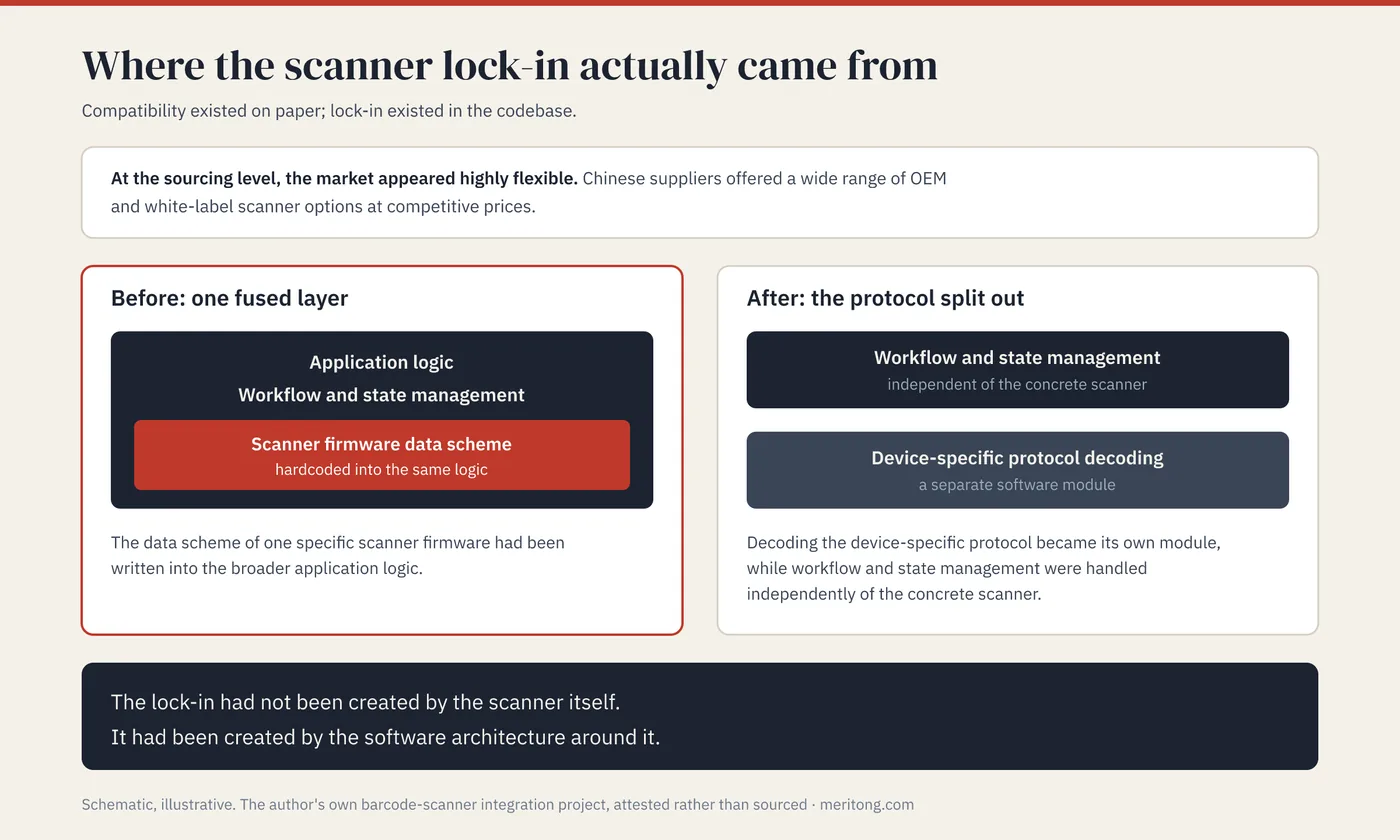
Most hardware founders discover their Chinese supplier dependency too late — when a component goes EOL, a geopolitical shock hits, or a quality failure forces a redesign. The root cause is almost never procurement. It is architecture.
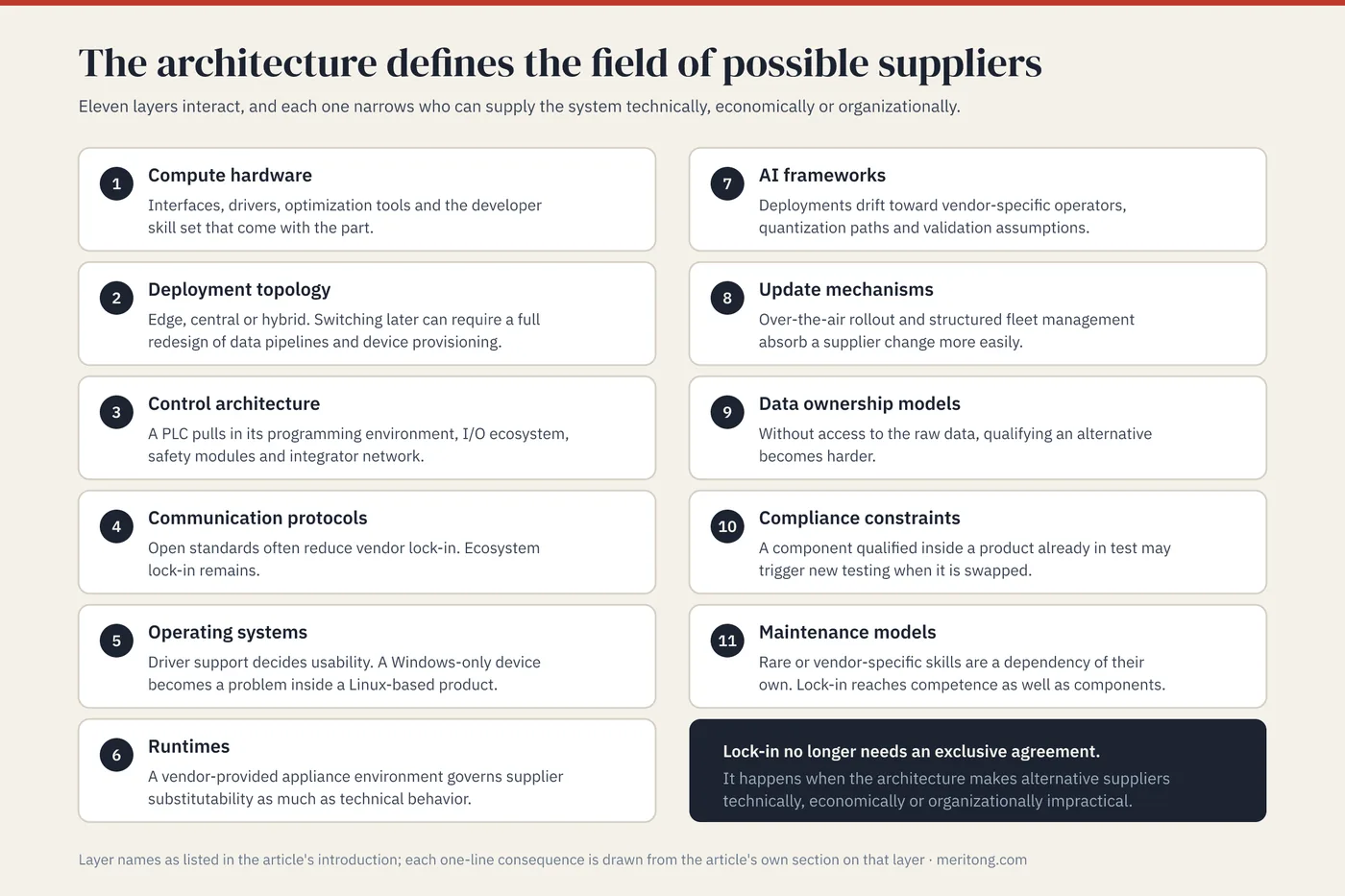
How System Architecture Shapes Supplier Flexibility
System architecture shapes supplier flexibility long before procurement gets involved. This article explores how hardware choices, software ecosystems, deployment models, compliance constraints, and other architectural decisions can quietly create supplier lock-in over time.
Customs, origin and regulation
Classification, origin, exemptions and EU requirements. Not a service offering, but the knowledge that shapes a component decision.

Conflict Minerals & the CMRT: How to Answer a Customer's 3TG Request Without Panicking
A customer's conflict-minerals spreadsheet usually reaches you by contract, because the EU and US rules mostly bind other companies. This guide explains who the rules actually bind and how to answer a CMRT request in six steps, honestly and without over-committing.
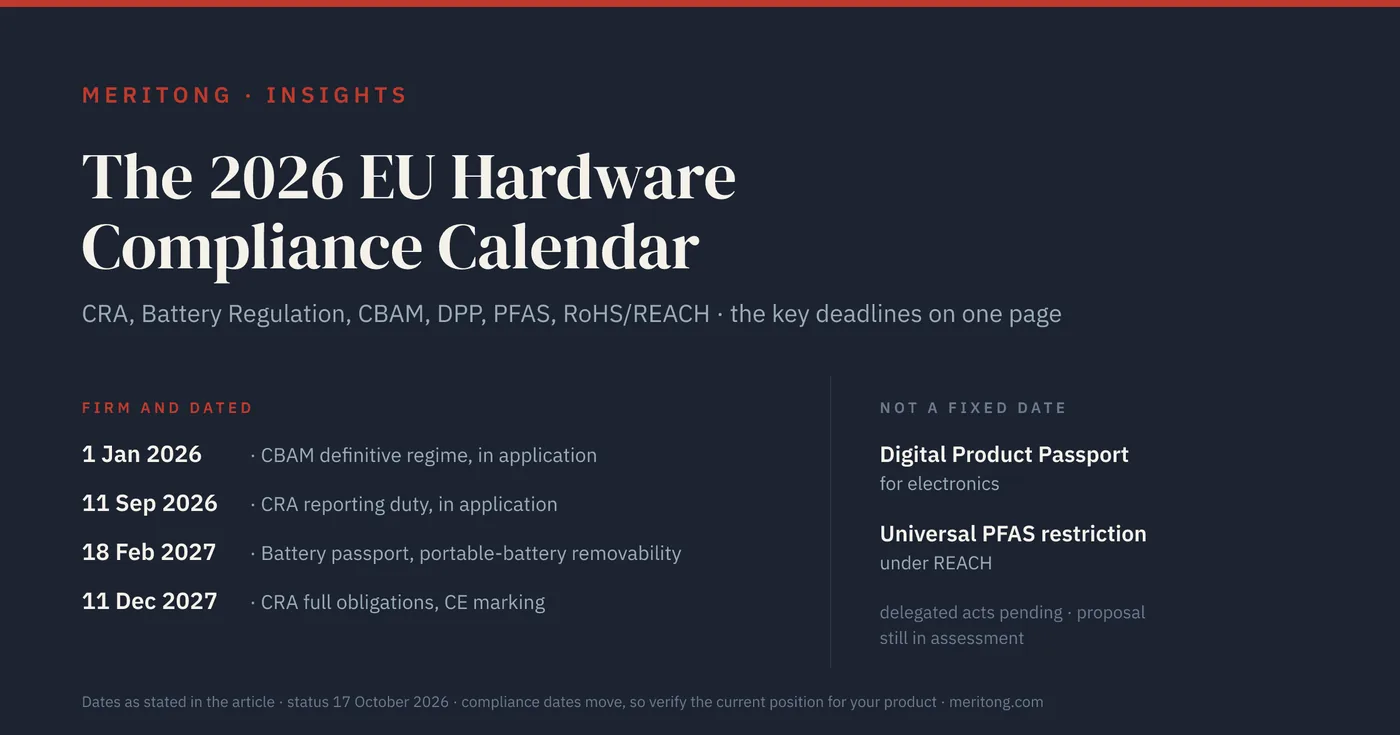
The 2026 EU Hardware Compliance Calendar: The Key Deadlines for CRA, Battery Reg, CBAM, DPP, PFAS and RoHS/REACH on One Page
A one-page calendar of the EU deadlines that matter to hardware makers: what is already in application under the Cyber Resilience Act, the Battery Regulation and CBAM, what still has no date set for the Digital Product Passport and PFAS, and which REACH and RoHS duties run continuously.
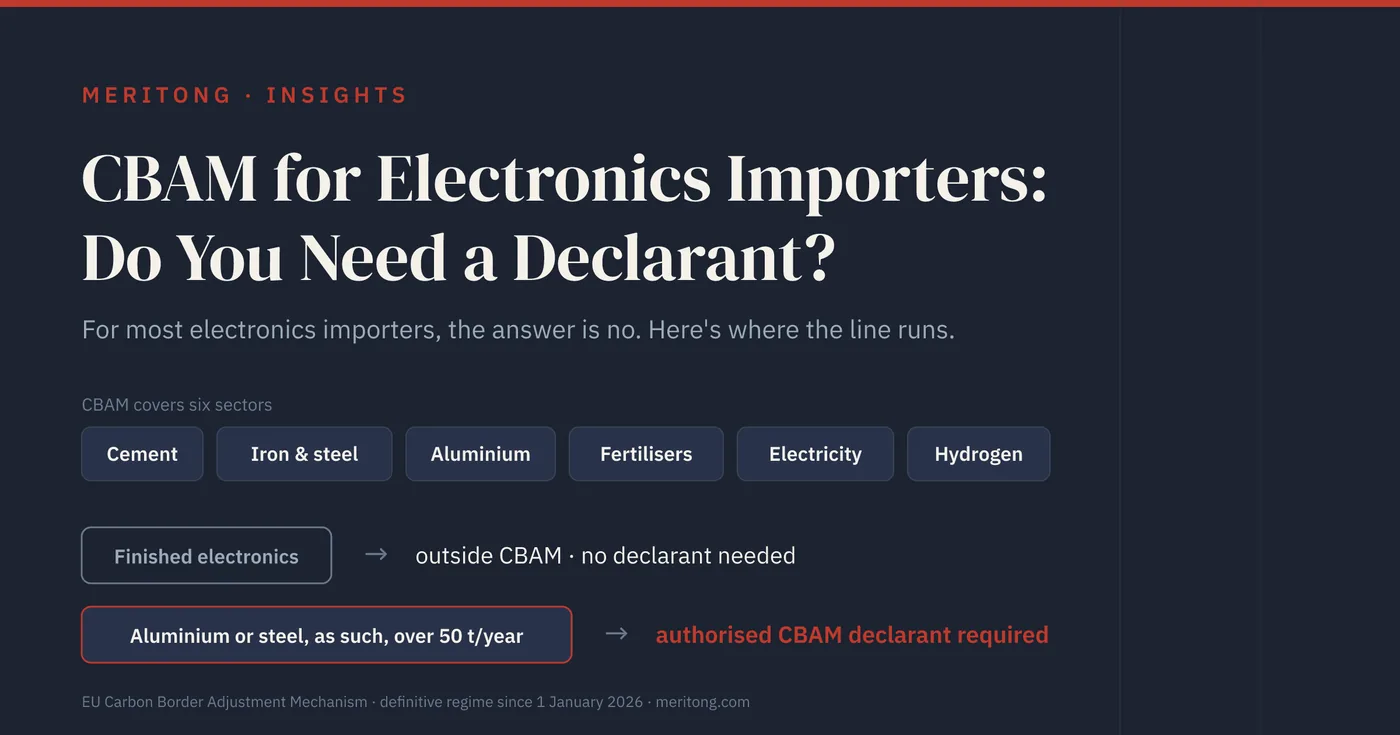
CBAM for Electronics Importers: Do You Actually Need an Authorised Declarant?
A finished electronic device falls under none of CBAM's six covered sectors, so most electronics importers do not need an authorised CBAM declarant. The obligation arises when you import a covered good itself, such as aluminium or steel under its own tariff heading, and for cement, iron and steel, aluminium and fertilisers it applies above 50 tonnes a year.
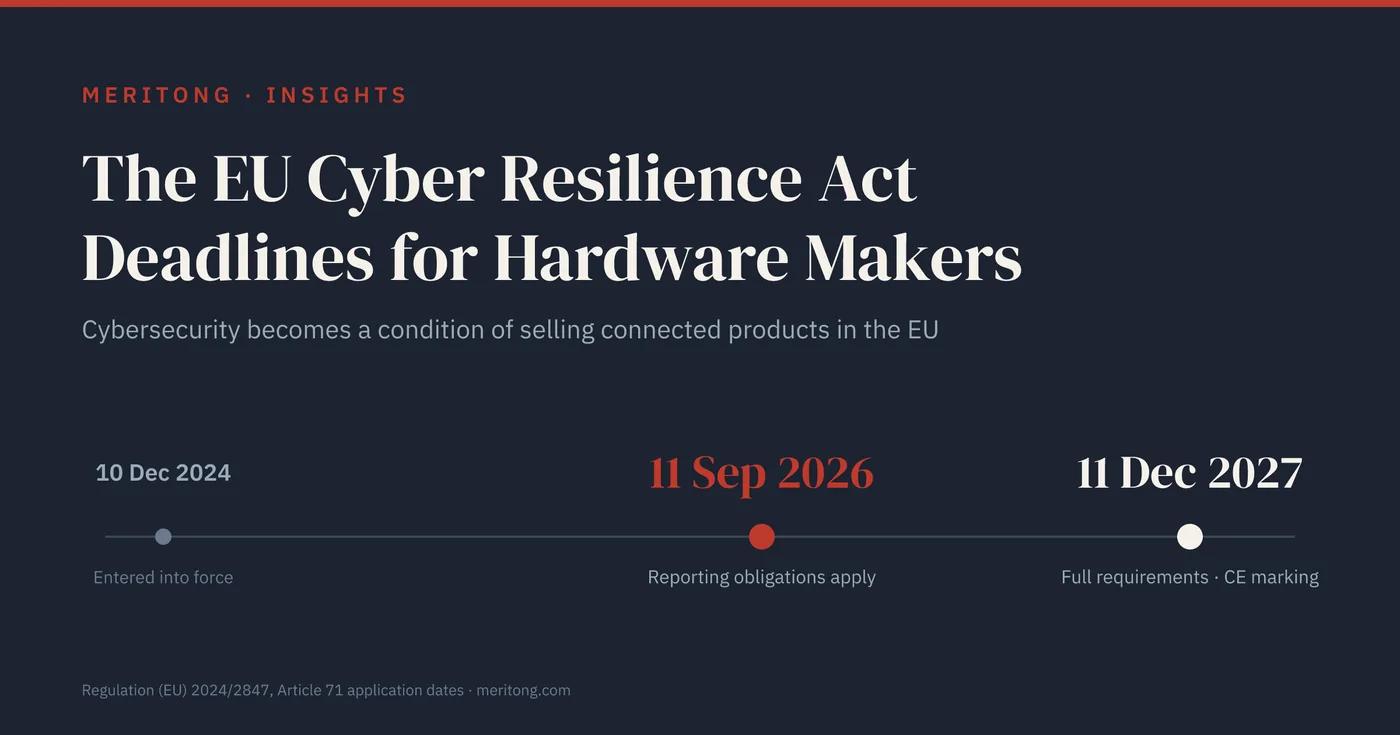
The Cyber Resilience Act (CRA): What Hardware Makers Must Do Before the Next Deadline
The Cyber Resilience Act turns cybersecurity into a condition of selling a connected product in the EU. Reporting of actively exploited vulnerabilities has applied since 11 September 2026; secure design, vulnerability handling and CE marking follow on 11 December 2027. The engineering behind that second date is not something you start in 2027.
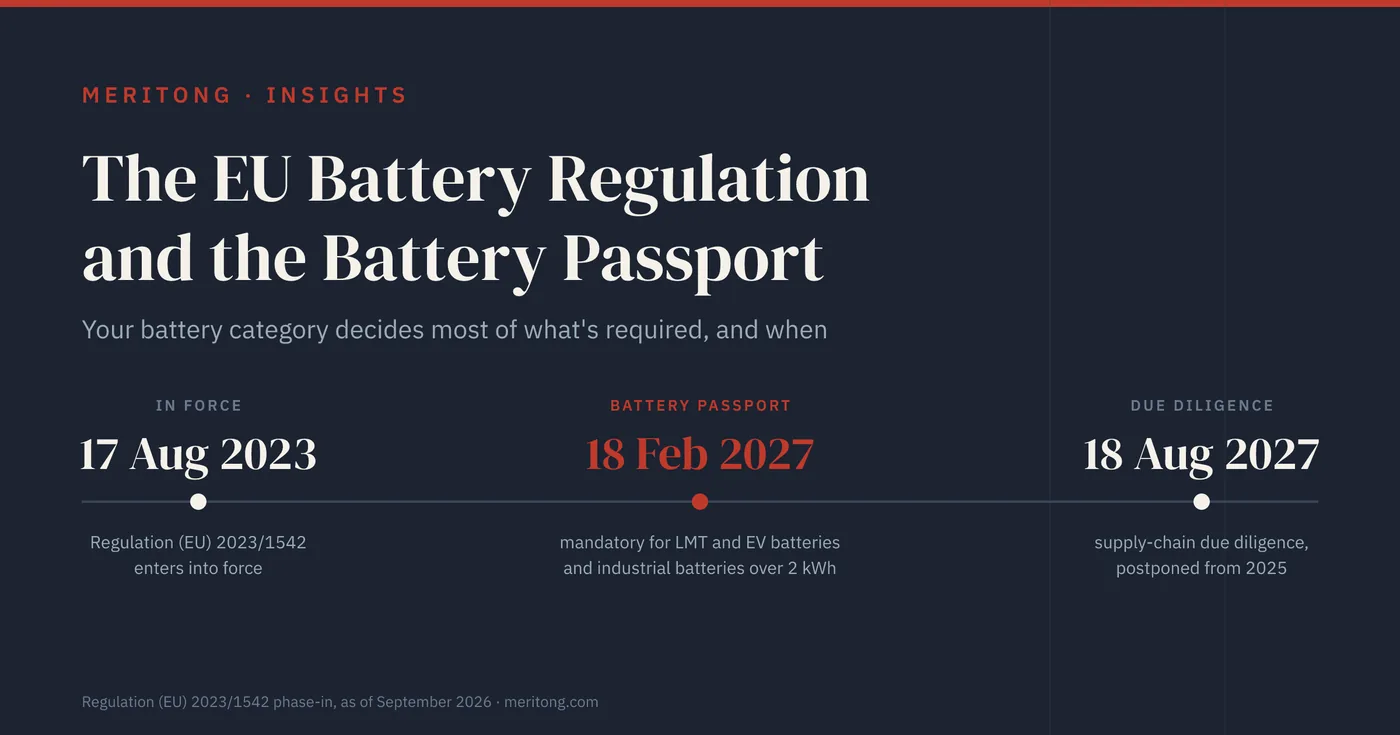
EU Battery Regulation & the Battery Passport: What's Required, and When
If your product contains a battery, the EU Battery Regulation applies to that battery when the product is placed on the EU market. Its obligations arrive in waves rather than all at once, and the headline obligation is the Battery Passport, mandatory from 18 February 2027 for the categories it covers.
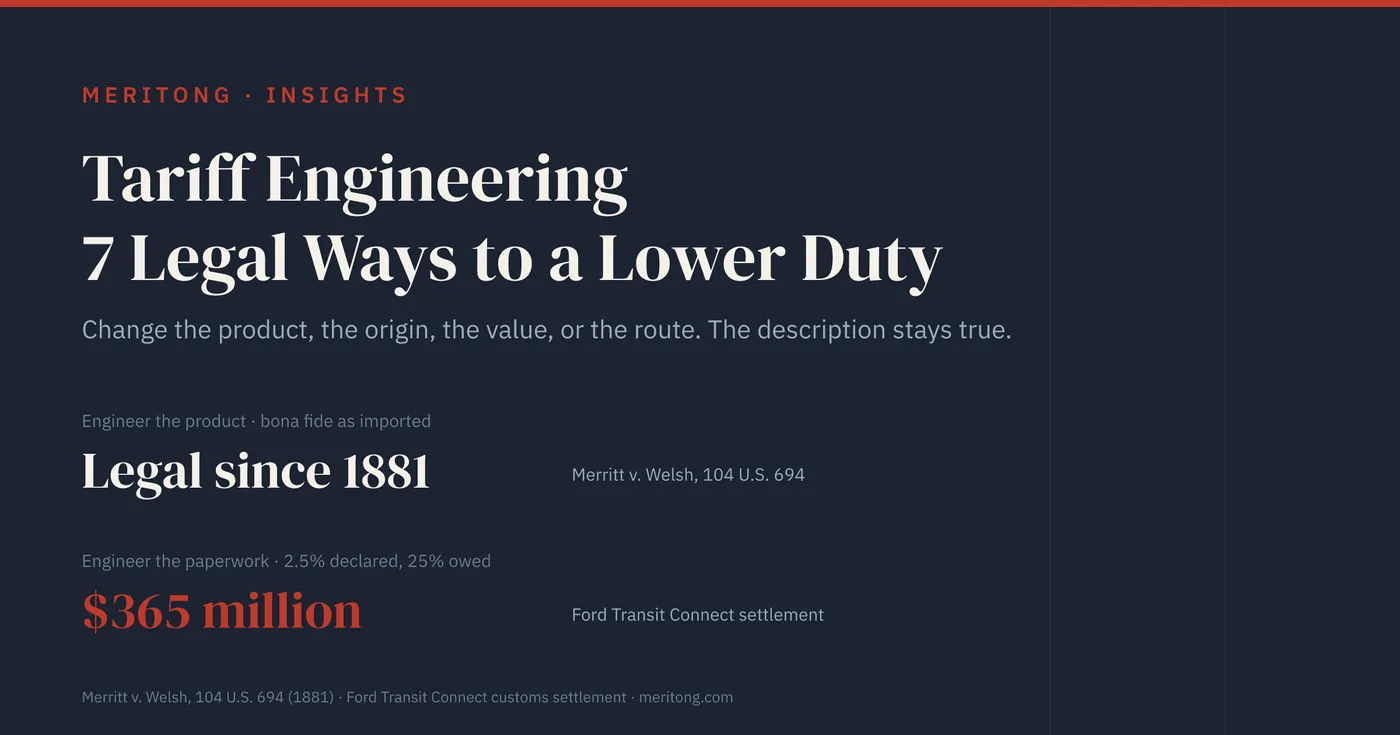
Tariff Engineering: 7 Legal Ways to Redesign a Product So It Clears at a Lower Duty
Tariff engineering is legal, and has been since 1881, on one condition: the article has to be bona fide as imported. Seven levers that change the classification, the origin, the value or the timing, each with the limit that keeps it lawful.
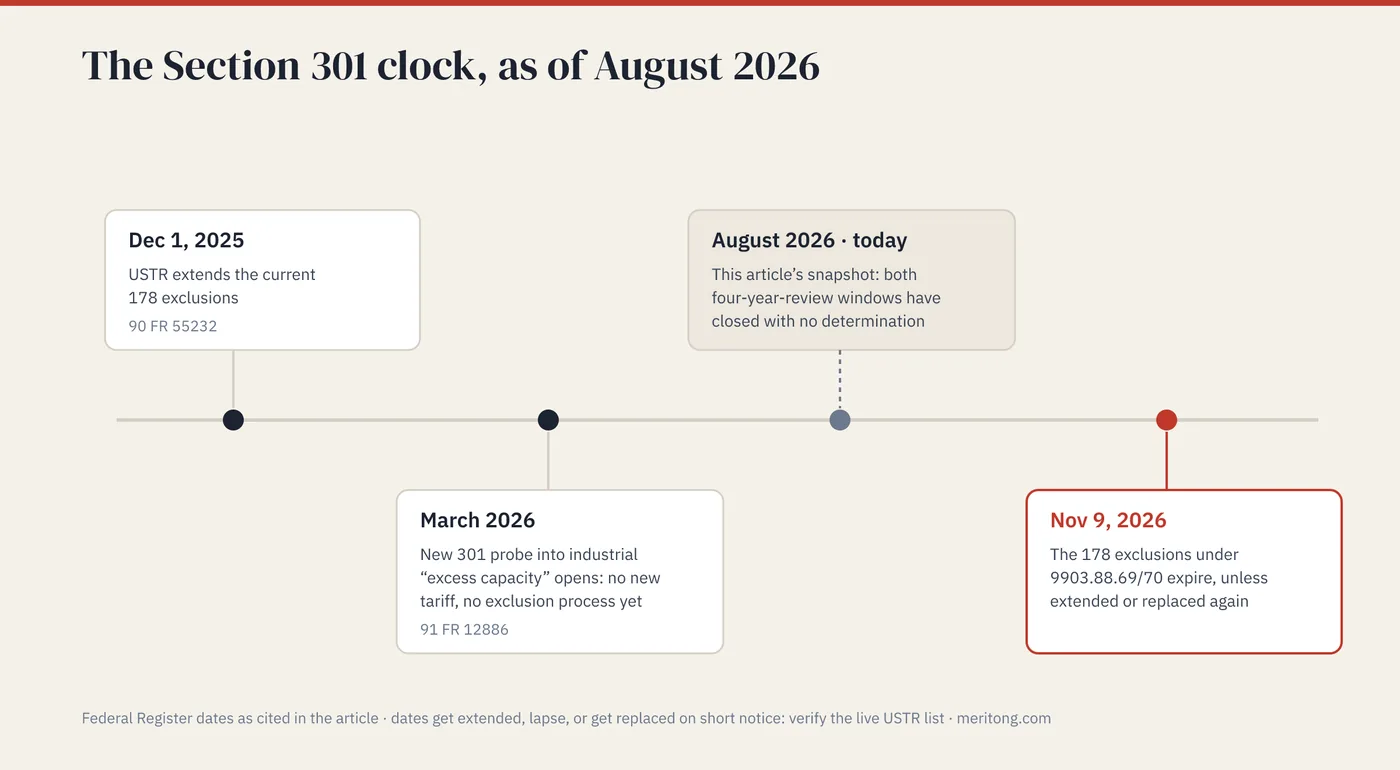
Section 301 Tariff Exclusions: How to Check If Your Components Qualify
A Section 301 exclusion only removes the tariff when your exact product, under its exact HTS code, matches a current, unexpired exclusion. The five-step check, and what a wrong claim costs.
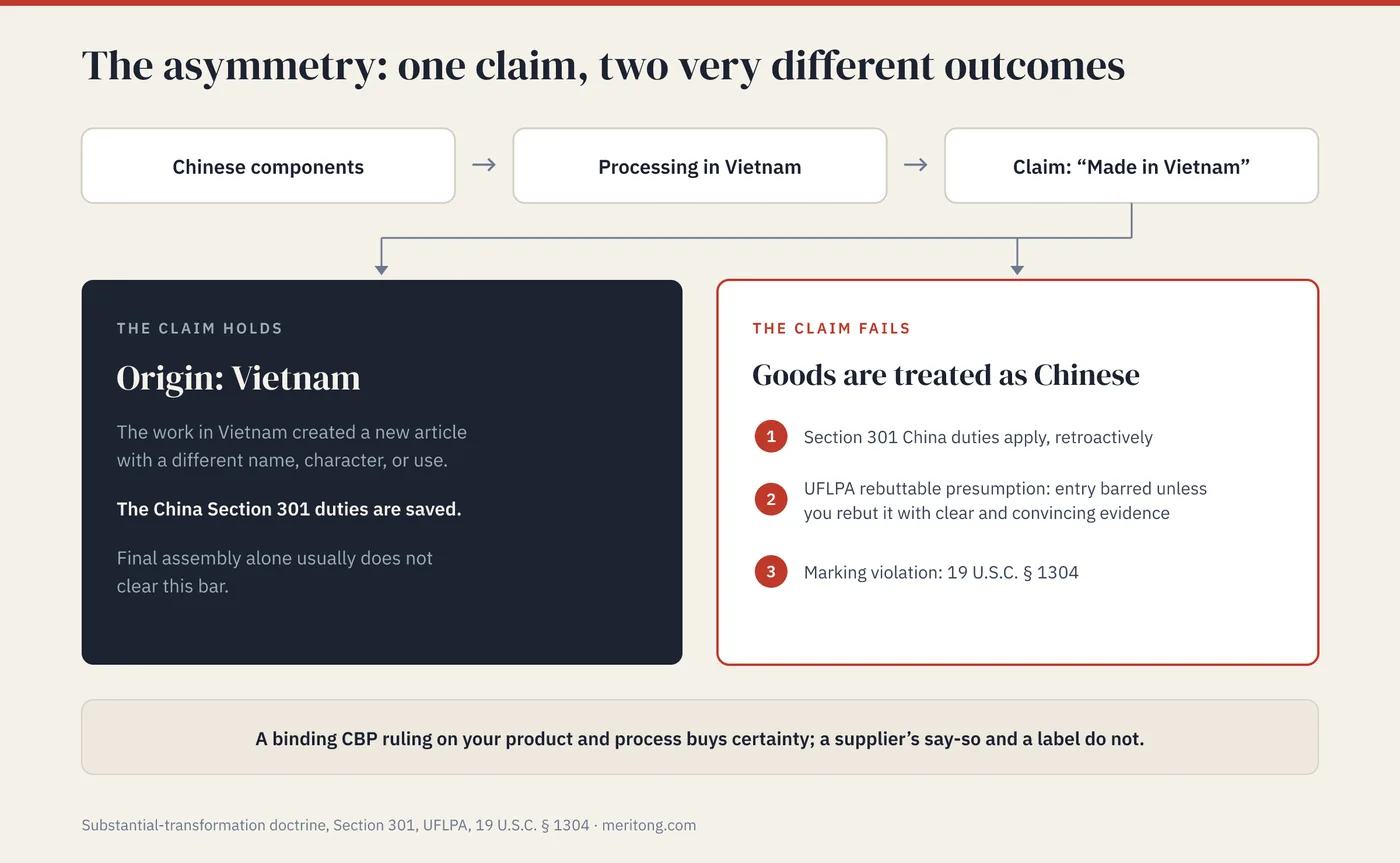
Country-of-Origin & Substantial Transformation: Will Your "Made in Vietnam" Survive a CBP Challenge?
Substantial transformation decides whether "Made in Vietnam" survives a CBP challenge. The test, three real CBP rulings, and the China+1 origin trap.
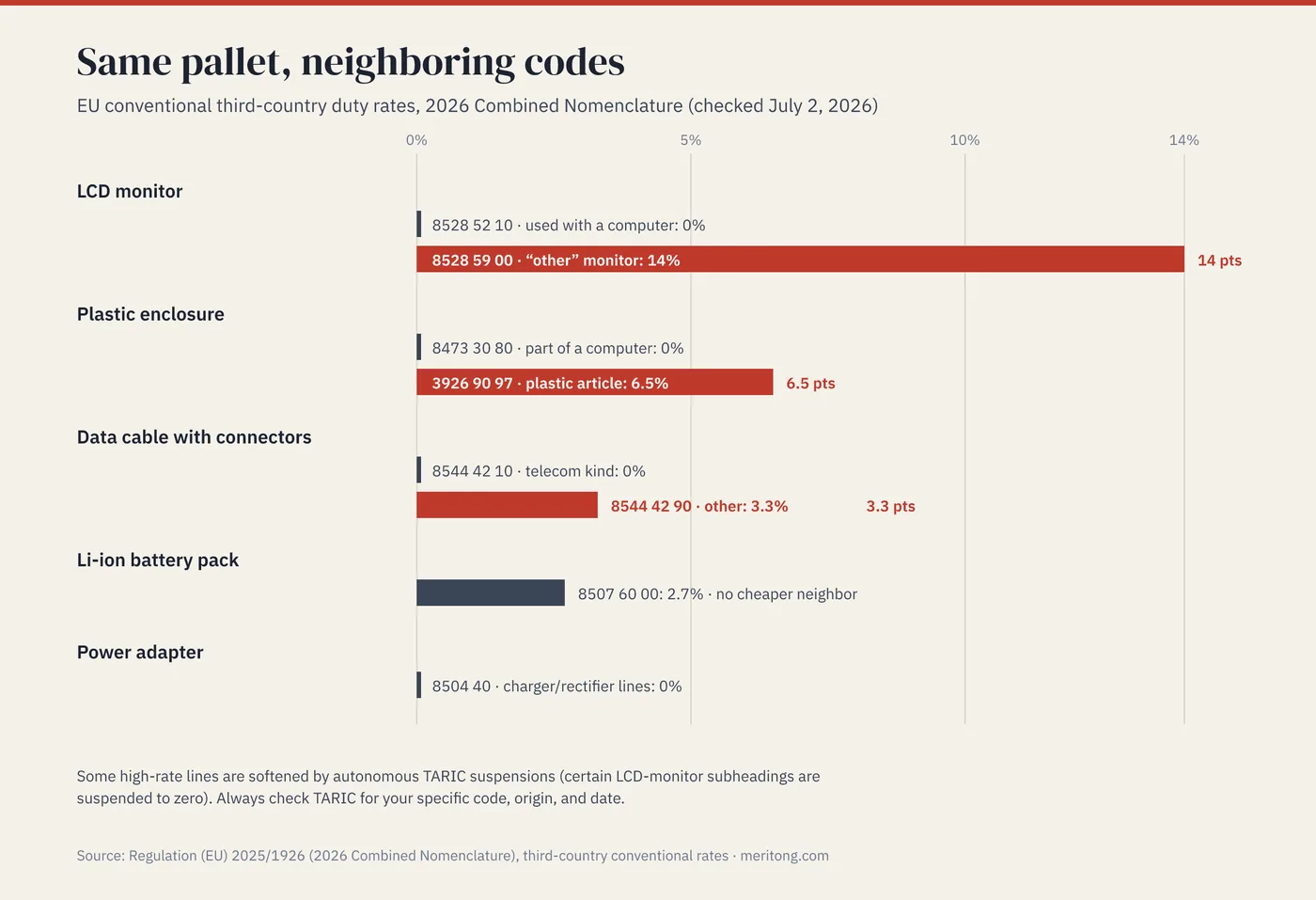
HS Code Classification for Electronic Components: A Step-by-Step Guide (and Where One Wrong Digit Costs You)
Every product that crosses a border gets classified under a commodity code, and that code — not your invoice description — decides your duty rate, your overlay tariffs, and which regulations apply. Classifying an electronic component comes down to seven steps.
From practice
Completed engagements with figures: which item was reviewed and what was saved in the end.
02 / The next step
How do I start?
The first call is free.
Thirty minutes. Your situation, your product, your suppliers. At the end you have the potential check: how many alternative suppliers are worth considering, and what saving is realistically on the table.