Customs
Section 301 Tariff Exclusions: How to Check If Your Components Qualify
A Section 301 exclusion only removes the tariff when your exact product, under its exact HTS code, matches a current, unexpired exclusion. The five-step check, and what a wrong claim costs.
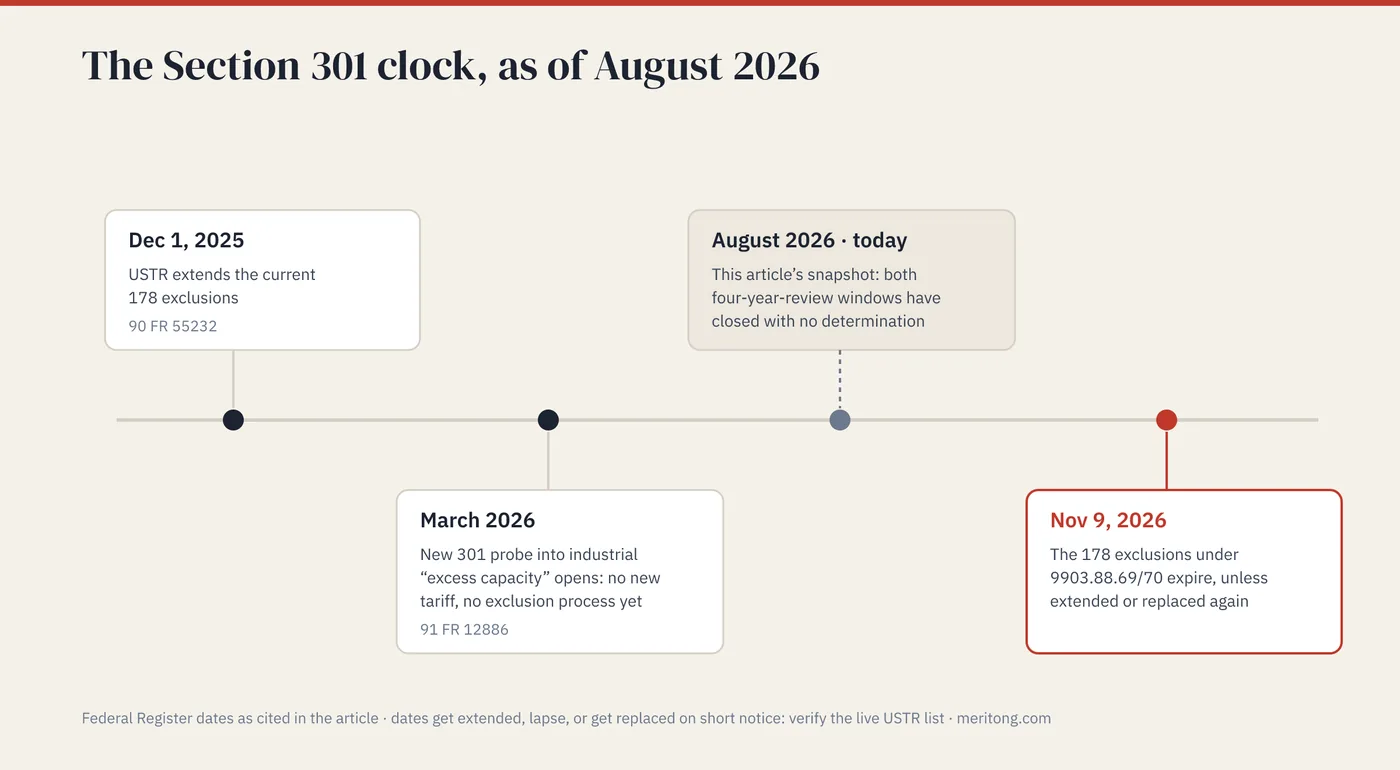
Last updated: August 2026. Section 301 exclusions and the underlying tariff lists are changing on short notice. Every date and list reference below is an August-2026 snapshot. Verify the live USTR exclusion list and your list's status before you rely on any of this.
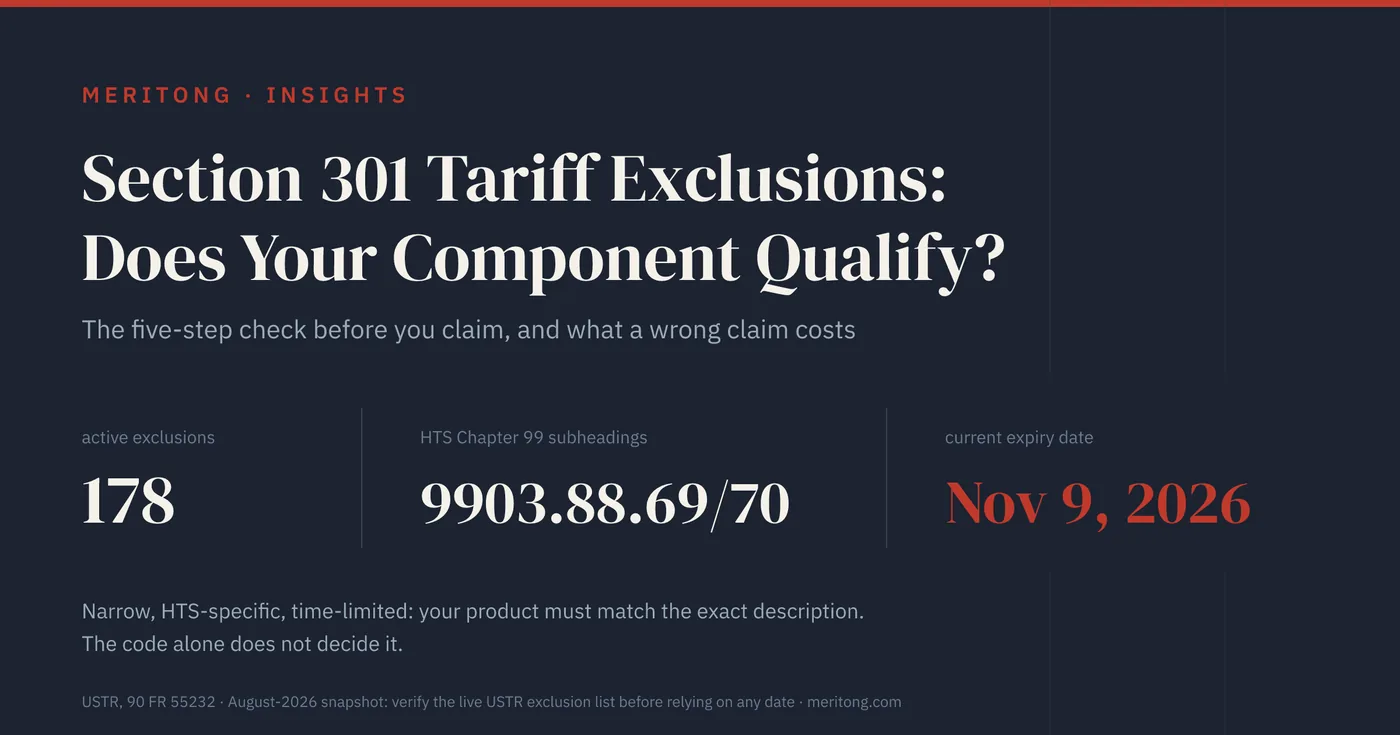
The short version
A Section 301 tariff exclusion can remove the extra China tariff from a specific imported component, and it does so on one condition only: that your exact product, under your exact HTS code, matches an exclusion that is currently active and has not expired. Exclusions are narrow, HTS-specific, and time-limited, which is why checking eligibility is a five-step job: find your Harmonized Tariff Schedule (HTS) code, check the active exclusion subheadings and the exclusion list of the U.S. Trade Representative (USTR), match the exact product description, confirm the dates, and claim it correctly. The same five steps also decide whether duties you have already paid can be recovered. Here is how, and how not to trip the reasonable-care rule while doing it.
What a Section 301 exclusion is
Section 301 is the statute behind the additional tariffs on Chinese-origin goods. When USTR grants an exclusion, it does so by publication, with nothing issued to you: the exclusion enters the tariff itself, as a Chapter 99 subheading of the HTS (currently the exclusions appear under headings 9903.88.69 and 9903.88.70), governed by specific U.S. notes that spell out exactly which products are covered. The grant, in other words, is text in the tariff schedule, which makes eligibility a matter of reading that text. Three features matter:
HTS-specific: an exclusion attaches to particular tariff lines and a particular product description.
Narrow: the product description in the note is often much narrower than the HTS code, so that a good matching the code while falling outside the description is not covered.
Time-limited: each exclusion has a hard expiry date written into the notice itself.
Together, the three features fix the shape of the check: the code locates a candidate exclusion, the description decides whether your product is inside it, and the dates decide whether a given entry can claim it.
As of August 2026, the current set of 178 exclusions under 9903.88.69/70 has been extended through November 9, 2026 (USTR determination, Federal Register 90 FR 55232, December 1, 2025). That end date is the one that governs. Confirm it against the live USTR list before relying on it, because these dates get extended, allowed to lapse, or replaced.
One important caveat concerns the broader picture. The underlying Section 301 tariff lists themselves are subject to a statutory four-year review. USTR opened the second such review in May 2026; List 1's request window closed July 6, 2026, and List 2's closed August 22, 2026, and as of this writing neither has produced a published continuation or termination determination. The review does not change how you check for an exclusion. It is, however, the reason the very first step before publication, or before a big sourcing decision, is to confirm which lists and exclusions are actually live that week.
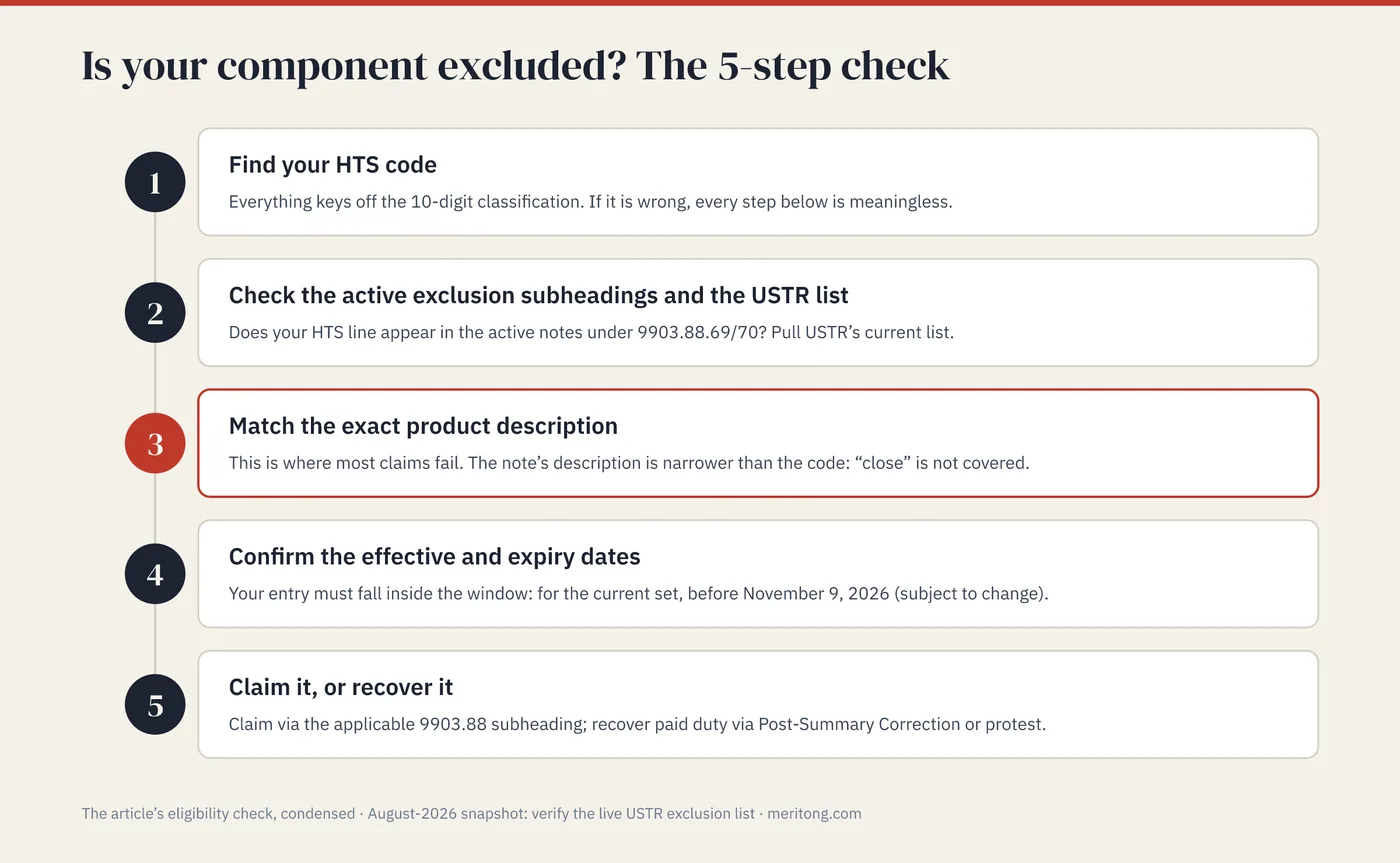
The 5-step check
1. Find your HTS code
Everything below depends on the 10-digit HTS classification of your component. If you are not certain of it, classify it properly first, because a mis-classification makes every subsequent step meaningless: you would be checking the wrong tariff line against the wrong exclusions. Use the official schedule at hts.usitc.gov and, for hard cases, the ruling database of U.S. Customs and Border Protection (CBP) or a binding ruling.
2. Check the active exclusion subheadings and the USTR list
Establish whether your HTS line appears in the active exclusion notes under 9903.88.69/70, and pull USTR's current exclusion list. This step answers the threshold question of whether any exclusion touches your tariff line at all. A hit at this stage establishes only that a candidate exists; the description and the dates decide the rest.
3. Match the exact product description
This is where most claims fail. The exclusion's product description in the U.S. note is frequently far narrower than the HTS heading it attaches to, which means the code can be right while the claim is wrong. Read the live description word for word and confirm that your product actually meets it. The operative text is the current tariff line itself, so open the actual note instead of relying on a paraphrase of it. If your part is "close" but does not fall within the description, you are not covered.
4. Confirm the effective and expiry dates
Check that your entry falls within the exclusion's effective window and before its expiry (for the current set, the November 9, 2026 date noted above, subject to change). An exclusion that expired before your entry date does not help that entry, however precisely the description matches.
5. Claim it, or recover it
If a qualifying entry is being filed, claim the exclusion on the entry using the applicable 9903.88 subheading. If you already paid the China tariff on entries that qualified, you may be able to recover it: through a Post-Summary Correction (PSC) before liquidation, or a protest after liquidation, within the applicable deadlines. Keep the documentation that proves the match, because a recovery in particular has to show that the entries met the exclusion. Before you claim, confirm the match with CBP or qualified customs counsel; this article is not customs advice, and a wrong claim entails the reasonable-care exposure covered below.
Eligibility at a glance
| Question | If yes | If no |
|---|---|---|
| Is your HTS line covered by an active exclusion? | Go to the product description | Not eligible: pay the 301 rate (or look at other levers) |
| Does your product meet the exact description in the note? | Check the dates | Not eligible: a close match isn't a match |
| Is your entry within the effective/expiry window? | Claim it (or recover via PSC/protest) | Not eligible for that entry |
| Not sure? | Get a binding ruling before claiming | N/A |
On the horizon: the March 2026 probe
You may have seen headlines about a new USTR Section 301 investigation into industrial "excess capacity" initiated in March 2026 (Federal Register 91 FR 12886), which names electronics and semiconductors among the sectors it covers. As of August 2026 that investigation is still at the pre-determination stage: it has produced no new tariff, no HTS overlay, and no exclusion process. It is worth watching, because it could change the landscape later this year. It does not, however, change today's answer to "is my part excluded?" That answer still turns on the current 9903.88.69/70 list. Watch USTR for any determination.
FAQ
How do I know if my part is excluded?
Find its HTS code; check whether that line appears in the active exclusion notes under 9903.88.69/70 and on USTR's current list; then read the exclusion's product description and confirm both that your product actually meets it and that the dates are open. All four have to be true.
My HTS code matches but the product description doesn't. Am I covered?
You are not. Exclusions are defined by the product description in the U.S. note, which is usually narrower than the HTS heading. A code match without a description match is not an exclusion.
Can I get a refund on duties I already paid?
Potentially: on entries that qualified, recovery runs through a Post-Summary Correction before liquidation or a protest afterward, within the deadlines. You need to show that the entries met the exclusion.
Do exclusions come back after they expire?
Sometimes they are extended or reinstated, and sometimes they are allowed to lapse; the difference is a policy decision published by USTR. Never assume an expired exclusion still applies; check the current list.
What if I claim an exclusion I don't actually qualify for?
You will owe the duty you avoided, and an incorrect claim creates reasonable-care exposure under 19 U.S.C. § 1592. If you find an error, a prior disclosure to CBP reduces the penalty exposure. When in doubt, get a binding ruling before claiming.
Close
Getting the HTS code right is upstream of everything here. An exclusion you are entitled to is worthless if the classification is wrong, and one you are not entitled to is a liability: the avoided duty comes back, and reasonable-care exposure comes with it. An answer, once established, is dated: the exclusions and the underlying lists change on short notice, so confirm the current state before a claim or a sourcing decision relies on it.
Whether an exclusion helps a given component depends on the component as well as on the list: how it is classified, what exactly it is, and where it comes from. I help work out what that means for a component's landed cost, looking at hardware, firmware, and sourcing together, particularly where China sourcing is involved; get in touch if that question is open at your company.
Meritong is a China-sourcing and landed-cost strategy practice. I am not a licensed customs broker or attorney; this article is general information, and it is not legal or customs advice. Exclusion eligibility is product- and fact-specific and the lists change frequently: confirm the current USTR exclusion list, and consult CBP, qualified customs counsel, or a binding ruling before claiming an exclusion.
Typical dependencies by email
Examples from real hardware audits, sent occasionally.
Working through this right now? Free intro call → or write to me →
Is this question on your desk right now?
In the free potential check you tell me the type of components you use. After 30 minutes you know whether an audit is worth it.
Free intro call