Regulation
Conflict Minerals & the CMRT: How to Answer a Customer's 3TG Request Without Panicking
A customer's conflict-minerals spreadsheet usually reaches you by contract, because the EU and US rules mostly bind other companies. This guide explains who the rules actually bind and how to answer a CMRT request in six steps, honestly and without over-committing.
Last updated: October 2026.
The short version
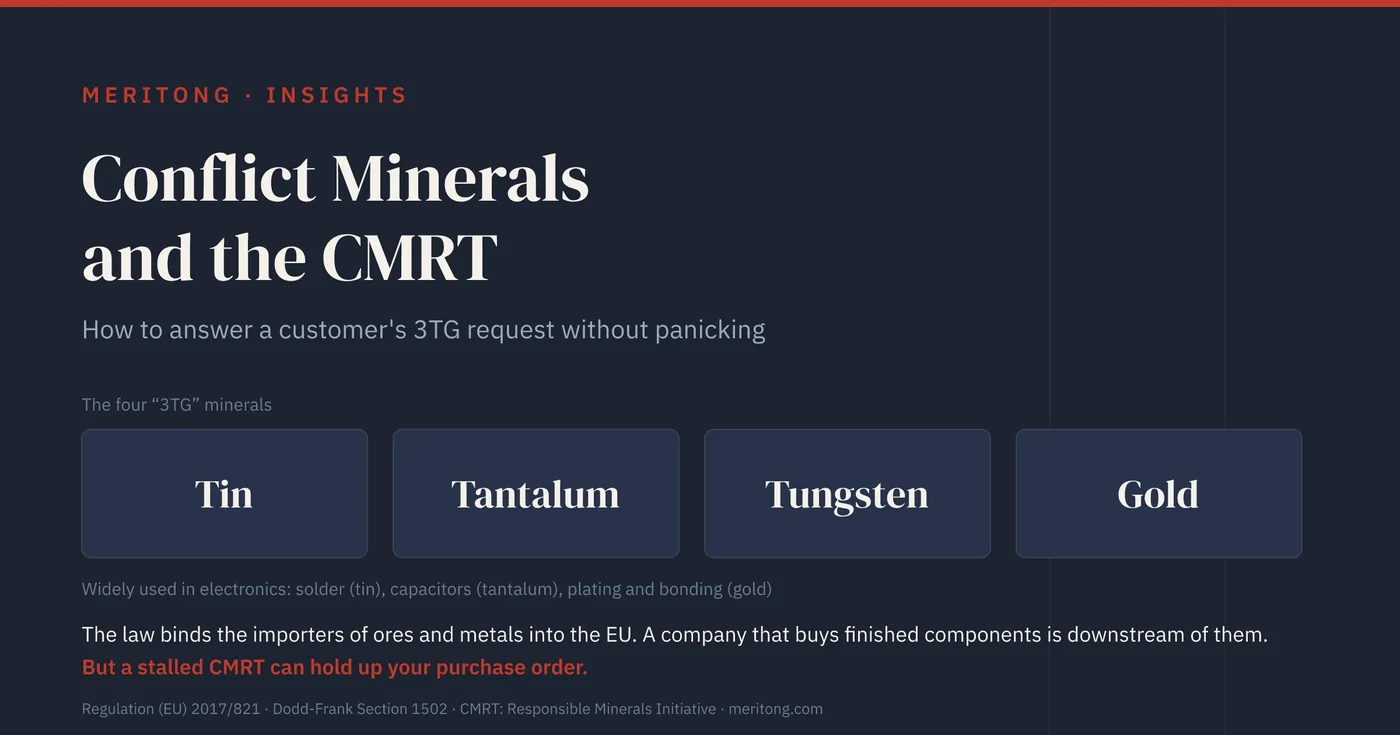
You are probably not the company the conflict-minerals laws directly regulate. A customer sends you a spreadsheet called a Conflict Minerals Reporting Template (CMRT) and asks you to declare your "conflict minerals" status, with a deadline. The EU Conflict Minerals Regulation binds the importers who bring the ores and metals into the EU. It does not bind the downstream companies that buy finished components and build products from them. The request reaches you through commerce: your customer's contract cascades it down the supply chain.
That distinction makes the task manageable. It does not entitle you to ignore the request, because a stalled CMRT can hold up a purchase order. Establish whether any of the four minerals is present in your product, and gather your suppliers' declarations. Then complete the template honestly, and decline to promise a guarantee you cannot stand behind.
What "3TG" and conflict minerals mean
"Conflict minerals" designates four materials known collectively as 3TG: tin, tantalum, tungsten and gold. The electronics industry uses them widely: tin in solder, tantalum in capacitors and gold in plating and bonding, among other places. The concern behind the rules is that the extraction and trade of these minerals can finance armed conflict and human-rights abuses. The concern applies notably to the Democratic Republic of the Congo (DRC) and the adjoining region. Two major regimes therefore ask companies to trace and disclose where their 3TG comes from.
Who the law actually binds
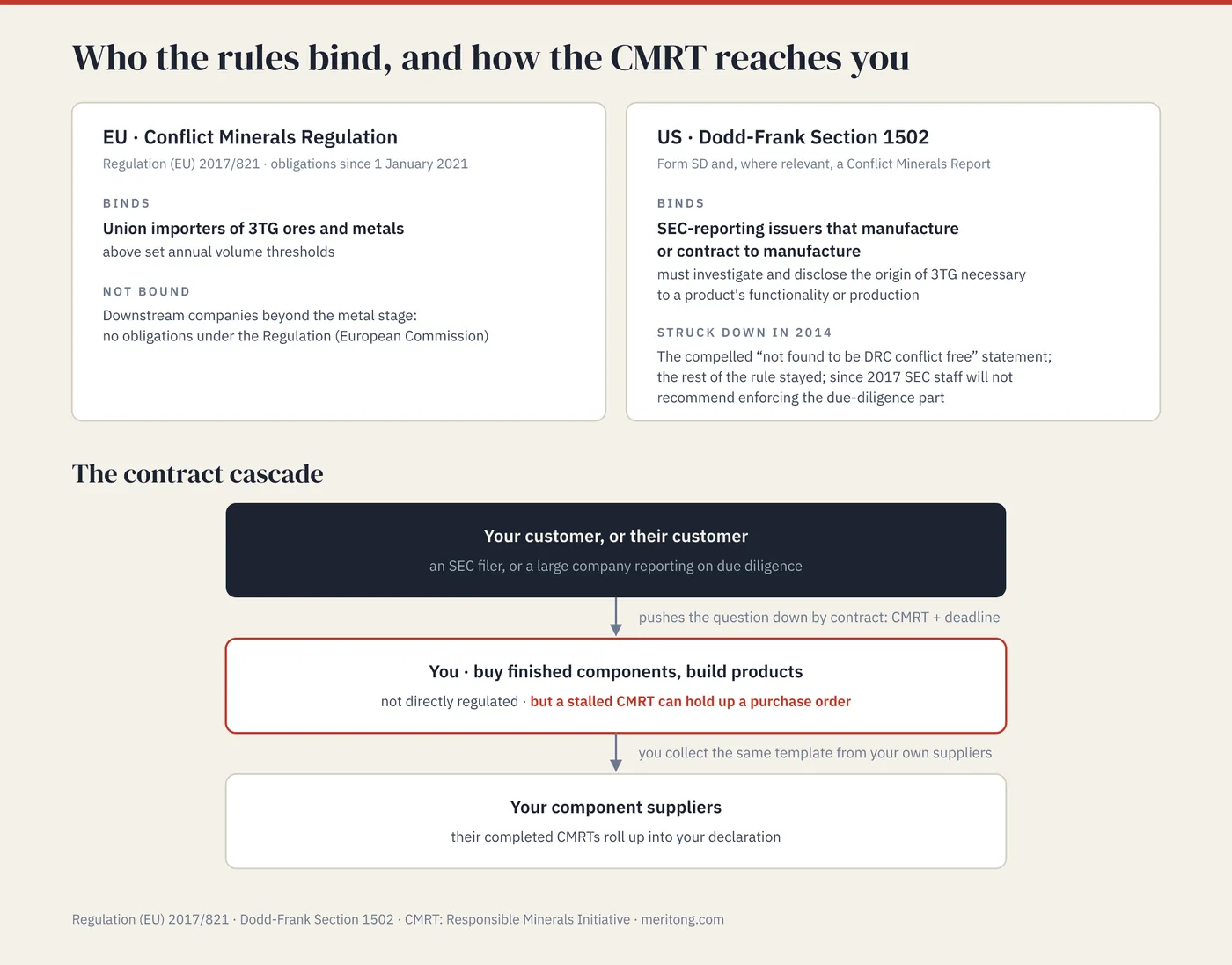
In the EU, the Conflict Minerals Regulation (Regulation (EU) 2017/821) places due-diligence obligations on Union importers of 3TG ores and metals above set annual volume thresholds. These importers are the companies that declare those ores and metals for release for free circulation in the EU. The Regulation entered into force in 2017, and these due-diligence obligations have applied since 1 January 2021. The European Commission is explicit that companies operating beyond the metal stage do not have obligations under the Regulation. The Commission nevertheless expects them to use reporting and other tools to make their due diligence more transparent. For many large companies, those tools include the ones in the EU's non-financial reporting rules. A business that buys finished components and assembles products operates beyond the metal stage, and the Regulation therefore does not regulate it directly.
In the US, Dodd-Frank Section 1502 requires issuers that report to the US Securities and Exchange Commission (SEC) to investigate and disclose the origin of their 3TG. The duty applies where those minerals are necessary to the functionality or production of a product the issuer manufactures or contracts to manufacture. Disclosure is made via a Form SD and, where relevant, a Conflict Minerals Report. A 2014 federal appeals-court decision struck down the requirement that a company state that any of its products had "not been found to be DRC conflict free". That statement was required in the company's report to the SEC and on its own website. The court reaffirmed the decision in 2015 and left the rest of the rule in place. Since April 2017, however, the SEC's staff has said it will not recommend enforcement action against companies that file only the country-of-origin part of Form SD. Such filings omit the due-diligence part. That position holds pending further Commission action. A company that is not an SEC filer is not directly bound by this regime either.
The two regimes select different addressees: the EU rule the importer of ores and metals, the US rule the reporting issuer that manufactures or contracts to manufacture. Yet both leave the ordinary non-filing company that buys finished components outside their direct reach. Why, then, does the spreadsheet arrive at all? The companies downstream of you, whether your customers or their customers, answer for their whole supply chain. Some of them file with the SEC. Others are large companies the European Commission expects to report on their due diligence. These companies therefore push the question down to you by contract. That is the cascade. It is how small and medium-sized enterprises commonly meet conflict-minerals compliance: as a customer requirement, which the law itself does not impose on them.
The CMRT, briefly
The CMRT is a free, standardized reporting template maintained by the Responsible Minerals Initiative (RMI). It is the cascade's common language. A company collects the same template from its own suppliers, then fills in its own CMRT and passes it up to its customer. In this way, each declaration aggregates the declarations beneath it. The form captures your company details and the scope of your declaration. The scope can be company-wide, product-level or a scope you define. The form also records your answers to a set of policy and due-diligence questions and a list of the smelters or refiners in your supply chain. Always use the current version from RMI, since the template is revised periodically.
How to answer a 3TG request, step by step
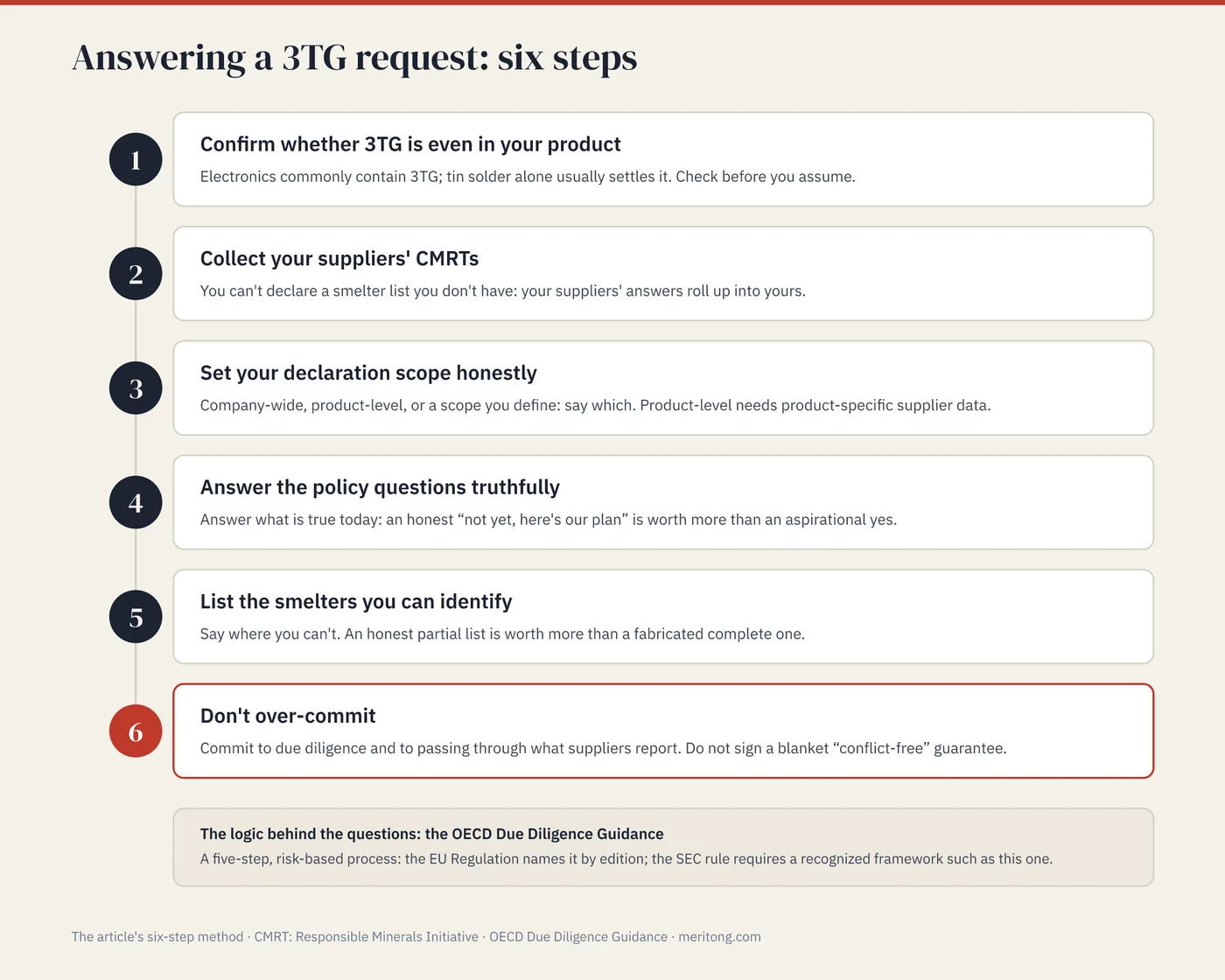
Confirm whether 3TG is even in your product: your answer is short and simple if your product contains no tin, tantalum, tungsten or gold. Electronics commonly contain 3TG (tin solder alone usually settles the question). Confirm the absence before you declare it.
Collect your suppliers' CMRTs: you cannot declare a smelter list you do not hold. Send your component suppliers the current CMRT, ask each to return a completed copy and let their answers roll up into yours. Since 5 August 2026, China's Ministry of Commerce (MOFCOM) has listed the Responsible Business Alliance on its countermeasure list (MOFCOM Order No. 2 of 2026). The RMI is an initiative of the Responsible Business Alliance. Suppliers in China may be constrained in what they can return on an RMI template. Where that comes up, ask the supplier what it can provide and tell your customer what the gap is.
Set your declaration scope honestly: the scope can be company-wide, a specific product or list of products, or a scope you define yourself. Decide which one applies and say so. A product-level declaration is the most precise, and it demands product-specific supplier data in exchange for that precision.
Answer the policy questions truthfully: the template asks whether you have a conflict-minerals policy, whether you conduct due diligence and so on. Answer what is actually true today. An aspirational "yes" you cannot support is worse than an honest "not yet, here's our plan."
List the smelters you can identify, and say where you cannot: completeness improves over time as suppliers respond. A partial list honestly declared is worth more than a complete one that has been fabricated.
Don't over-commit: resist signing up to a blanket "conflict-free guarantee." You can commit to conducting due diligence and to passing through what your suppliers report. You usually cannot personally guarantee the origin of every atom of gold three tiers down. If you commit to due diligence, you promise a process you control, whereas a guarantee of origin asserts a fact you usually cannot verify. Say what you can actually stand behind.
The framework behind all of this comes from the Organisation for Economic Co-operation and Development (OECD). It is the OECD Due Diligence Guidance for Responsible Supply Chains of Minerals from Conflict-Affected and High-Risk Areas. It describes a five-step, risk-based process. The first two steps are to establish management systems and to identify and assess risk in the supply chain. The third is to respond to the risks identified. The fourth is an independent third-party audit of supply-chain due diligence. The fifth is annual reporting. Both regimes build on the Guidance. The EU Regulation defines the term "OECD Due Diligence Guidance" in Article 2(o) by reference to the second edition of 2013. The SEC rule requires due diligence to follow a recognized framework, such as the OECD Guidance. The current edition is the third (2016). The CMRT's questions follow the Guidance's logic. Filling in a CMRT does not require you to master the Guidance itself.
FAQ
Does the EU Conflict Minerals Regulation apply to me?
It applies to you directly only if you import 3TG ores or metals into the EU above the volume thresholds. A company that buys finished components and builds products operates beyond the metal stage, where the Regulation places no obligations on it. Its customers can still require a CMRT by contract.
Do I have to be "conflict-free"?
Neither regime requires it: Regulation (EU) 2017/821 requires due diligence of Union importers, and the SEC rule requires investigation and disclosure. Your customer's contract is a different matter, so read what it asks you to warrant before you sign. What is expected is honest due diligence and disclosure. A guarantee you cannot verify to the mine is a different undertaking.
What if I don't have all my suppliers' smelter data?
Declare what you have, note what remains outstanding and keep collecting. An honest, improving CMRT is normal and acceptable, whereas a fabricated "complete" one is a real risk.
Which CMRT version do I use?
Use the current one published by the Responsible Minerals Initiative (RMI). The template is updated periodically, so pull the latest version before each use.
My product has no tin, tantalum, tungsten or gold: do I still answer?
You do. Once you have confirmed the absence, your answer is simply that 3TG is not present. Respond to the request, because silence is what holds up the purchase order.
How long does this take?
The first CMRT is the slow one, because you are chasing supplier data you have never collected before. After that the work is mostly maintenance: refreshing declarations and re-sending the current template when your customer or RMI updates it. Start collecting supplier data early, and the rest becomes a lookup that no longer needs a project of its own.
Close
A conflict-minerals request asks the same questions as a supply-chain-visibility review: who is in your chain and what is in your parts. Dependency and cost risk turn on those same questions. Perhaps the hard part turns out to be that nobody can say what is in the parts across your bill of materials (BOM), or who is behind them. That is an architecture and sourcing question the form alone cannot answer, and I am glad to look at it across hardware, firmware and sourcing together.
Meritong is a China-sourcing and supply-chain strategy practice. I am not a lawyer, and this article is general information and not legal advice. Conflict-minerals obligations depend on your role in the supply chain and jurisdiction. Consult qualified counsel for your specific situation, and use the current CMRT and OECD guidance.
Typical dependencies by email
Examples from real hardware audits, sent occasionally.
Working through this right now? Free intro call → or write to me →
Is this question on your desk right now?
In the free potential check you tell me the type of components you use. After 30 minutes you know whether an audit is worth it.
Free intro call