Obsolescence
Component Obsolescence Management: The 2026 EOL / NRND / Last-Time-Buy Playbook
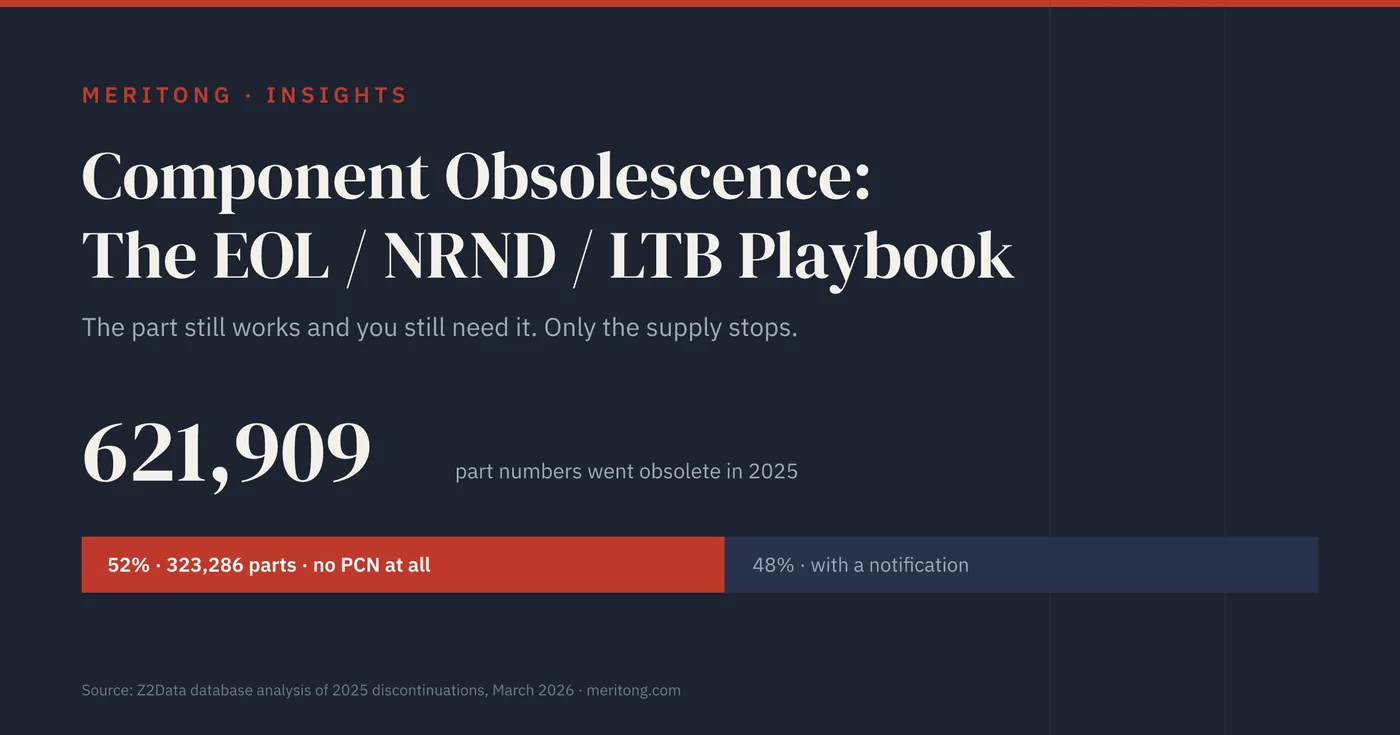
More than 620,000 electronic part numbers went obsolete in 2025, and about half of them were discontinued without a product change notification. If your product ships for seven years and carries three hundred components, discontinuation is not a risk — it is a schedule.
Last updated: July 9, 2026 · ≈19-minute read
The short version
More than 620,000 electronic part numbers went obsolete in 2025, and about half of them were discontinued without a product change notification. If your product ships for seven years and carries three hundred components, discontinuation is a schedule. The language of risk fits it poorly, because risk describes a possibility and a schedule describes dated events.
Two propositions govern what that schedule costs. The first is that a component's supply life and a product's service life are set by different parties on different clocks, so the interval between them has to be managed. The second is that the price of a resolution depends on how early it is chosen, which is why the companies that handle it cheaply run two loops.
A proactive loop knows, part by part, where the bill of materials (BOM) stands in its lifecycle, and it fixes the worst exposures at design time, when a fix is an alternate part number instead of a board respin.
A reactive loop treats every end-of-life notice as a timed, repeatable process: validate the notice, quantify exposure, walk a fixed resolution ladder from cheapest to most expensive, size the last-time buy with explicit assumptions, and document the decision.
The two loops are not independent of one another. Which rung of the reactive ladder is open to you on the day a notice lands was shaped by the proactive loop, months or years earlier; that dependency is why both belong in one playbook.
If you do nothing else this quarter, put every part of your BOM through a lifecycle-status check, subscribe to your manufacturers' change notifications for every part you buy, and pre-agree who owns the decision when a notice lands. The rest of this playbook works through the detail.
What the words actually mean
Obsolescence has a precise definition. The international obsolescence-management standard IEC 62402:2019 defines it as the transition of an item that is still required from being available to no longer being available from its manufacturer. Each half of that formulation matters. The item has not stopped working, and you have not stopped needing it; what has stopped is the supply. The change occurs on the manufacturer's side; the consequence occurs on yours. (For DACH readers: the standard exists in German adoption as DIN EN IEC 62402:2025-05.)
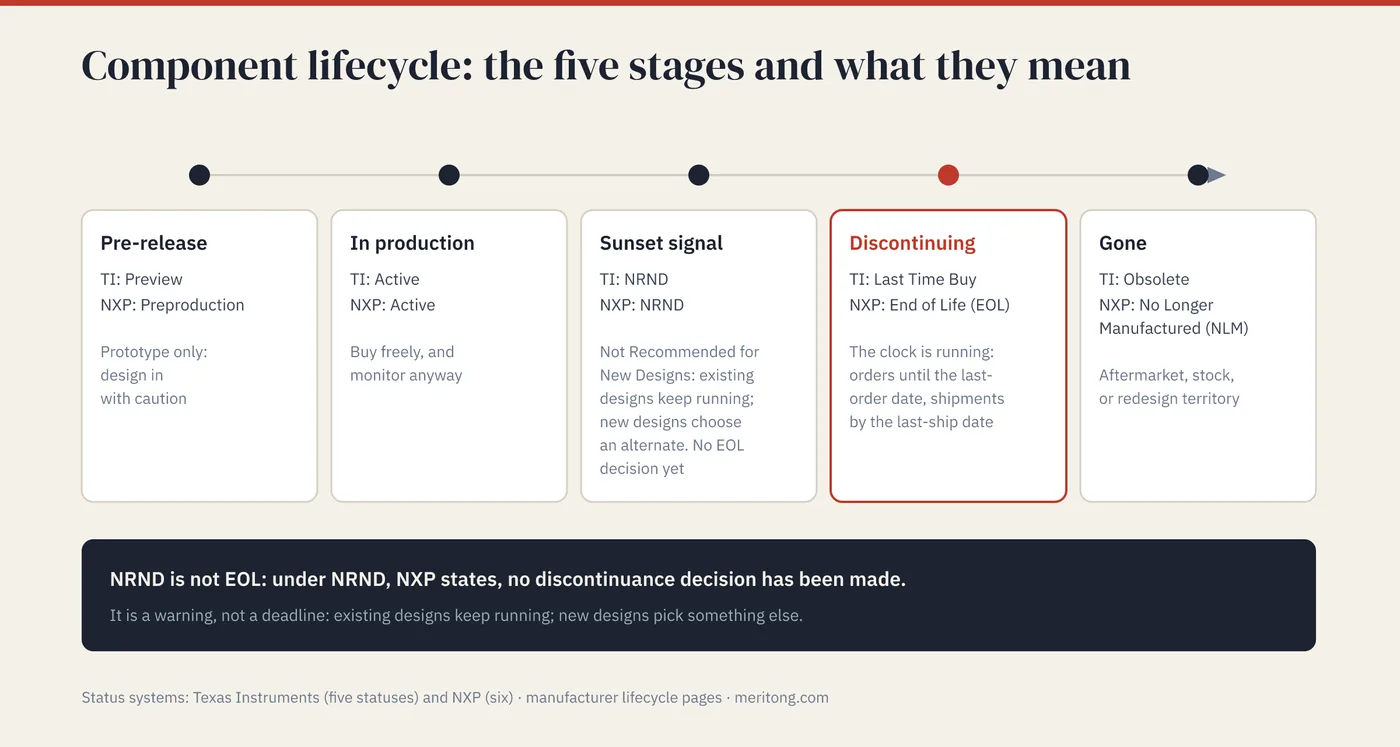
Manufacturers signal where a part stands by means of lifecycle statuses, whose vocabulary differs from one manufacturer to the next. The two systems you will meet most often, the five statuses of Texas Instruments (TI) and the six of NXP, map onto each other like this:
| Lifecycle stage | TI status | NXP status | What it means for you |
|---|---|---|---|
| Pre-release | Preview | Preproduction (Development, Qualification) | Prototype-only; design in with caution |
| In production | Active | Active | Buy freely, and monitor anyway |
| Sunset signal | Not Recommended for New Designs (NRND) | Not Recommended for New Designs (NRND) | Existing designs keep running; new designs choose an alternate; no discontinuance decision yet |
| Discontinuing | Last Time Buy | End of Life (EOL): orders until the last-time-buy date, shipments by the last-time-delivery date | The clock is running: reactive loop starts now |
| Gone | Obsolete | No Longer Manufactured (NLM) | Aftermarket, stock, or redesign territory |
Three distinctions prevent expensive confusion, all of them variants of one error, which is treating a signal as more final than it is.
First, Not Recommended for New Designs (NRND) is not End of Life (EOL): NXP states explicitly that under NRND "no discontinuance decision has been made" and longevity commitments are honored. The status functions as a warning, and it sets no deadline; new designs choose an alternate, while existing designs keep running.
Second, a product change notification (PCN) and a discontinuance notice are different instruments: per TI's policy, a PCN announces major changes affecting form, fit, function, quality or reliability; a discontinuance notice ends supply. The two call for different work, which is the practical reason the distinction is worth keeping.
Third, allocation is not obsolescence: demand exceeding supply on an active part is a shortage problem, often the opposite signal.
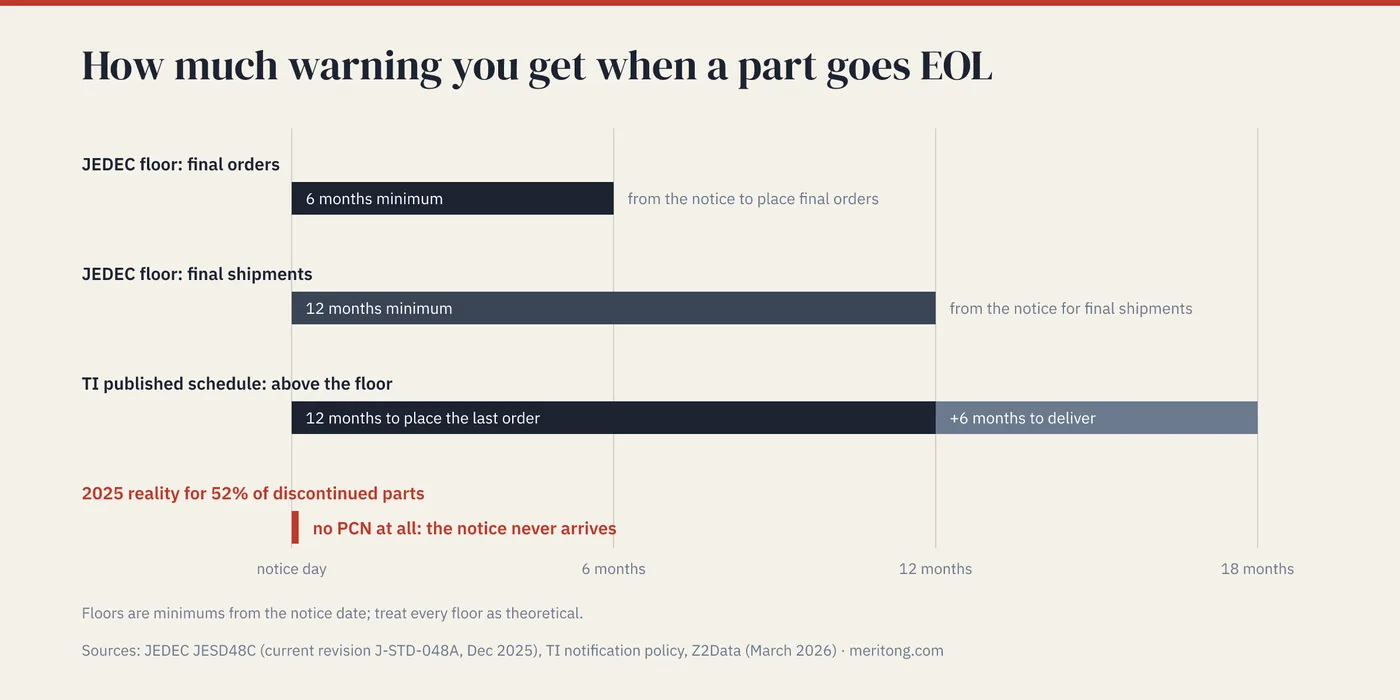
How much warning are you entitled to? Less than you would hope; the entitlement and the practice have to be examined separately. The semiconductor industry's discontinuance standard, JEDEC JESD48C (2011; current revision: J-STD-048A, December 2025), set the floor: at least 6 months from the notice to place final orders, and 12 months from the notice for final shipments. Some manufacturers commit to more, TI's published schedule being one documented instance, which allows 12 months for the last order plus an additional six months for final delivery. Any floor of that kind presupposes a notice. Treat every floor as theoretical, then, because in 2025, per Z2Data's database analysis, 52% of discontinued part numbers had no PCN at all. A commitment measured from the notice is worth what the notice is worth, which is why the loop below is triggered by observation as well as by notification.
The 2026 landscape in numbers
The stat that sets the tempo: 621,909 manufacturer part numbers (MPNs) went obsolete in 2025, and 323,286 of them, 52%, were not accompanied by a PCN from the manufacturer. (Source: Z2Data database analysis, March 2026; vendor-reported figures from its proprietary component database.)
The volume is volatile; it does not rise steadily. Z2Data's own history shows roughly 530,000 discontinuations in 2021, over 750,000 in the 2022 post-shortage peak, about 470,000 in 2023, and then 2025's 622,000. A series that moves like that is described badly by a trend through it, so plan for waves.
Two structural facts make the waves damaging.
The first is the lifecycle mismatch, which states the clock problem in numbers. Automotive products are engineered for fifteen-plus years of service, while industry commentary puts many semiconductors at under seven years to EOL, and long-lived industrial equipment faces the same mismatch. Where a product's service life exceeds the supply life of its components, the gap turns that product into a rolling series of obsolescence events, each with dates of its own.
The second is that supply cut-offs no longer come only from manufacturers' portfolio decisions. The Nexperia episode of late 2025 made that concrete. After the Dutch government took control of the chipmaker under the Goods Availability Act on September 30, 2025, China's Ministry of Commerce on October 4 blocked exports of certain finished components from Nexperia's Chinese operations. That block cut supply of ordinary, active parts with zero notice. The acute phase eased when the Dutch order was suspended in November 2025 amid Chinese supply-easing measures, but the lesson survives the resolution: a geopolitical event can behave exactly like an EOL notice you never received. The playbook below works for both, because the loop responds to the interruption of supply itself.
The reactive loop: when the notice lands
The six steps below work toward the cheapest resolution the remaining time still permits.
Step 1: Validate the notice and extract the two dates
Read the notice itself rather than the distributor summary. You need the last-order date and the last-ship date, which are different commitments and are both set out in the notice. Confirm which of your part numbers, including customer-specific variants, are affected, and log the notice where engineering and purchasing both see it. Where the part went obsolete without a notice, which is the 52% case, your monitoring tool or a distributor stock-out serves as the notice. Validate it against the manufacturer's lifecycle page before acting.
Step 2: Quantify exposure to end of support
One number drives everything: the units needed until your product's end of support. Pull every assembly that uses the part (where-used), then add production demand, service and warranty demand, and expected scrap. A part costing €0.40 can gate a €4,000 product, so exposure is measured as the product revenue at risk. The component spend measures the wrong thing, since it prices the part while the exposure attaches to the product. This is also the moment to check whether the same notice quietly hits other boards in your portfolio.
Step 3: Walk the resolution ladder, cheapest first
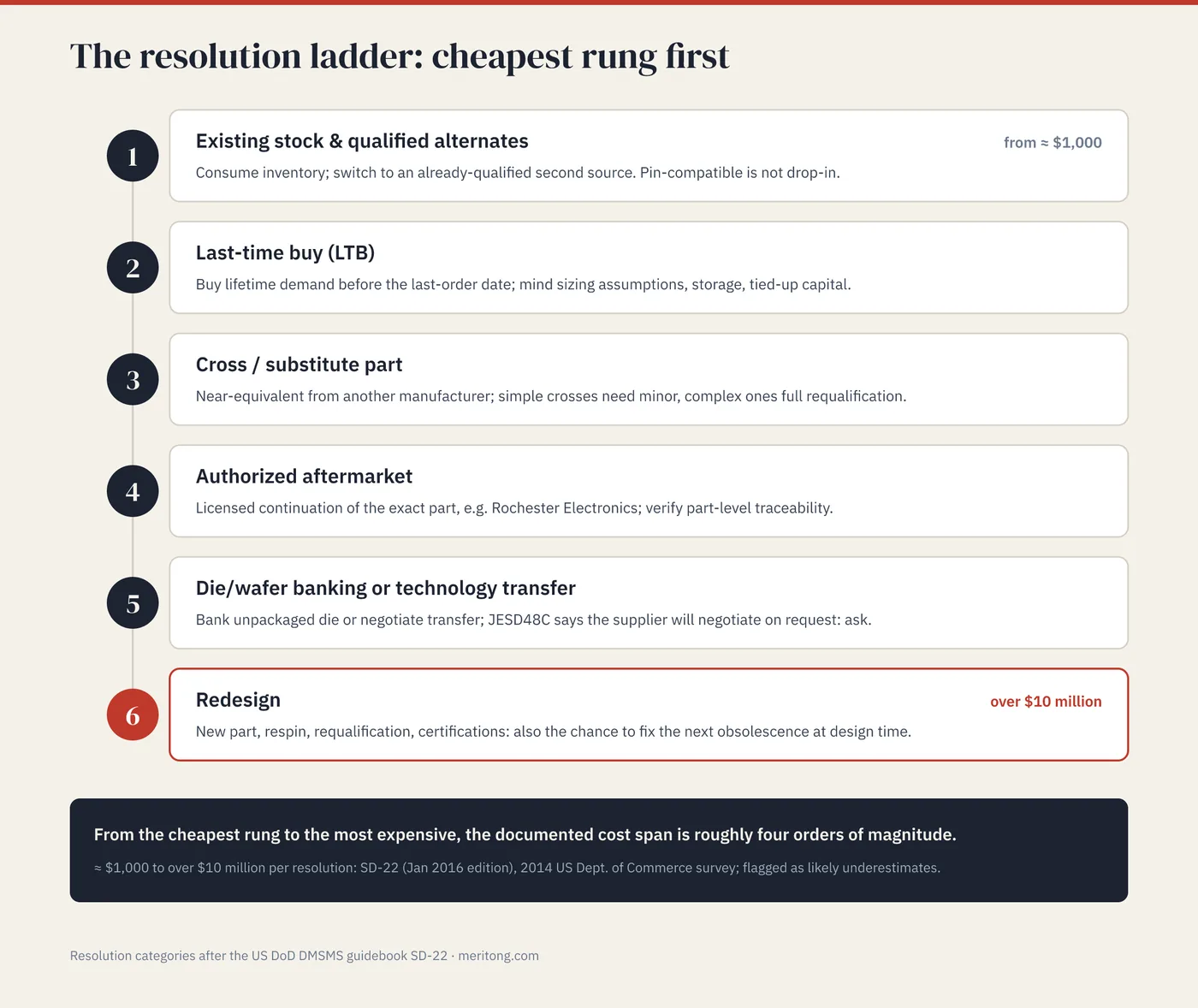
The US Department of Defense (DoD) obsolescence guidebook SD-22, which is the closest thing the discipline has to a canonical playbook, organizes resolutions into three categories of rising complexity: use existing material, substitute, or redesign. Its January 2016 edition tabulated average implementation costs from a 2014 US Department of Commerce survey, running from roughly $1,000 for the simplest resolution to over $10 million for a complex system redesign, and the guidebook itself flagged these figures as likely underestimates. It has been updated repeatedly since; a March 2024 edition restated cost factors in FY2024 dollars, and the currently listed edition is dated January 2026. The exact numbers age; the logic does not: from the cheapest rung to the most expensive, the documented cost span is roughly four orders of magnitude.
A span of that width settles the order of the work.
| Rung | Option | The move | Watch out for |
|---|---|---|---|
| 1 | Existing stock & qualified alternates | Consume inventory; switch to an already-qualified second source | "Pin-compatible" is not "drop-in": requalify what changed |
| 2 | Last-time buy (LTB) | Buy lifetime demand before the last-order date | Sizing assumptions; storage; tied-up capital (Step 4) |
| 3 | Cross / substitute part | Near-equivalent from another manufacturer | Simple substitutes need minor qualification; complex ones, full requalification |
| 4 | Authorized aftermarket | Licensed continuation of the exact part | Rochester Electronics states it manufactures from technology transferred by the original component manufacturer (OCM), with 12+ billion die in stock: company-published claims; verify part-level traceability |
| 5 | Die/wafer banking or technology transfer | Bank unpackaged die, or negotiate tooling/technology transfer | JESD48C itself provides that, upon customer request, the supplier will negotiate such options: ask; few do |
| 6 | Redesign | New part, respin, requalification, certifications | The order-of-magnitude rung: also the chance to fix the next obsolescence at design time |
The timeline is sometimes too short to walk the ladder calmly, because the notice reached you late or never reached you at all.
Step 4: Size the last-time buy with explicit assumptions
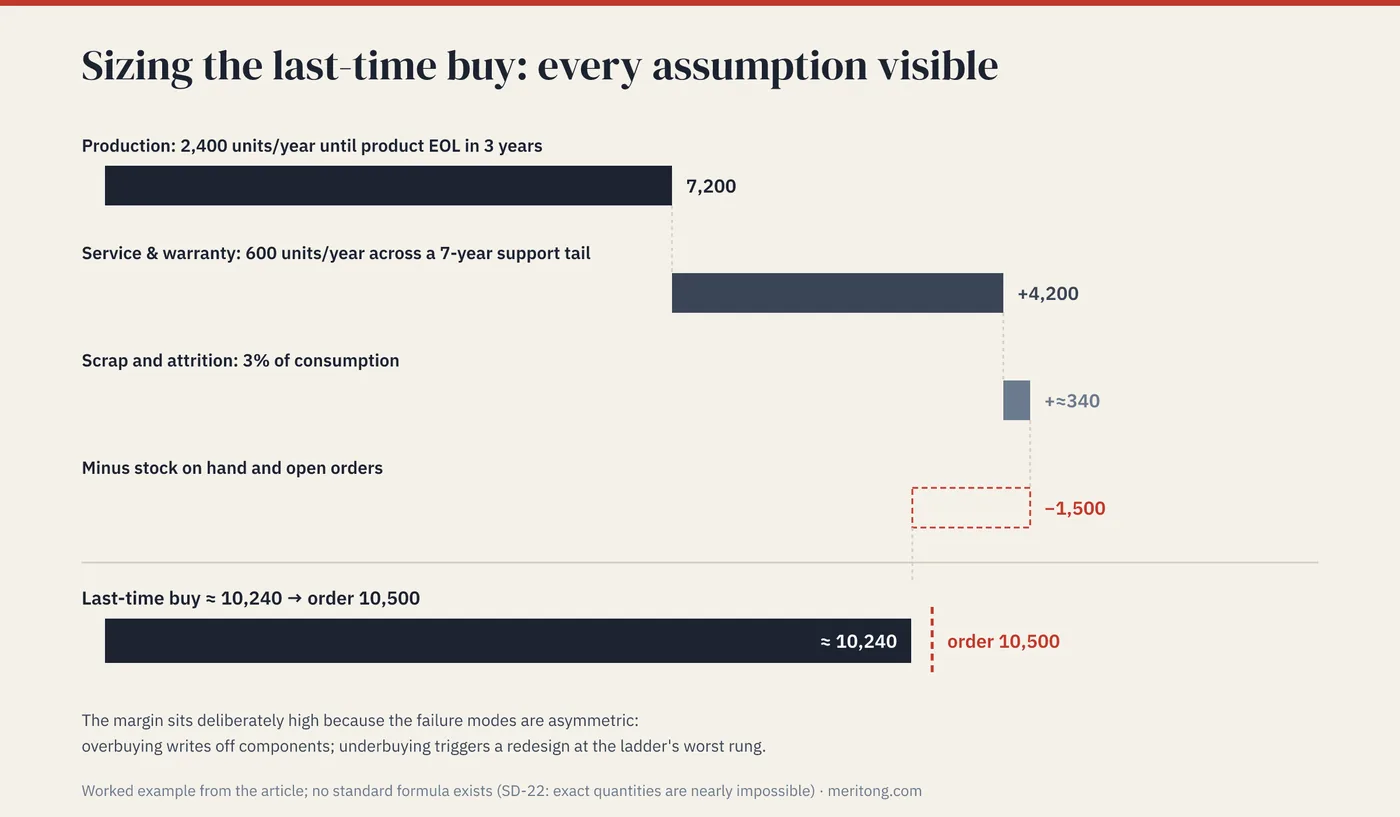
There is no standard formula, and serious sources admit as much. SD-22's January 2016 edition put it plainly: because reliability and end-of-life dates are estimates, "accurately determining the quantity of an item to buy is nearly impossible." The estimate is therefore unavoidable; what you can control is whether the assumptions behind it are visible. In the worked example, each is stated separately so that each can be challenged separately.
Production: 2,400 units/year, planned until product EOL in 3 years → 7,200
Service & warranty: 600 units/year across a 7-year support tail → 4,200
Scrap and attrition at 3% of consumption → ≈340
Minus stock on hand and open orders → −1,500
Last-time buy ≈ 10,240 → order 10,500: the margin is deliberately on the high side, because the failure modes are asymmetric. Overbuying writes off components; underbuying triggers the redesign you were avoiding, at the ladder's worst rung, on someone else's schedule.
Then treat the stored parts as an asset with a shelf life. Moisture-sensitive packages and solderability both degrade in storage, and SD-22 warns that plastic-encapsulated parts absorb moisture and are damaged in reflow if they are not baked out. Specify dry storage, moisture-barrier packaging, and periodic solderability checks in the purchase, and put the carrying cost of capital, storage, and insurance into the comparison against the rung 3 and 4 options. What that cost decides is whether the buy remains the cheaper option once the parts have been held for the length of the support tail.
Step 5: If the open market is unavoidable, put guardrails on it
When stock, aftermarket, and crosses all fail, the independent/broker market is what remains, and it is where counterfeits live. ERAI, the industry's counterfeit-parts reporting clearinghouse, logged 1,055 suspect parts in 2024 (a figure inflated by one 248-part government batch report; the underlying increase was 3%). Obsolete parts were, as always, the most-reported category at 42.75%, while active, readily available parts accounted for a substantial share too, so scarcity is not the only trigger.
The second half of that finding bears on how the guardrails are scoped, because a screen aimed only at obsolete part numbers would leave the rest of an open-market purchase unexamined. The working guardrails are three, each covering a different point in the transaction: buy only against full traceability; use the counterfeit-avoidance standards as your contract language (SAE AS5553 for your own organization's process, AS6081 for what you require of independent distributors); and put third-party test-lab inspection between the shipment and your production line.
Step 6: Document, then tell your customers
Record the decision: the notice, the exposure math, the option chosen and the reasoning for it, and the assumptions behind the buy quantity. That record is what turns the next notice into a process instead of a crisis. If you sell to OEMs it does a second job, since it is what lets you notify your customers properly, and JESD48C expects distributors and authorized agents to pass discontinuance notices down the chain.
The proactive loop: before the notice
In the BOMs I audit, obsolescence exposure is usually untracked until the first line-down scare, and then it is tracked obsessively for eighteen months and forgotten again. A durable proactive loop is smaller and duller than that, with its value showing up in the rungs it keeps open, since each of the four practices settles in advance something that would otherwise have to be settled inside the notice period.
Score the BOM: for every part, record the lifecycle status (from the manufacturer's page rather than the distributor's), a forecast of years-to-EOL where available, the number of qualified sources, and single-fab or single-geography flags. Lifecycle-intelligence platforms automate this. Z2Data describes its approach as forecasting time-to-EOL from market demand, manufacturing sites, technology roadmaps, and part activity, and SiliconExpert and Accuris, among others, operate in the same category. A spreadsheet kept against manufacturer lifecycle pages beats nothing, and it beats most companies. Those four fields are what turn a parts list into a statement of exposure.
Design for exit: prefer parts with a published longevity commitment. TI, for instance, states its products typically live 10–15 years and are not considered for discontinuation while they have recent sales, current demand, or under ten years in production. Prefer parts with existing crosses as well, and avoid designing a sole-source part into a load-bearing role without a documented exit plan. That decision is taken years before it pays for itself: a part with a qualified alternate already in the file can resolve on the cheapest rung of the ladder, whereas a part designed in without an exit plan has fewer rungs available when the notice arrives.
Put it in the contracts: have PCN and discontinuance notices routed to a monitored address rather than to a person who left two years ago, secure last-time-buy rights, and, where the leverage exists, negotiate escrow or technology-transfer clauses. The JESD48C negotiation lever works best when it is pre-agreed.
Give it an owner and a cadence: one named owner, a quarterly BOM review, and a standing agenda item beat a task force after the fact. In the DACH region, the Component Obsolescence Group Deutschland (COGD) is where the practitioners compare notes; it is the German industry association for obsolescence management, which also maintains the smartPCN digital notification standard.
Glossary
Obsolescence: an item still in use becoming unavailable from its manufacturer (IEC 62402). End of Life (EOL): the manufacturer is discontinuing the part; ordering windows apply. Not Recommended for New Designs (NRND): sunset signal; supply continues, new designs should look elsewhere. Product Change Notification (PCN): advance notice of a major change to form, fit, function, quality or reliability. Discontinuance (EOL) notice: the formal notification that supply will end, with last-order and last-ship dates. Last-order date / last-ship date: deadline to place final orders / final delivery date; both set in the discontinuance notice. Last-time buy (LTB): the final purchase covering remaining lifetime demand (also: lifetime or life-of-need buy). DMSMS: Diminishing Manufacturing Sources and Material Shortages; the US DoD's umbrella term for the loss or impending loss of manufacturers or suppliers of items, raw materials, or software. Allocation: demand exceeding supply for an active part; a shortage condition, distinct from obsolescence. Authorized aftermarket: continuation manufacturing/supply licensed by the original component manufacturer (OCM). Die/wafer banking: storing unpackaged silicon for later packaging, extending supply past fab shutdown. YTEOL: years-to-EOL; a forecast of remaining lifecycle, produced by lifecycle databases.
FAQ
Is NRND a reason to redesign now?
Usually it is not. NRND means that no discontinuance decision has been made and that existing commitments are honored, so for parts already in your product it is a monitoring trigger and a reason to identify a cross, and it does not amount to a reason for an automatic respin. For new designs it is a hard "pick something else."
Why can't I just switch to the successor part, like a software upgrade?
Sometimes you can: when the manufacturer names a replacement and the replacement matches in every respect the design depends on, that is rung 1 or 3 of the ladder. But a component has no abstraction layer. Its "interface" is its entire physical and electrical behavior (package, pinout, tolerances, timing, thermal profile), including behavior your circuit relies on without the datasheet promising it. A successor is a different physical object, so the swap means requalification and can reopen certification work, and units already in the field never upgrade at all. Most discontinued parts also have no designated successor, which is why the resolution ladder exists, with redesign as its most expensive rung and five cheaper options standing ahead of it.
How much notice am I entitled to when a part is discontinued?
The JEDEC discontinuance standard (JESD48C; current revision: J-STD-048A, December 2025) set a floor of 6 months from notice for final orders and 12 months from notice for final shipments, and some manufacturers commit to more (TI: 12 months to order, plus 6 to deliver). In practice, per Z2Data, 52% of 2025's discontinued part numbers had no PCN. Every one of those periods runs from a notice, so build the loop on the assumption that the notice may not come.
How big should a last-time buy be?
Size it as production demand to product end-of-life, plus service demand across the support tail, plus scrap, minus stock, with every assumption written down and the buffer set by asymmetry: under-buying costs a redesign, over-buying costs inventory. No formula removes the estimation risk, and even SD-22 (in its 2016 edition) called exact quantities "nearly impossible."
Are broker-market parts for EOL components safe?
Treat them as guilty until tested. ERAI logged 1,055 suspect counterfeit and nonconforming parts in 2024, with obsolete parts the largest category. Buy on traceability, contract to AS6081, verify through a test lab, and prefer authorized aftermarket sources where they exist.
Does obsolescence only affect old designs?
No, it does not. Discontinuations hit part numbers at every lifecycle age (over 620,000 in 2025 alone, half without notification), and supply can vanish for non-portfolio reasons too, as the 2025 Nexperia export-control episode showed for active parts. Monitor the whole BOM; its gray-haired corner is one part of the job.
What's the difference between DMSMS and obsolescence?
Obsolescence is one cause; DMSMS is the umbrella. A part can be obsolete with no supply problem (stock everywhere), and a supply problem can exist with no obsolescence (allocation, export controls, a supplier bankruptcy). The management loop is the same either way.
Obsolescence exposure is a dependency you can name
The two loops answer the same question at different prices. A dependency named at design time costs an alternate part number, whereas the same dependency named after the notice costs whichever rung of the ladder the calendar leaves you. Neither loop removes the exposure, since the decision to discontinue belongs to the manufacturer throughout. What they change is how much of the resolution is still yours on the day the notice arrives.
A BOM's obsolescence risk is rarely alone. The same audit that finds the NRND part in a load-bearing socket usually finds the single-sourced module next to it and the retail-priced reseller behind both.
Those dependencies can be named in your own BOM before a notice arrives, while more of the resolution is still yours. That is the kind of hardware-component problem I help with, particularly where China sourcing is involved, and I look at hardware, firmware, and sourcing together; get in touch if an obsolescence question is open at your company.
Figures and standards cited were verified against the linked sources on July 9, 2026. Lifecycle statuses, notice policies, and discontinuation volumes change. Verify part-level status against the manufacturer's current lifecycle page before acting. This article is general information, not procurement or engineering advice for any specific part, and not legal advice; I am not an attorney or licensed customs broker. For export-control or contract questions specific to your situation, consult qualified counsel.
Typical dependencies by email
Examples from real hardware audits, sent occasionally.
Working through this right now? Free intro call → or write to me →
Is this question on your desk right now?
In the free potential check you tell me the type of components you use. After 30 minutes you know whether an audit is worth it.
Free intro call