Sourcing
Reshoring & Nearshoring Electronics: What It Really Costs, and When It Actually Pays
Whether reshoring or nearshoring electronics pays is a cost-model question that differs from product to product. Using Kearney's tariff-inclusive model, Eurostat labor costs and IFR robot data, this article sets out when moving production closer pays and when importing stays cheaper.
Last updated: October 2026. Tariff and cost figures below are dated snapshots from named sources. Verify current rates and data before you rely on them.
The short version
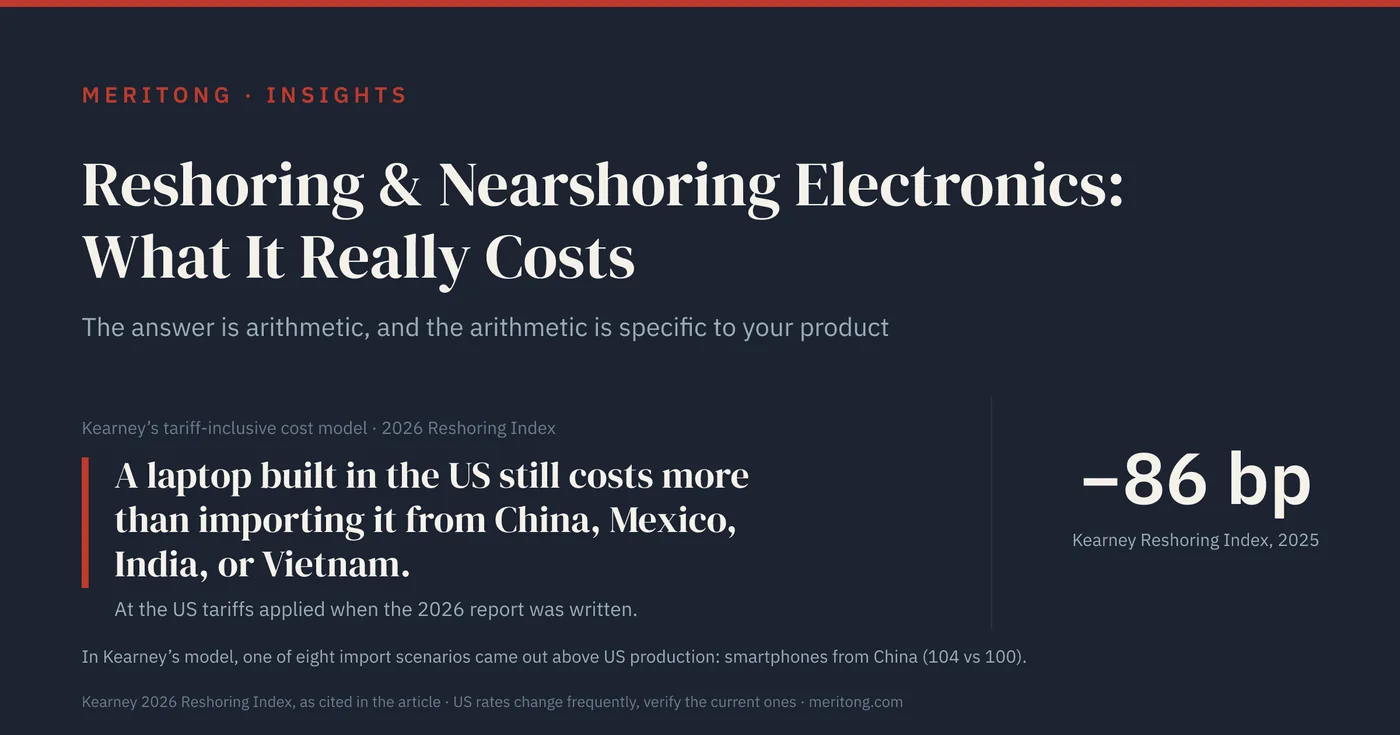
The answer on reshoring and nearshoring is arithmetic, and the arithmetic is specific to your product. Reshoring, which brings production home, and nearshoring, which moves it closer, to Mexico or to Eastern Europe, are sold in two ways, as a patriotic choice or as a response to concern about dependence on China, though neither pitch can settle a question whose answer changes from one product to the next. For the two electronics products in Kearney's US cost model, a laptop and a smartphone, the uncomfortable headline is that full US production still costs more than importing in seven of the eight import scenarios tested, even with the US tariffs of 2025 and early 2026 included: the labor and scale advantages are large, and they do not vanish because a tariff appeared.
That headline, however, describes two modeled products, and a specific product can differ from them in either direction. Reshoring or nearshoring pays under identifiable conditions: when your product is highly automated, so that labor content is low; when logistics and tariffs make up a large share of landed cost; or when lead time, intellectual property (IP) protection, and quality control are worth a premium. Whether reshoring manufacturing pays is, at bottom, a cost-model question, because labor content, logistics, tariffs, and lead time differ from one product to the next and decide the result.
The costs, with real numbers
Start with the reason offshore is cheap in the first place, because that advantage is what you pay to give up.
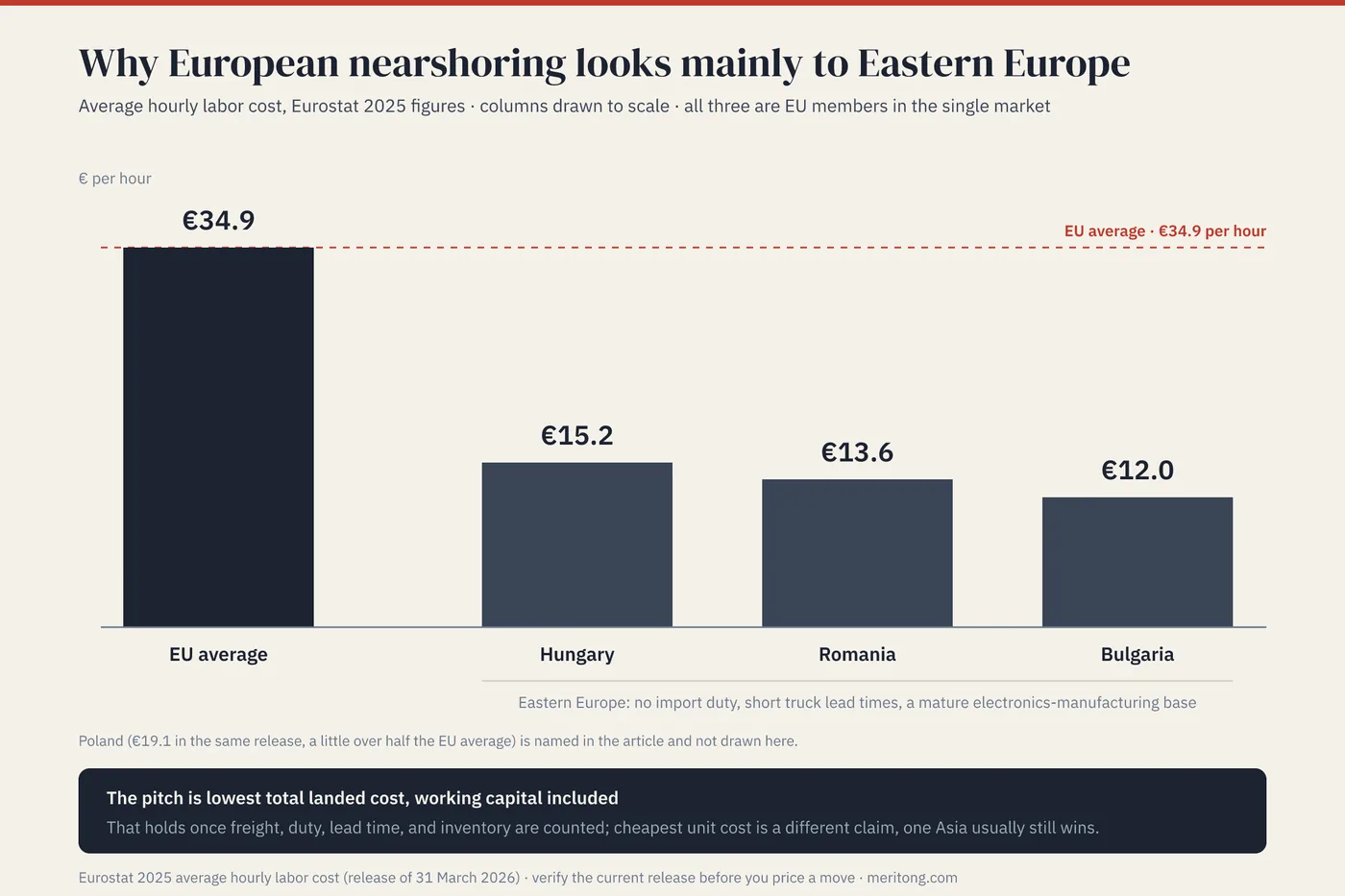
Labor: the gap is real and large. Eurostat's figures for 2025 put average hourly labor cost across the EU at €34.9, against €12.0 in Bulgaria, €13.6 in Romania, and €15.2 in Hungary (whole economy excluding agriculture, forestry and fishing, public administration and some other sectors, enterprises with ten or more employees; Eurostat, 31 March 2026), which is why European nearshoring looks mainly to Eastern Europe. The Reshoring Initiative estimates that US manufacturing costs on average 10–50% more than offshore production, and about 50% more than production in China (Reshoring Initiative, 2024 Annual Report). Labor content is the swing factor: the larger the share of your cost that is hands-on assembly, the more that gap hurts.
The tariff twist, and why it does not settle the question: you would expect the US tariffs of 2025 and early 2026 to flip the math; in Kearney's model, importing mostly stays cheaper even with them included. Kearney's tariff-inclusive cost model, in its 2026 Reshoring Index, indexed full US production of a laptop and of a smartphone at 100 and compared it with importing the same product at the US tariffs applied when the report was written. Importing a laptop from China, Mexico, India, or Vietnam came out at 67 to 75, below full US production. Importing a smartphone from Mexico, India, or Vietnam came out at 86 to 96, also below it, while importing a smartphone from China came out at 104, slightly above it. Kearney's Reshoring Index, which tracks the year-on-year change in the ratio of US manufactured-goods imports from 14 Asian low-cost countries and regions to US domestic manufacturing output, improved slightly in 2025, from −115 to −86 basis points, but remained in negative territory. Take that as the evidence for the "against" case: in seven of Kearney's eight import scenarios, importing came out cheaper than full US production with the tariffs included, and in the eighth, a smartphone imported from China, full US production came out slightly cheaper. Kearney does not report the same scenarios without tariffs, so the model shows where tariff-inclusive costs land without measuring how far the tariffs moved them. US tariff rates change frequently, so treat Kearney's result as a dated snapshot and rerun the comparison at the rates in force when you decide.
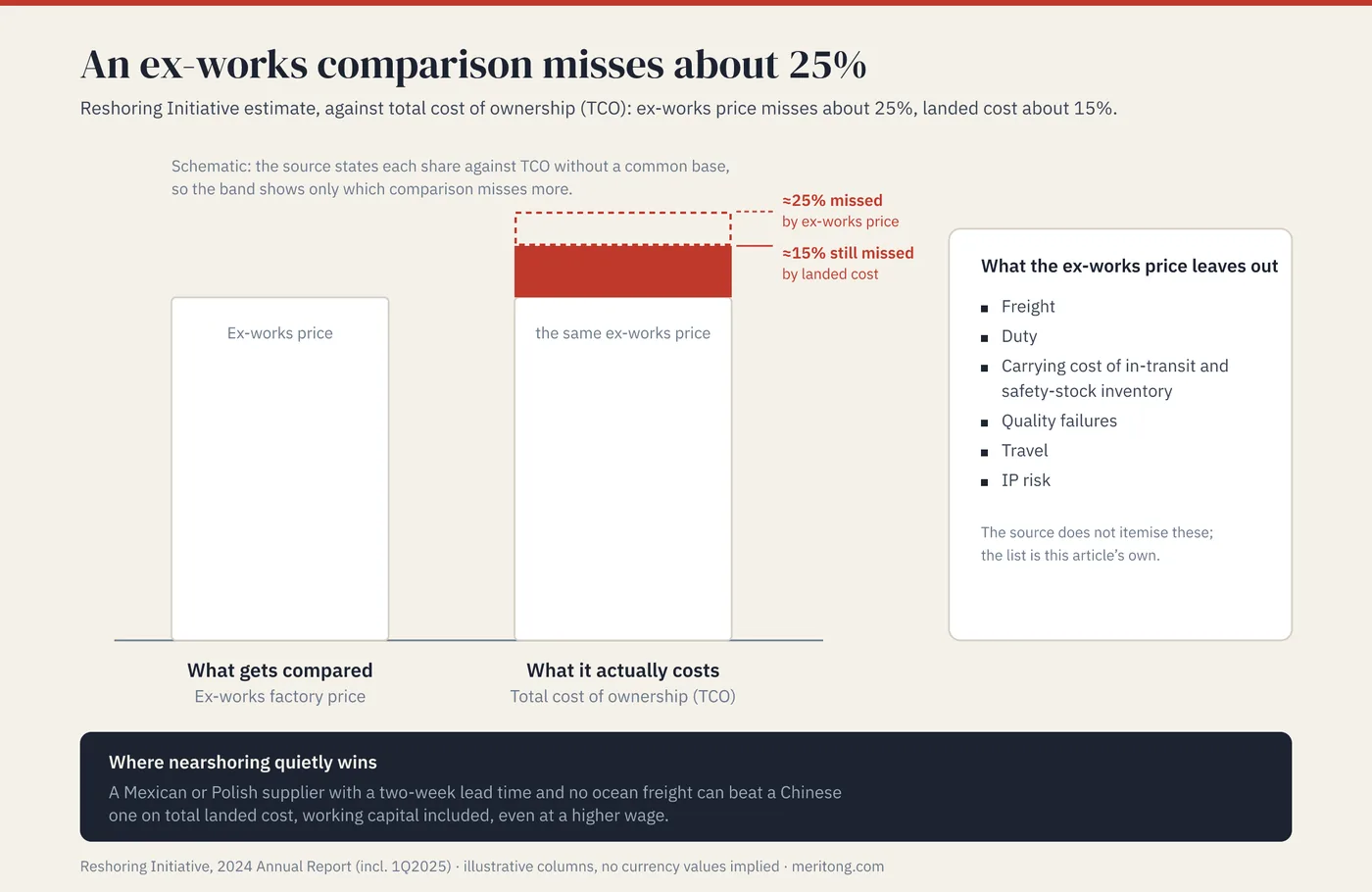
A landed-cost comparison still understates offshore cost: drawing on its 2025 National Reshoring Survey, the Reshoring Initiative estimates that original equipment manufacturers (OEMs) comparing on the ex-works price, the price at the factory gate, miss about 25% of offshoring costs and risks against a full total cost of ownership (TCO), and that those comparing on landed cost, which adds freight and duty and is used by the largest segment of OEMs, still miss about 15% (Reshoring Initiative, 2024 Annual Report). In this article's accounting, a TCO calculation adds items such as the carrying cost of in-transit and safety-stock inventory, quality failures, travel, and IP risk, and "total landed cost" from here on means that full figure. That gap is where nearshoring quietly wins even when the unit price is higher: a Mexican or Polish supplier with a two-week lead time and no ocean freight can beat a Chinese one on total landed cost, working capital included, even at a higher wage.
Automation as the offset
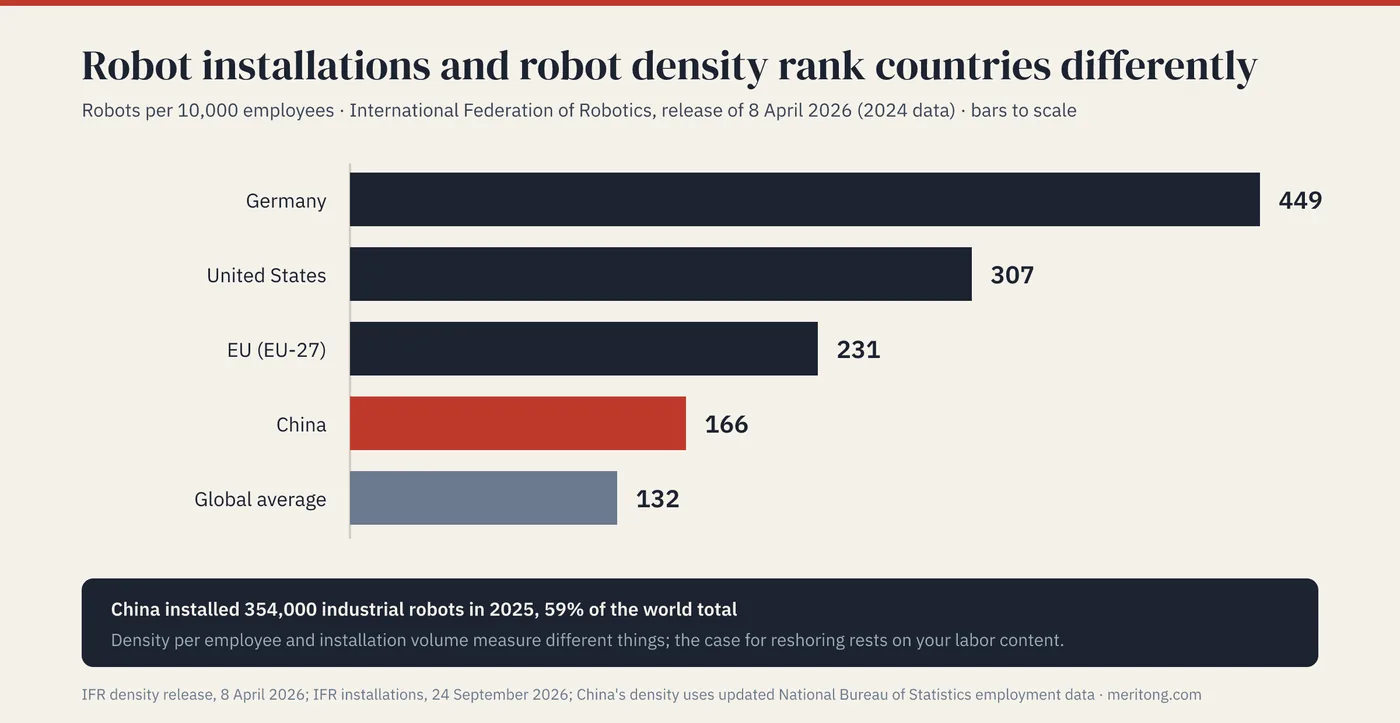
Automation can decide the case. If a product is highly automated, its labor content is low, and the wage gap that makes offshore cheap mostly disappears, leaving logistics, tariffs, and lead time, all of which favor "close." Automation, however, is advancing at scale in China as well. According to the International Federation of Robotics (IFR), China installed 354,000 industrial robots in 2025, 59% of all robots installed worldwide that year (IFR, 24 September 2026). Measured per employee, the ranking differs: on updated employment data from China's National Bureau of Statistics, the IFR puts China's robot density for 2024 at 166 robots per 10,000 employees, against 449 in Germany, 307 in the US, and 231 across the EU, with a global average of 132 (IFR, 8 April 2026). "Automate and reshore" is therefore a real strategy, though one that competes with a China that installed more industrial robots in 2025 than the rest of the world combined, so the automation case for reshoring rests on your labor content. A Western lead in robot density does not settle it, because the installation figures show Chinese manufacturing automating at scale. (Some research also questions how many jobs automated reshoring creates: a working paper in the Federal Reserve Bank of San Francisco series argues that reshoring "does not necessarily bring jobs back to the home country or boost domestic wages, especially when firms have access to labor-substituting technologies such as automation" (Firooz, Leduc, and Liu, 2024). That matters if policy incentives are part of your business case; treat it as an open question, one the research has not settled.)
Nearshoring: the middle path
For many European and US companies, a realistic move is to nearshore. A return all the way to a high-wage home country pays the full wage gap, while a nearshore location pays only part of that gap, replaces the ocean crossing with a far shorter land route, and collects most of the lead-time, tariff, and working-capital benefits.
For European companies seeking lower labor cost inside the single market, the nearshore candidates are mainly in Eastern Europe, and the reason is the same wage arithmetic. Hungary (€15.2), Romania (€13.6), and Bulgaria (€12.0) run at roughly a third to under half of the EU average of €34.9 an hour, and Poland, at €19.1 in the same release, at a little over half; inside the single market they offer no import duty, short truck lead times, and a mature electronics-manufacturing base. For US companies, Mexico plays the same role, with lower wages than the US, land transport instead of ocean freight, and, for qualifying goods, preferential trade access. In both cases the pitch is lowest total landed cost, working capital included, once you count freight, duty, lead time, and inventory. Cheapest unit cost is a different claim, one that Asia usually still wins.
The catch is capability and capacity. Not every part or process has a qualified nearshore supplier, and moving means the same second-source qualification work as any supplier change. Nearshoring can be a total-landed-cost win when the capability exists, and even then the move requires a qualification project that costs time and money before any saving appears.
When it actually pays
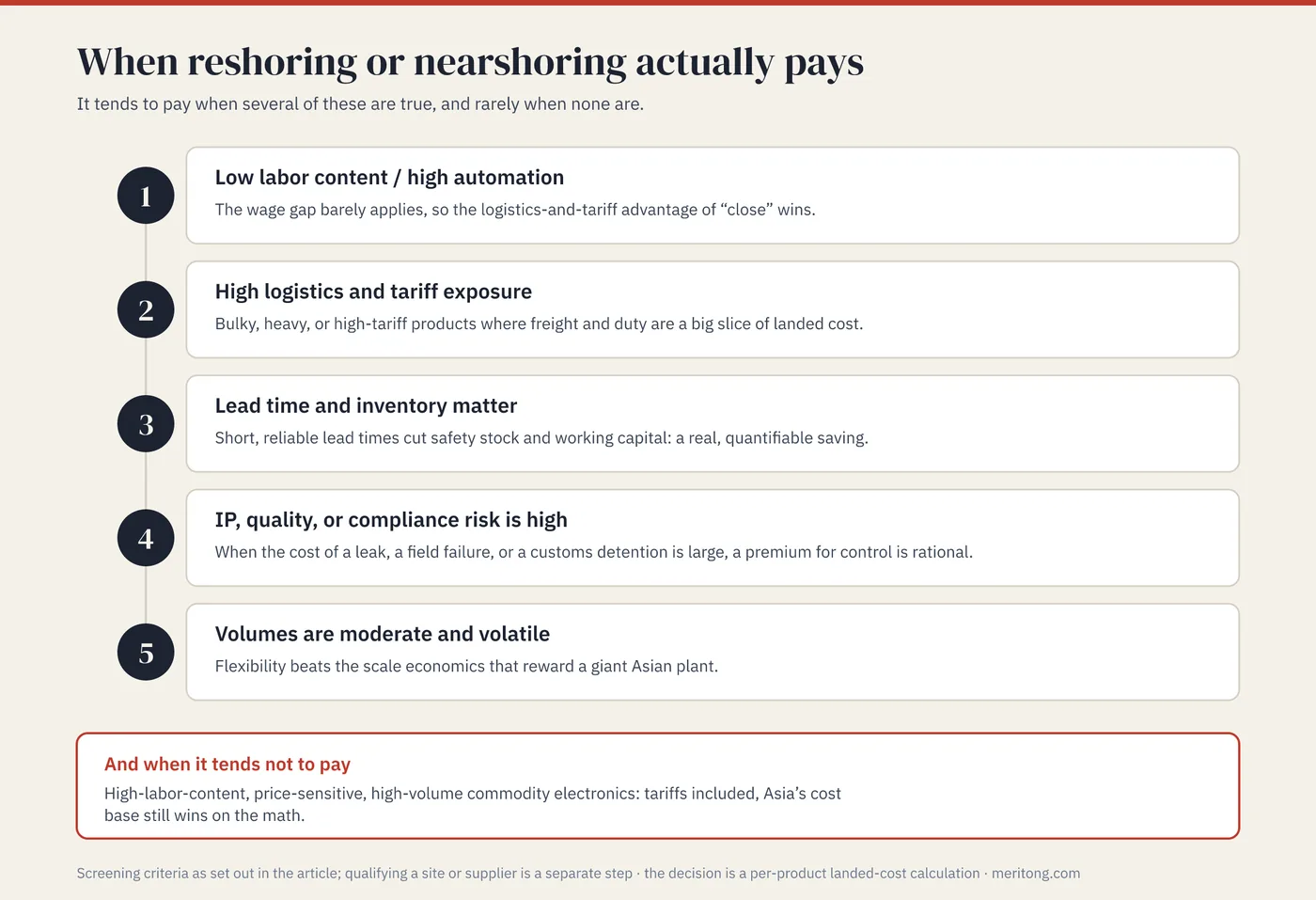
Reshoring or nearshoring tends to pay when several of these are true, and rarely when none are:
Low labor content / high automation: the wage gap barely applies, so the logistics-and-tariff advantage of "close" wins.
High logistics and tariff exposure: bulky, heavy, or high-tariff products, for which freight and duty are a big slice of landed cost.
Lead time and inventory matter: short, reliable lead times cut safety stock and working capital, which is a real, quantifiable saving that nearshoring can deliver.
IP, quality, or compliance risk is high: when the cost of a leak, a field failure, or a customs detention is large, paying a premium for control is rational.
Volumes are moderate and volatile: flexibility beats the scale economics that reward a giant Asian plant.
It tends not to pay for high-labor-content, price-sensitive, high-volume commodity electronics, where, tariffs included, Asia's cost base still wins on the math.
Reshore, nearshore, or stay: the trade-offs
| Factor | Stay offshore (Asia) | Nearshore (Mexico / E. Europe) | Reshore (home) |
|---|---|---|---|
| Unit labor cost | Lowest | Middle | Highest |
| Freight & lead time | Worst (ocean) | Much better | Best |
| Tariff exposure | Highest, varying by origin | Lower | Lowest (finished product) |
| Working capital (inventory) | Highest | Lower | Lowest |
| IP / quality oversight | Hardest | Easier | Easiest |
| Best when | High labor content, price-driven | Lead time + tariff-sensitive | Low labor content / high automation |
The right answer is often split: keep the labor-intensive, price-driven lines in Asia and nearshore or reshore the tariff-heavy, lead-time-sensitive, or IP-critical ones. It is a per-product decision, made on total landed cost.
To see how the columns can flip, picture two products, both illustrative and neither drawn from a specific case. Product A is a low-value, high-volume product built by labor-intensive hand assembly: the wage gap dominates, freight is a small share, and Asia wins even with tariffs. Reshoring would raise its unit cost by more than tariffs and freight ever cost you. Product B is highly automated, bulky, and tariff-exposed, with volatile demand: labor content is low, so the wage gap barely applies, while freight, duty, and the safety stock needed to cover a six-week ocean lead time are large; nearshoring can win on total landed cost even at a higher wage. A company making both reaches opposite answers, because the decision used total landed cost, which includes freight, duty, and inventory carrying cost. That is the whole method: ask which column your specific product lands in. A ranking of countries by unit cost would give the answer for the average product, and it would have sent Product B to the wrong column.
FAQ
Did the US tariffs of 2025 and early 2026 make reshoring pay?
For the two products Kearney modeled, they mostly did not. Its tariff-inclusive model, run at the tariffs applied when its 2026 report was written, shows a laptop built in the US costing more than one imported from any of the four origins tested, and a smartphone built in the US costing more than one imported from Mexico, India, or Vietnam but slightly less than one imported from China (100 against 104). Tariffs can help the case. In Kearney's model, importing still came out cheaper in seven of the eight import scenarios with them included; the model does not show how far the tariffs moved the result. (US rates change frequently: verify the current ones.)
Isn't nearshoring just cheaper reshoring?
It is a middle option with its own math: labor costs below home-country levels, and far lower freight, lead time, and tariff exposure than shipping from Asia. Eastern Europe and Mexico are the nearshore locations considered here; hourly labor costs in Bulgaria, Romania, and Hungary run at roughly a third to under half of the EU average. It can win on total landed cost even when the unit price is higher.
How do I actually decide?
Build a total landed-cost comparison for each product, because the same country can be the right answer for one product and the wrong one for another. Include freight, duty, carrying cost, quality, and IP risk as well as the ex-works price. Then apply the "when it pays" criteria. The decision rests on that arithmetic, which a general preference for one location cannot replace.
What does a factory-price comparison leave out?
By the Reshoring Initiative's estimate, a comparison on the ex-works price misses about 25% of offshoring costs and risks against a full TCO, and a landed-cost comparison, which adds freight and duty, still misses about 15%. In this article's accounting, the items still missing include inventory carrying cost, quality failures, travel, and IP risk, and that undercount is exactly where nearshoring's lead-time and working-capital advantages hide.
Does automation make reshoring pay?
It can, for products where labor is a large share of cost: automating collapses the wage gap and leaves logistics and tariffs, which favor "close." Two cautions apply. China is automating at scale as well, having installed more than half of the world's new industrial robots in 2025, so do not assume that a Western lead in robot density per employee settles the comparison; and some research questions how many jobs automated reshoring actually creates, which matters if incentives are part of your case. Automation shifts the math on labor content without guaranteeing the answer.
Is nearshoring always cheaper than reshoring?
It is not always cheaper. It can be, on total landed cost, because it keeps most of the lead-time and tariff benefits at a lower wage than home. Even so, it depends on whether a qualified nearshore supplier exists for your parts and process. Where the capability is not there yet, "nearshore" is a multi-quarter qualification project before it is any kind of win, so factor that cost and time into the comparison.
Do IP and quality change the math?
They do, and they are the hardest lines to put in a spreadsheet. Closer, lower-volume suppliers can be easier to audit, to protect IP with, and to get fast quality feedback from. If a design leak, a counterfeit, or a field failure would be expensive for you, that is a real, if soft, number on the reshore/nearshore side of the ledger, and it is exactly what a pure unit-cost comparison leaves out.
Close
Reshoring, nearshoring, and staying put are three columns in a total-landed-cost model, and the right answer usually differs line by line. None of the three is an ideology, since each can be the right column for one product and the wrong one for the next. If you are working out which of your product lines would pay to move and which would not, I can help you build that comparison, looking at the product's design, its firmware, and the sourcing behind it together, particularly where the supply chain runs through China.
Meritong is a China-sourcing and landed-cost strategy practice. I am not a licensed customs broker or attorney. This article cites named, dated third-party data alongside my own analysis; it is general information and not legal, tax, or customs advice. Tariff rates and cost data change frequently. For decisions on your own products, verify current figures and obtain advice from a licensed customs broker or attorney, including a binding ruling where classification or origin is in question.
Typical dependencies by email
Examples from real hardware audits, sent occasionally.
Working through this right now? Free intro call → or write to me →
Is this question on your desk right now?
In the free potential check you tell me the type of components you use. After 30 minutes you know whether an audit is worth it.
Free intro call