Components
Nexperia Second Sourcing: De-Risking Your Discrete-Semiconductor Lines Before the Next Supply Disruption
Nexperia parts that have an industry-standard number can be second-sourced on the same number, while the Nexperia-specific PMEG, PESD and PMV parts need a qualified functional equivalent. With a dated record of the Nexperia case and a four-step triage for your BOM.
Last updated: October 2026. This article describes a supply situation whose status was last verified for this article on 16 October 2026 (details and dates below); confirm the current position before acting. Datasheet revisions named in the text were checked on the same day. This is general supply-chain and engineering guidance and not legal or trade-compliance advice; consult qualified counsel on export-control and sourcing decisions.
The short version
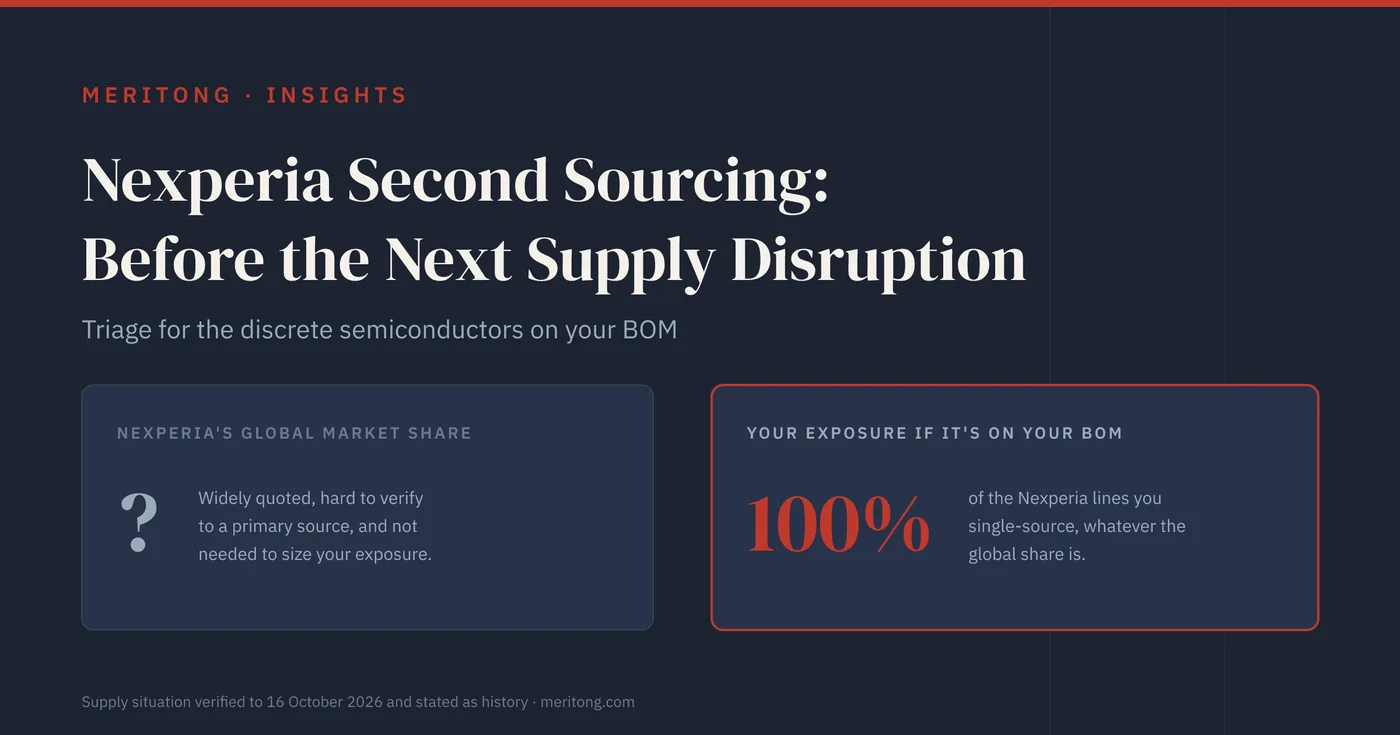
If your bill of materials (BOM) has Nexperia parts on it, the parts that have an industry-standard number can be second-sourced on that same number, while the Nexperia-specific PMEG, PESD and PMV parts have functional equivalents and no guaranteed identically numbered drop-in. Qualifying second vendors on the standard-numbered lines is therefore the inexpensive part of the work, and the Nexperia-specific remainder is the part that needs a plan; both are best done before the next disruption.
The events of late 2025 showed that cheap, standard-looking parts can stop a line when they are single-sourced. Nexperia makes small, unglamorous semiconductors: logic gates, small-signal transistors, switching diodes, electrostatic discharge (ESD) protection, MOSFETs. They are cheap and reliable, and precisely because they feel interchangeable, it is easy never to ask whether they are interchangeable.
The 74-series logic and the transistors and diodes numbered under the JEDEC Solid State Technology Association (JEDEC) and Pro-Electron schemes have same-number equivalents, for example from Texas Instruments (TI) and Diodes Incorporated for 74-series logic, onsemi for the BC847B, Diodes Incorporated for the BAV99, and Vishay and Diodes Incorporated for the 1N4148W. The PMEG, PESD and PMV lines have no guaranteed same-number equivalent, and they are where the engineering work is.
Two principles govern the triage. The first is that exposure is a property of your own BOM: whatever Nexperia's share of any market may be, the lines you buy from a single vendor are the lines a disruption at that vendor can stop once your stock runs out. The second is that substitutability follows the part number: a number that an industry standard or a long-standing industry convention defines is built by many makers, while a number that one manufacturer defines has functional equivalents and no guaranteed identically numbered drop-in.
| Line type | Examples | What second-sourcing takes | Check before you approve the alternate |
|---|---|---|---|
| Standard-numbered logic | 74LVC1G08, 74HC595 | Qualifying a second vendor on the number you already use | Datasheet limits, package code, the pin table, temperature grade, Automotive Electronics Council (AEC) Q100 qualification for automotive designs |
| Standard-numbered transistors and diodes | BC847B, BAV99 | Qualifying a second vendor on the number you already use | Datasheet limits, package code, gain group (A, B or C on a BC847), lifecycle status, AEC-Q101 qualification for automotive designs |
| Nexperia-specific numbers | PMEG, PESD and PMV parts | Finding a functional equivalent, comparing parameters, a validation build, and a board spin if the footprint or pinout differs | The parameters that govern the function, then a build with the exact orderable part |
What actually happened (dated, and deliberately bounded)
What follows is a brief, factual timeline, stated as history and limited to dated public records. The situation has moved repeatedly since September 2025, and the last status verified for this article is from 16 October 2026.
On 30 September 2025, the Dutch Minister of Economic Affairs issued an order concerning Nexperia under the Goods Availability Act (Wet beschikbaarheid goederen). Nexperia is headquartered in Nijmegen in the Netherlands and is owned by China's Wingtech. According to the government's statement of 12 October 2025, the order allowed the minister to block or reverse company decisions that are (potentially) harmful to the company's interests, to its future as a Dutch and European enterprise or to the preservation of the value chain, while the company's regular production could continue. On 4 October 2025, according to Nexperia's release of 14 October 2025, China's Ministry of Commerce (MOFCOM) issued an export-control notice prohibiting Nexperia China and its subcontractors from exporting specific finished components and sub-assemblies manufactured in China. The Dutch government's letter to parliament of 19 November 2025 describes deliveries by Nexperia's Chinese entities to customers as requiring an export license. In October 2025, the Enterprise Chamber of the Amsterdam Court of Appeal granted interim measures, among them the suspension of the chief executive as a director and the temporary placement of all shares but one under the management of a court-appointed administrator, with ownership of the shares unchanged. On 1 November 2025, according to a MOFCOM spokesperson statement of 4 November 2025, China announced that it would grant exemptions for eligible exports, and on 19 November 2025 the Dutch minister suspended the order. A MOFCOM spokesperson statement of 22 December 2025 describes the exemptions as covering compliant chip exports for civilian use.
Two later records bear on supply. On 11 February 2026, the Enterprise Chamber ordered an investigation into Nexperia's policy and conduct of affairs and kept its interim measures in place. Its press release records a split, after the October 2025 measures, between the group's Chinese entities and its European and South-East Asian entities, as well as serious disruption to Nexperia's production chain and a serious risk to deliveries to customers. On 28 August 2026, Nexperia reported that it had deconsolidated Nexperia (China) Ltd. and other China entities with effect from 1 October 2025. The sources checked for this article record no settlement between the parties as of 16 October 2026.
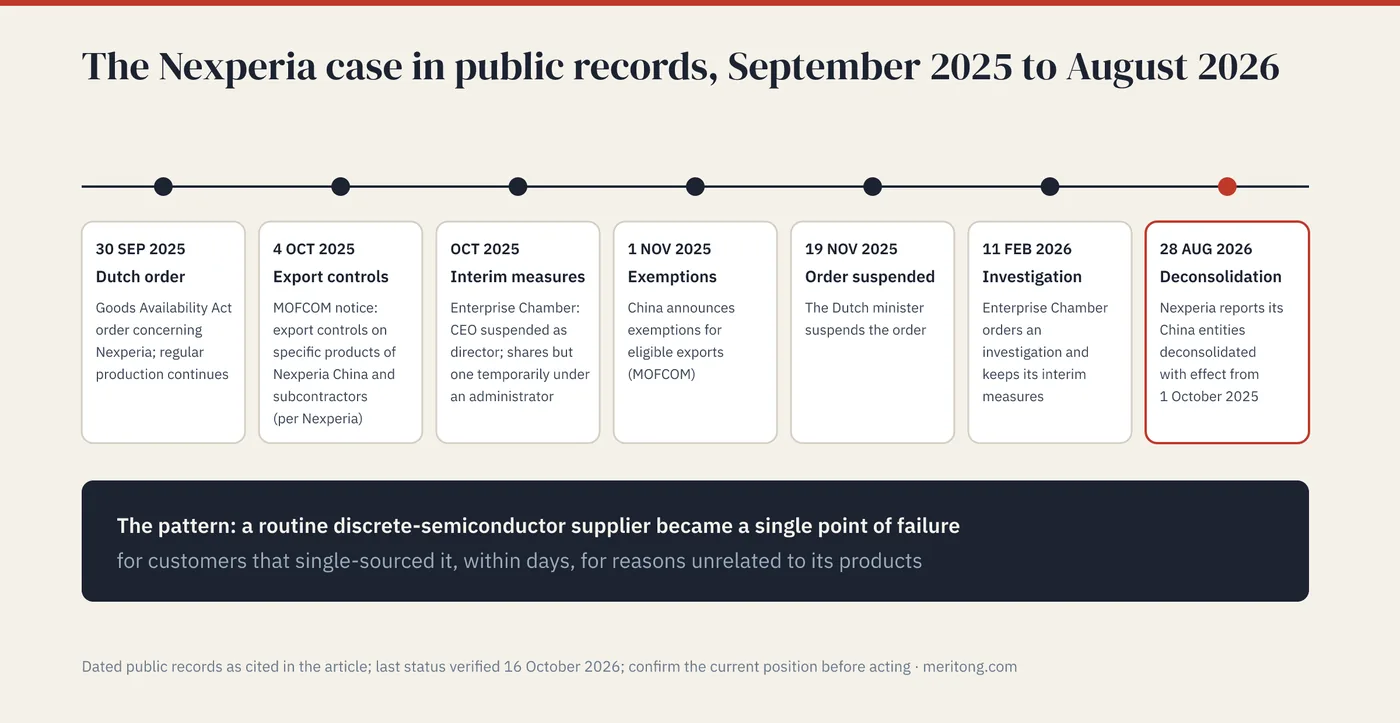
Everything beyond those records, including how supply and lead times have moved for particular part numbers and what the final corporate outcome will be, is outside what can responsibly be asserted here. The timeline is here to establish a pattern, and it predicts nothing. A routine discrete-semiconductor supplier turned out, within days and for reasons unrelated to its products, to be a single point of failure for customers that had single-sourced its parts. Treat the specifics as an example of the risk class, and confirm the current position yourself before you make a sourcing decision on it.
(A note on figures often quoted in coverage of this episode, Nexperia's share of various markets or the percentage of European or automotive designs that depend on it: those numbers circulate widely and are hard to verify to a primary source, so this article deliberately does not repeat them. The argument does not need them. If Nexperia is on your BOM, your exposure is 100% of the lines you single-source, whatever the global share is.)
What Nexperia actually makes, and why it matters for sourcing
You cannot build a second-source plan without knowing what you are second-sourcing. Nexperia's portfolio, taken from its own product pages (checked 16 October 2026), falls into a few buckets, and they do not all have the same substitutability:
- Logic: the 74-series families (74HC, 74HCT, 74LVC, 74AUP and relatives): gates, buffers, flip-flops, shift registers.
- Small-signal and switching diodes: general-purpose switching diodes, Schottkys, Zeners.
- Bipolar transistors: the general-purpose small-signal workhorses.
- MOSFETs: small-signal and power.
- ESD protection, transient voltage suppressor (TVS) and filtering devices: the PESD and related protection families.
- Analog and interface integrated circuits (ICs), which Nexperia's product pages list together with the logic families under "Analog & Logic ICs".
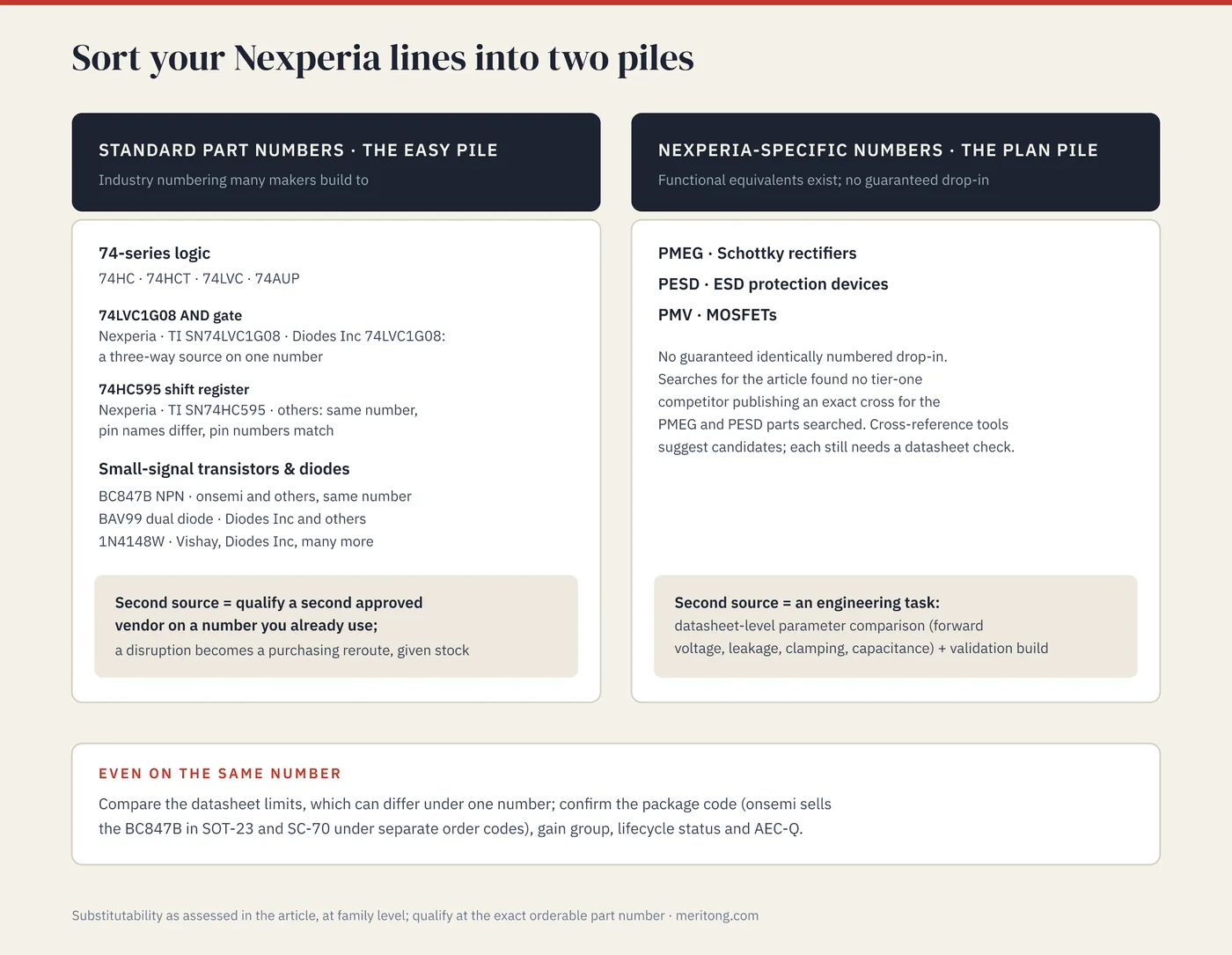
The distinction that decides sourcing difficulty is between industry-standard-numbered parts and manufacturer-specific parts. A 74LVC1G08 or a BC847B is a standard: the number denotes a function defined across the industry, and many makers build to it. A PMEG-series Schottky or a PESD-series protector is a Nexperia part number, and while functional equivalents exist, there is no guaranteed identically numbered drop-in from another vendor. The distinction matters because it decides who defines the part. Where an industry standard or convention defines it, many manufacturers build to that definition; where the manufacturer defines it, a second maker may match the function without any guarantee of matching the number. Your second-source difficulty tracks that distinction closely.
The lines that are easy: standard part numbers
For the standard-numbered lines of a Nexperia BOM, second-sourcing is straightforward, because the parts have industry-standard numbers that multiple vendors build to.
74-series logic: this is a straightforward line. The 74-series numbers are a decades-old, multi-sourced industry convention: the number denotes the same logic function from maker to maker, while the package fixes the pin assignment and each maker sets its own datasheet limits. A 74LVC1G08 single AND gate is made, to the same function and the same part number, by Nexperia, by TI (SN74LVC1G08) and by Diodes Incorporated (74LVC1G08), a three-way source on one number (datasheets: Nexperia 74LVC1G08 Rev. 16.1, 3 September 2024; TI SCES217AA, revised August 2026; Diodes Incorporated DS32199 Rev. 10-2, April 2016). A 74HC595 shift register is likewise available from Nexperia, from TI (SN74HC595) and from others (Nexperia 74HC_HCT595 Rev. 12, 20 March 2024; TI SCLS041J, revised October 2021). TI names the pins SER, SRCLK and RCLK where Nexperia uses DS, SHCP and STCP, at the same pin numbers, so the pin table deserves a glance during qualification. For standard logic, therefore, second-sourcing is mostly a matter of qualifying a second approved vendor on a part number you already use, since the number fixes the function, and the package code and the pin table fix the pinout, leaving you to compare the limits.
Small-signal transistors and diodes: the same logic applies to the general-purpose transistors and diodes. A BC847B NPN transistor is a Pro-Electron-standard part that onsemi and others build to the same number; a BAV99 dual switching diode is second-sourced by Diodes Incorporated and others on the same number (Nexperia BAV99 Rev. 9, 1 July 2022; Diodes Incorporated DS12007 Rev. 29-2, September 2025); a 1N4148W switching diode is an industry standard that Vishay, Diodes Incorporated and many more build to (Vishay document 86356 Rev. 1.0, 16 November 2023; Diodes Incorporated DS30086 Rev. 31-2, September 2024).
One caveat applies even here, and it is the reason you qualify rather than merely assume: package and grade can differ across an identical function number. Nexperia lists its BC847B as a SOT23 part in production (product page, checked 16 October 2026), while onsemi sells the BC847B in SOT-23 as BC847BLT1G (datasheet BC846ALT1/D, Rev. 21, September 2026) and in SC-70 as BC847BWT1G (BC846AWT1/D, Rev. 14, September 2026), so one number spans two footprints. "Same number, different vendor" therefore secures the function, and you still compare the datasheet limits, because ratings can differ under one number: at a forward current of 10 mA, Vishay specifies the 1N4148W's forward voltage at 1 V maximum and Diodes Incorporated at 0.855 V maximum. You also confirm the package code, the gain group (the A, B or C suffix on a BC847) and the automotive qualification to the Automotive Electronics Council's AEC-Q standards if it is an automotive design. Lifecycle status belongs in the same check: Nexperia's product page lists its glass-packaged 1N4148 (SOD27) as end of life and states that the manufacturing and selling of the 1N4148 glass-diode family has been taken over completely by TAK CHEONG under license from Nexperia. The work is small, and it is not zero.
The lines that need a plan: manufacturer-specific parts
Not everything is a standard number, and this is where the sort gets harder. Nexperia's PMEG Schottky rectifiers, PESD ESD-protection devices and PMV MOSFETs are Nexperia-specific part numbers (representative datasheets: PMEG2010EA Rev. 3, 5 February 2024; PESD5V0S1BA Rev. 6, 26 April 2024; PMV50XNEA Rev. 1, 26 January 2021). Functional equivalents exist, since other vendors make low-VF Schottkys, ESD protectors and small MOSFETs with comparable specifications, but there is no guaranteed identically numbered drop-in, and the searches for this article (most recently on 16 October 2026) found no tier-one competitor publishing an exact cross for PMEG2010EA or PESD5V0S1BA (searched 16 October 2026) or for PMEG6010 (searched July 2026). Vendor cross-reference tools suggest candidates without certifying equivalence; Diodes Incorporated's tool, for one, states that it does not guarantee the completeness or correctness of its suggestions and tells users to confirm drop-in status against the datasheet.
For these lines, "second source" names an engineering task. You find a functional equivalent, compare the parameters that matter (for a Schottky, the forward voltage VF, the forward current IF, the reverse leakage and the capacitance; for an ESD part, the stand-off voltage, the clamping voltage and the junction capacitance, which is the same discipline as selecting the part the first time) and qualify it as an alternate. That is doable, though it takes a datasheet comparison and a validation build, plus a board spin if the footprint or pinout differs, which is exactly why you want it done before the part is on allocation. Done afterwards, the same comparison and the same build happen in the middle of the disruption instead of ahead of it.
The de-risking playbook
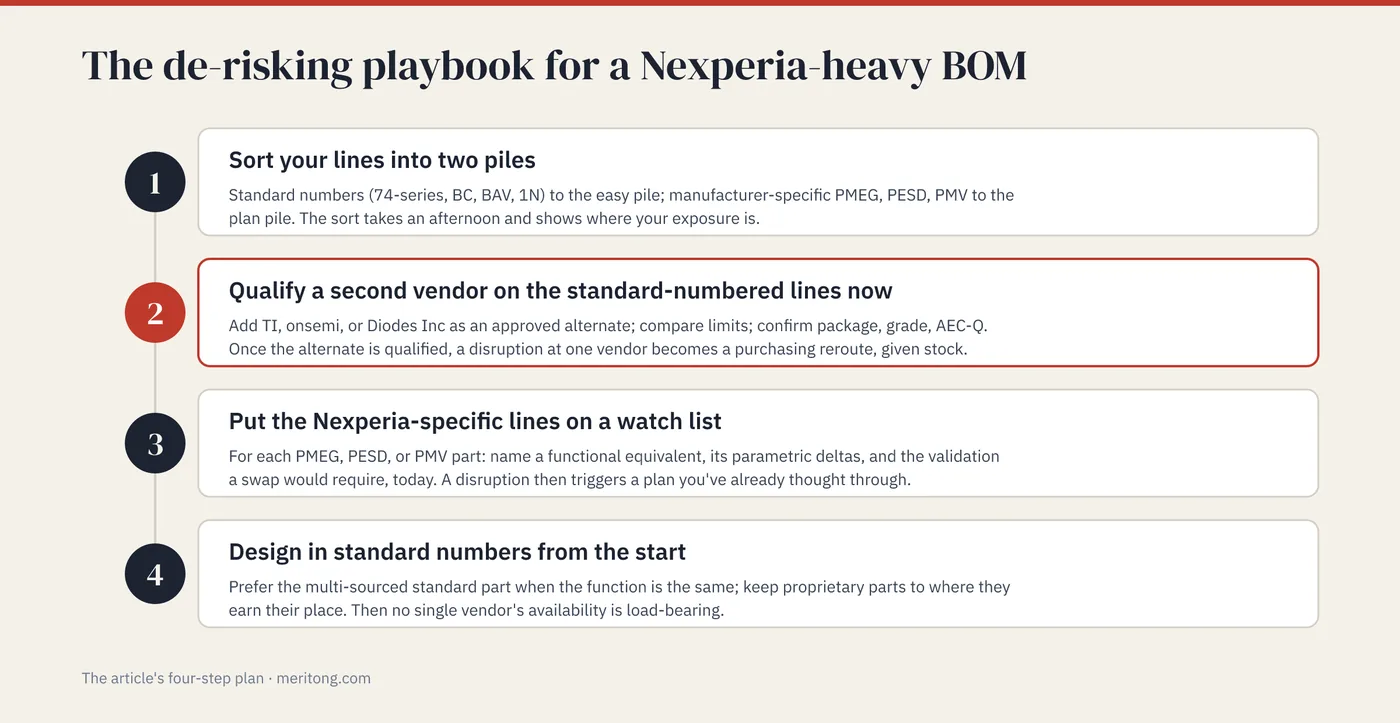
Putting it together, here is a practical, do-it-now plan for any Nexperia-heavy BOM.
Sort your Nexperia lines into two piles: standard-numbered parts (74-series logic, BC-, BAV- and 1N-numbered transistors and diodes) go in the easy pile; manufacturer-specific parts (PMEG, PESD, PMV and the like) go in the plan-required pile. This sort takes an afternoon and tells you where your exposure is.
Qualify a second vendor on the standard-numbered lines now: these are cheap wins. Add TI, onsemi or Diodes Incorporated as an approved alternate on the logic and small-signal parts, comparing datasheet limits and confirming package, grade and, where needed, automotive qualification. Once a second source is qualified, a disruption at any one vendor becomes a purchasing reroute rather than a fresh qualification under pressure, provided the alternate vendor has stock or capacity.
Put the manufacturer-specific lines on a watch list with named alternates: for each PMEG, PESD or PMV part, identify a functional equivalent and its parametric deltas today, and note what validation a swap would require. Qualification can wait; knowing now what you would do means that a disruption triggers a plan you have already thought through.
Dual-source at the part-number level where you can: one durable protection is designing standard-numbered parts in from the start, so that no single vendor's availability is load-bearing. This is the lock-in-avoidance discipline in general: prefer the multi-sourced standard part over the single-sourced proprietary one when the function is the same, and keep the proprietary ones to where they earn their place.
The through-line is that the standard-numbered share of the risk is cheap to neutralize and the rest is manageable, provided the thinking has been done in advance. Second-sourcing has costs of its own: qualification effort for every alternate and, on the manufacturer-specific lines, a validation build and a board spin where the footprint or pinout differs. How far to go depends on how many such lines the product contains and how long it can run on stock, and the sort is what puts a number on the first of those. A line stops when stock runs out on a "commodity" part that nobody had checked was single-sourced.
FAQ
Is there a drop-in replacement for my Nexperia parts?
For the standard-numbered ones (74-series logic, BC847-class transistors, BAV99- and 1N4148-class diodes) there is: other makers build to the same numbers (for example TI and Diodes Incorporated for 74-series logic, onsemi for the BC847B, Diodes Incorporated for the BAV99); compare datasheet limits and confirm package, grade and any automotive qualification. For the Nexperia-specific parts (PMEG, PESD, PMV) there is no guaranteed identically numbered drop-in, and what you need instead is a functional-equivalent qualification.
How exposed am I really?
Your exposure is the set of Nexperia lines you single-source: if a part is only ever bought from one vendor, a disruption at that vendor can stop your line once stock runs out, whatever that vendor's overall size or market share. Count your single-sourced Nexperia lines, and that number is the core of your exposure.
Should I panic-buy Nexperia stock?
This article cannot and will not give you a trade call, and the last status it verifies is from 16 October 2026, so the current situation may be different. The durable answer is to qualify second sources, so that you depend on no single vendor's availability, and inventory hoarding does not provide that. Buffer stock buys time; a qualified alternate removes the dependency.
Which lines should I second-source first?
The standard-numbered ones, because they are the cheapest to qualify: logic and small-signal transistors and diodes. Then work the manufacturer-specific parts (PMEG, PESD, PMV) as a watch list with named alternates. The easy wins come first and the engineering tasks second.
Do I have to worry about the export-control side myself?
The trade-compliance dimension of a situation like this is real, and it is specialist territory. This is general guidance and not legal or trade advice. If your sourcing decisions touch export controls, get qualified counsel. What you can do on the engineering side is reduce how far a disruption at any single supplier can stop your production, which is what the second-sourcing playbook is for.
Is a vendor cross-reference tool enough to pick an alternate?
For standard numbers, it confirms what you already know: the same number, multiple makers. For proprietary parts, treat a cross-reference tool as a starting shortlist; it certifies nothing, and at least one vendor's tool states in terms that it does not guarantee its suggestions. A proprietary-part swap still needs a datasheet-level parameter comparison and validation.
Close
The late-2025 Nexperia episode illustrated a general risk. The parts that can blindside a supply chain include cheap, commoditized ones that were never second-sourced, and the event that disrupted them in this case had nothing to do with the silicon. The standard-numbered share of that risk is inexpensive to remove: the 74-series logic and the standard-numbered transistors and diodes are multi-sourced, and qualifying a second vendor on them is mostly purchasing and documentation work. The remainder, the Nexperia-specific PMEG, PESD and PMV lines, needs a real plan, and a plan of that kind is built before it is needed. Sorting a Nexperia BOM into "easy" and "needs a plan," and acting on the easy pile now, is the kind of unglamorous supply-resilience work that turns a supply shock of that kind into a purchasing task. How far to take the plan for the remainder depends on how many such lines the product contains and how long it can run on stock.
If your own sort turns up single-sourced lines that have no standard number, that is the kind of hardware-component and product-architecture problem I help with, particularly where China sourcing is involved, looking at the hardware, firmware and sourcing together.
Meritong is a China-sourcing and supply-chain strategy practice. I am not a licensed customs broker or attorney. This article's supply-situation timeline is verified through 16 October 2026 and is stated as history; confirm the current status before acting. Part equivalences are quoted from vendor datasheets at the standard-part-number level and still require your own package/grade/qualification check. This is general supply-chain and engineering guidance and not legal or trade-compliance advice; consult qualified counsel on export-control and sourcing matters.
Typical dependencies by email
Examples from real hardware audits, sent occasionally.
Working through this right now? Free intro call → or write to me →
Is this question on your desk right now?
In the free potential check you tell me the type of components you use. After 30 minutes you know whether an audit is worth it.
Free intro call