Meritong. EN / DE Free intro call

Industry · Deep tech

The BOM audit for the production ramp

What worked in the prototype but no longer works in series production. The jump from 50 to a few hundred units exposes dependencies nobody had seen before.

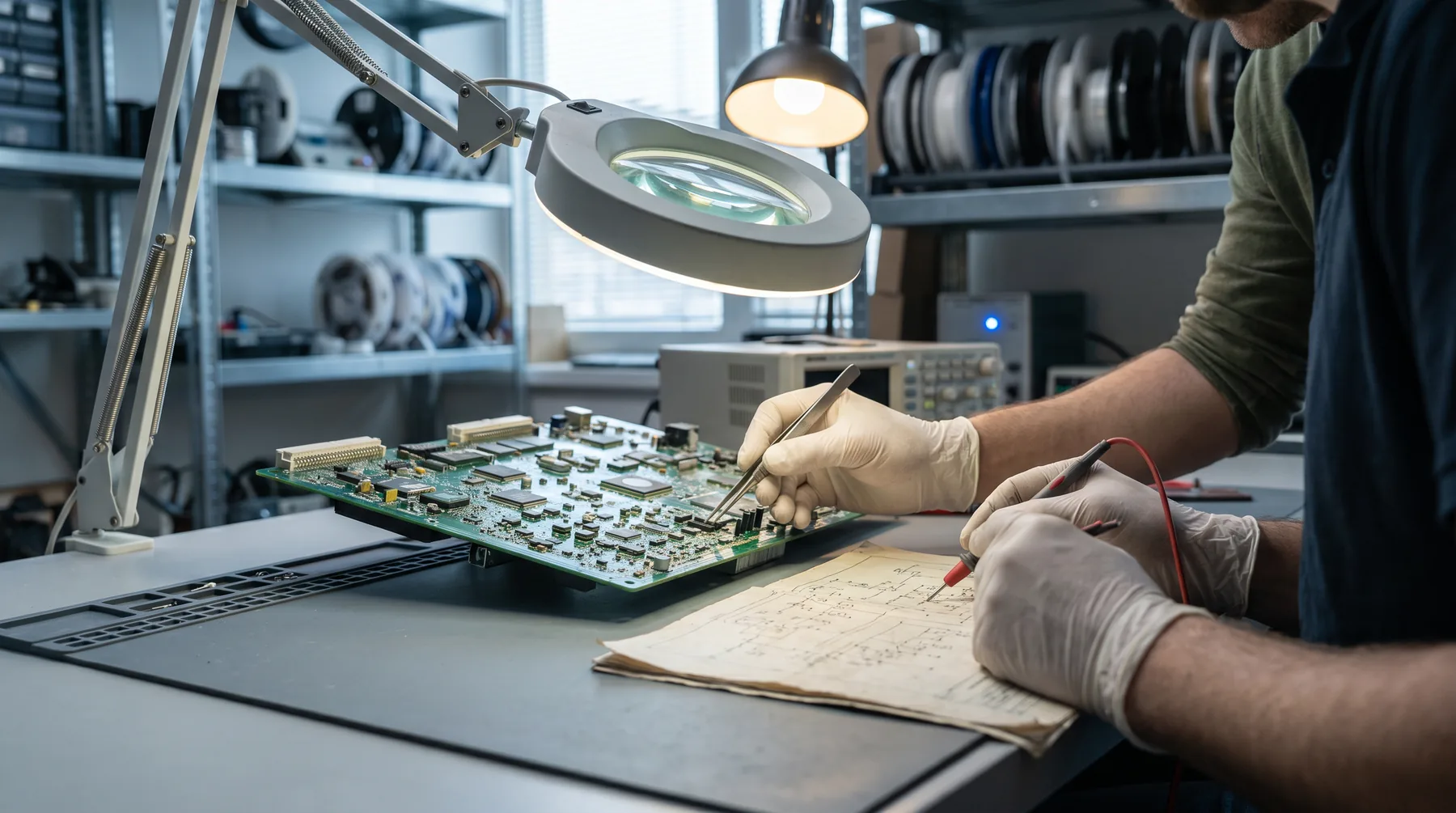
Electronics review at an ESD workstationAI
The step from prototype to series production shows which components are fit for higher volumes.

01 / The starting position

How do I know it is time for an audit?

Three situations in which deep tech companies commission a BOM audit

  1. The prototype components are not fit for series production

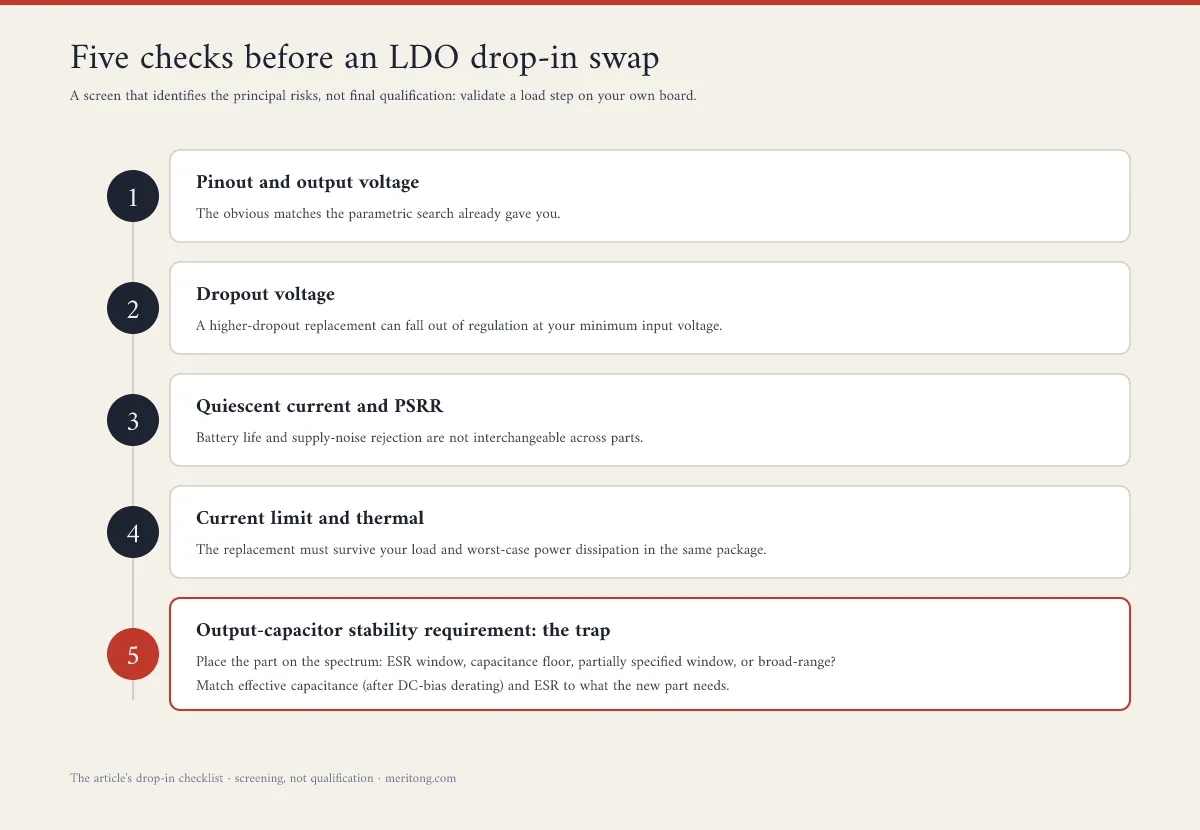
    For the prototype, whatever was available was procured. There is no solid relationship with any of the suppliers, and none of it holds up at a few hundred units.

    Series readiness
  2. The component swap fails on the firmware tie-in

    The driver is written against the manufacturer's SDK. The cheaper replacement does not fail on the component but on the code, and nobody budgeted for adapting it.

    Firmware tie-in
  3. A component has reached EOL or is unavailable

    The EOL notice has arrived, or the lead time stands at 52 weeks and the spot market is asking four times the price. The choice between a last-time buy and a redesign is being made today without a reliable figure.

    Procurement

02 / Differentiation

Why Meritong and not another provider?

Four levels of scrutiny where a production ramp fails

01 Hardware

From prototype to series production. I examine every component for cost, dependencies and AI suitability.

02 Software

Software and firmware are a decisive factor today. That is why I review them from the full assessment upwards, provided your product contains software or firmware.

03 China

I speak fluent Mandarin and read original Chinese documentation. I hold the conversations with your suppliers in Mandarin and, where needed, in English, German or Spanish.

04 AI

Want to run AI on your hardware? I assess on technical grounds whether a component supports the planned AI application.

03 / The solution

What does the audit actually solve in my situation?

How the BOM audit works for deep tech companies

Three approaches, one result: a bill of materials designed for the start of series production, with reliable second sources and quantified switching effort.

Approach 01

Firmware and bill of materials in a single analysis

I read the code base for vendor-specific integrations, proprietary protocols and embedded ML models. The result is a prioritised refactoring map with an hour estimate per replacement.

Approach 02

Series readiness per line item

Every line item is examined for whether it makes the jump into series production. Tolerances, manufacturing decisions and ties to a specific manufacturer are named and quantified.

Approach 03

Alternatives, assessed for AI suitability

Second sources come from direct manufacturer contact in the local language. For components used in AI applications I also assess whether they are sufficient for the planned application.

Example
Extract · sampleBOM audit
Line itemSeverityReplacement cost
MCU · STM32H7xxPeripheral mapping in firmwareHIGH (88)€12–18k
Inference runtime · SDKModel format locked inHIGH (76)€20k–35k
Sensors · single sourceCalibration data held by the manufacturerMEDIUM (57)€4k–7k
Confidential · sample

04 / Client testimonials

Who has already worked with Sebastian Kirsch?

Client testimonials

When critical components could no longer be sourced through the usual channels, Sebastian opened up alternatives for us on the Asian market: fast, structured and on site. He not only found suppliers, he also checked them for integrity and the goods for authenticity. In the end we had a clear and dependable basis for our decision.

Dr. Achim OehlerSenior Director, Dream Chip Technologies GmbHGermany

Sebastian conducted a scalability audit of our systems and supply chain and helped us define a development and procurement roadmap aligned with our financial constraints. He identified a better-fit hardware component and supplier in China, projected to save tens of thousands of euros at scale, and supported the efficient integration into our software stack.

Tobias FinéCEO, Be-In GmbHGermany

Sebastian combines deep technical understanding with strong system-level thinking across software, hardware, and global supply chains. He consistently demonstrated excellent analytical skills and the ability to communicate complex topics clearly across engineering and executive teams.

Steve CampbellCTO (retired), Western DigitalUSA

Sebastian led the implementation of a cloud-based platform with integrated edge devices for our municipality. He coordinated across software, hardware, and stakeholder groups and successfully delivered a system that operates reliably at scale. His ability to translate complex technical requirements into practical solutions was particularly valuable.

Alexander ScheutzMayor, European Municipality (Digital Infrastructure Project)Austria

05 / Packages and prices

What does a BOM audit cost?

Packages and prices for your BOM audit

Stage 0 · entryfree of charge

30-minute free intro call with potential check

You name the type of component, for example camera sensor, optics or focus drive, and you get an order of magnitude back: how many alternative suppliers are worth considering and what saving is realistically on the table. An NDA can be signed on request. The potential check can, however, also be carried out without any confidential information.

Free intro call
Package 1

Cost check

€2,000–5,000
Fixed price, agreed up front in the engagement brief

For small bills of materials, limited budgets, or a single component where time is pressing.

  • The critical line items, not the whole list
  • Assessment across four dimensions, with a ranking
  • Quantified saving potential per line item examined
  • Short report stating whether the full assessment is worthwhile
  • Without firmware deep dive and alignment session with management, purchasing and engineering
Best choice Package 2

Full assessment

€5,000–8,000
Fixed price, agreed up front in the engagement brief

For any company with its own bill of materials. In one engagement the savings identified came to 3.8 times the fee.

  • The complete bill of materials, every item fitted
  • Severity score, ranking and amount per line item
  • Candidate suppliers and switching effort named
  • Firmware deep dive included (not applicable to pure hardware)
  • Alignment session with management, purchasing and engineering
Package 3

Implementation

from €10,000
Agreed individually

For clients after Package 2 for whom implementation pays off.

  • Substitution roadmap instead of a recommendation
  • Selection and qualification of the alternatives
  • Support through to introduction. The aim is approved second sources, where technically and economically feasible.
  • In-depth firmware review and alignment session with management, purchasing and engineering included
Option · on request
On site in Asia.

Supplier meetings and factory visits in China, Vietnam, Thailand and other countries, when you want to meet a supplier in person or see the factory from the inside.

Option · on request
Supplier negotiation.

I build the relationship with the manufacturer directly and negotiate in the local language on prices, delivery and payment terms, quality requirements and everything else that secures your procurement.

Afterwards
Ongoing support.

Quarterly reassessment, monitoring of end-of-life notices, ongoing contact with your suppliers, support with integration and advice on a resilient software and firmware architecture. Terms are discussed at the report handover.

Additional service

Technical communication with manufacturers

You have found an alternative, for example from a Chinese manufacturer, but cannot reach its engineers because the documentation is only available in Chinese or your follow-up questions fail on language? I handle the technical clarification directly with the manufacturer, in their language, and in Mandarin with Chinese manufacturers.

Send an enquiry →

06 / Questions

What gets asked before an engagement?

Common questions from this industry

Then step 2 is dropped and the audit goes straight to the hardware architecture review. Your audit uses only the steps that apply to your product.

That is precisely when it is cheapest. A dependency made visible before the start of series production usually costs only a fraction of what it costs afterwards.

Yes. Machine learning was my degree specialism. I judge whether an SoC is sufficient for the planned AI application, for example computer vision directly on the device, before purchasing places the order.

Not by counting the suppliers on record, but by asking how many engineering hours it would take to swap a component out. If the answer is more than a few days, that item is single source in practice, even with a second supplier in the system — the dependency sits in the firmware, not in purchasing. Only the code answers it: in the scanner case the driver was a single file of 1,266 lines written tightly around one vendor protocol, and only reading it revealed that around 80 per cent could be deleted rather than ported. So map every place in the code where vendor-specific APIs, types or constants appear — the reasoning is in How System Architecture Shapes Supplier Flexibility.

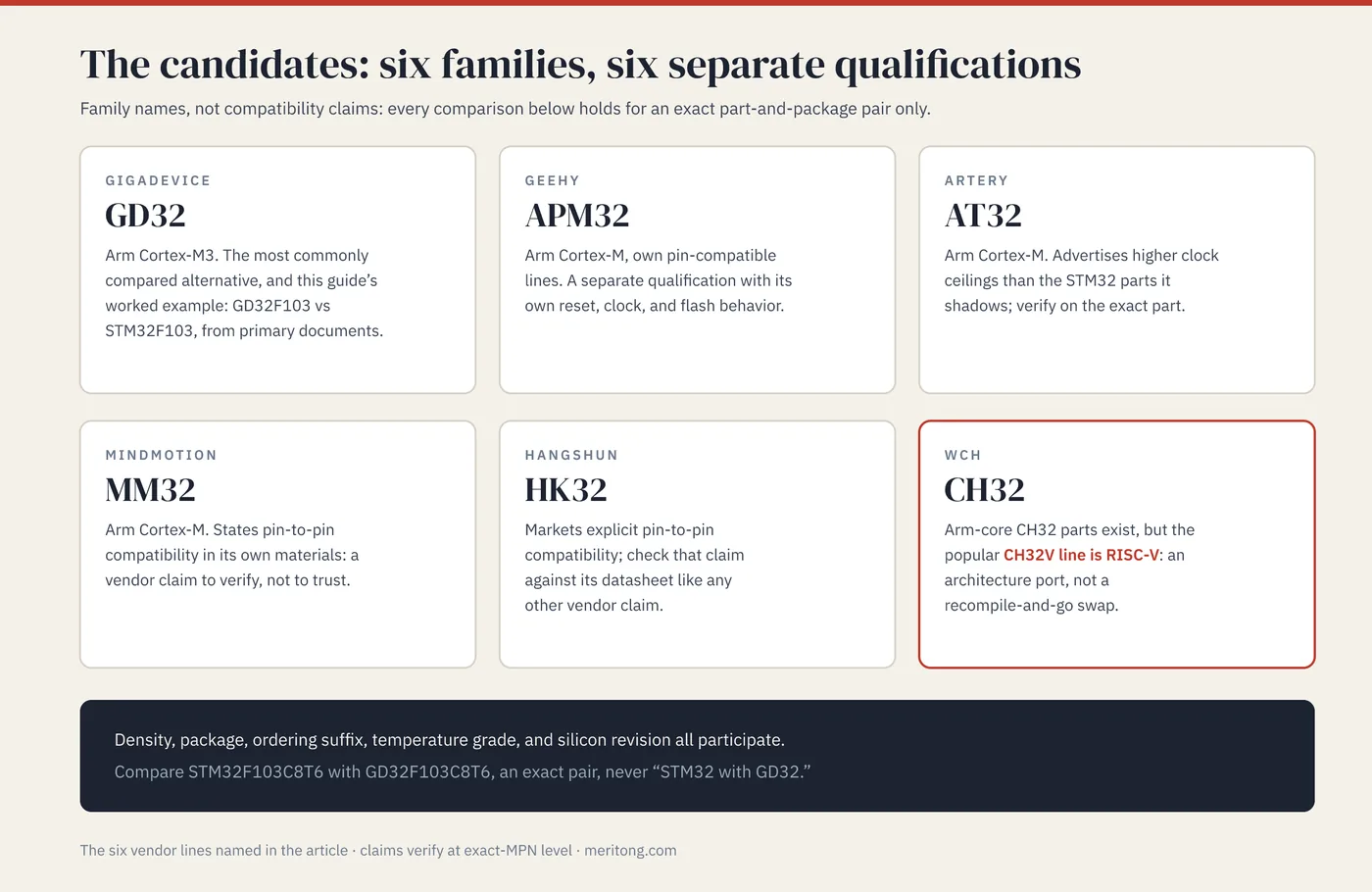
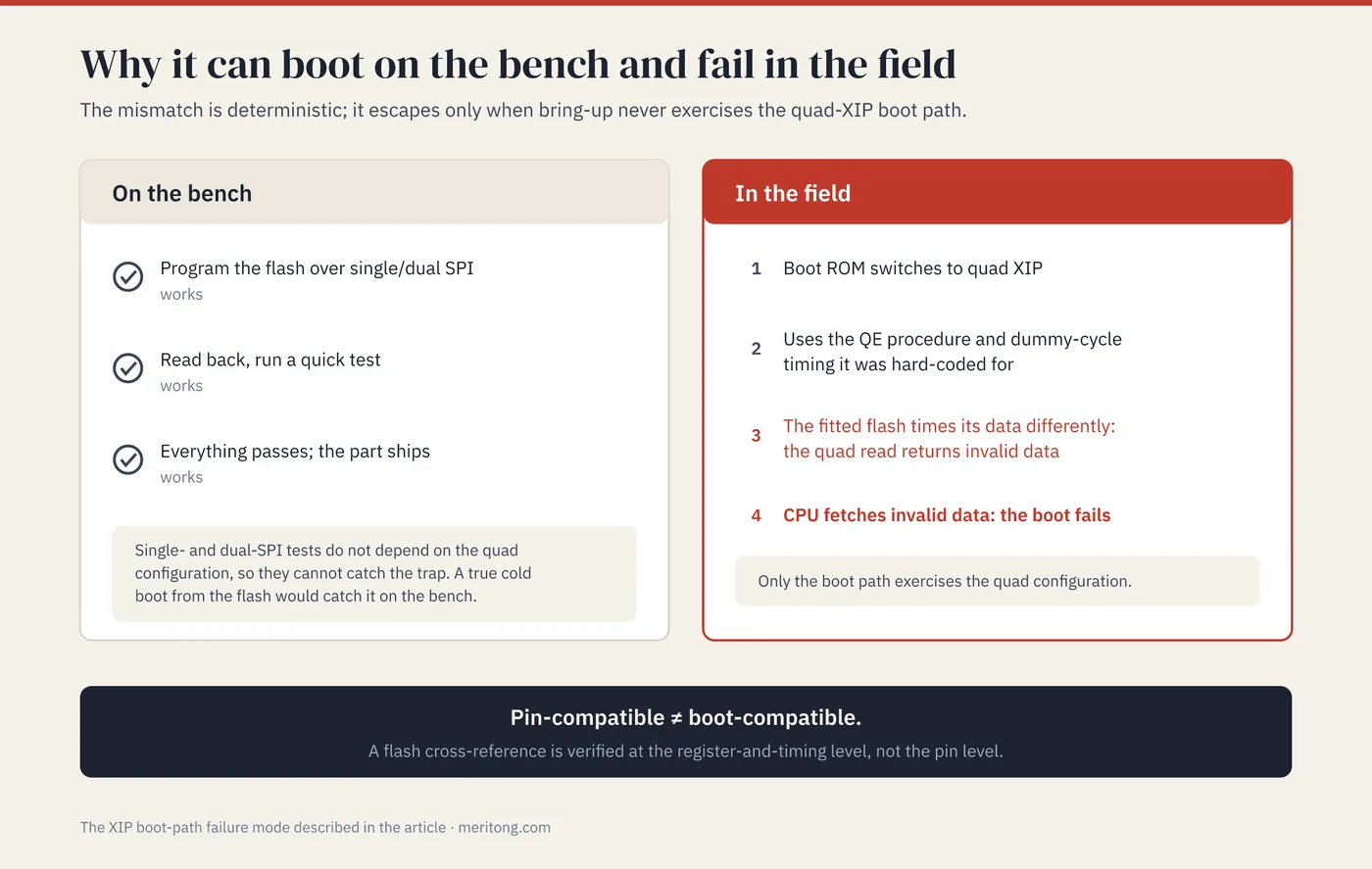
Finding candidates is the easy part: manufacturer cross-reference tools and lifecycle databases will suggest them. The work is in the verification, because “pin-compatible” is a statement about the pinout and about nothing else. On the most compared pair, STM32F103 against GD32F103, the reset threshold, the specified supply range and the flash latency mechanism differ far enough that a “compatible” swap can produce a board that does not start. The verification steps are in Pin-Compatible Isn’t Drop-In, the worked deltas in the Chinese second-source guide for STM32.

A bill of materials is enough to start with, an Excel export will do, it does not have to be a maintained ERP. For the deeper levels the schematic and access to the firmware are added, above all to the driver code that is tied to specific components. Whatever is missing we clarify in the intro call, before the engagement brief is written.

A confidentiality agreement is concluded for every commissioned audit before any documents are handed over. The potential check does not require an NDA, because you only name the type of component, not your bill of materials. An NDA can, however, be signed for it on request.

Through the scope: how many line items are examined and how deeply. That produces a fixed price stated in the engagement brief — no billing by time spent and no supplementary claims. The three packages are further up this page; which one fits your case is something we discuss in the free intro call.

The analysis runs in parallel, it stops nothing. All it does is bring forward decisions that are due anyway: which line item is touched once more before the ramp and which one deliberately is not. Anyone who receives the findings only after the ramp decides the same question under pressure and with parts already ordered.

It becomes an architecture question. Whether a replacement triggers a re-test depends not on the price of the component but on what function it performs in the approved build and what the firmware assumes about it. The audit records this effort per line item, so that the comparison between keeping and switching does not fail on unknown approval costs.

08 / The next step

How do I start?

The first call is free.

Thirty minutes. Your situation, your product, your suppliers. At the end you have the potential check: how many alternative suppliers are worth considering and what saving is realistically on the table.

Sebastian Kirsch, your contact in the intro call
Your contact: Sebastian Kirsch, founder of Meritong