Last updated: September 2026.
The short version
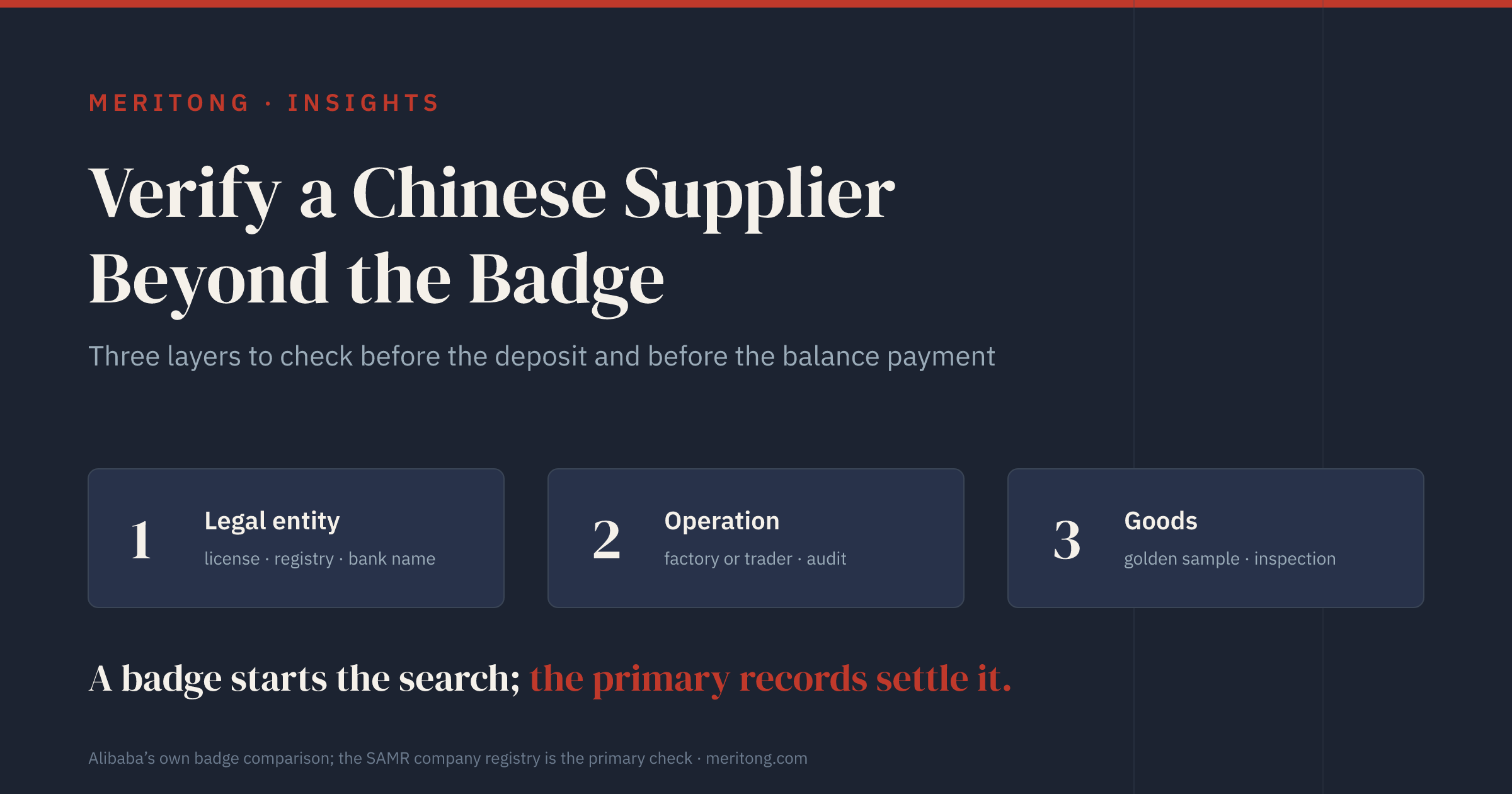
The "Verified Supplier" badge confirms less than its name suggests: on its own published comparison, Alibaba disclaims liability for the accuracy of the third-party assessments behind its badges. The same comparison shows that the Verified Supplier inspection does cover business type (factory, trading company, or both), a question the narrower Gold Supplier tier leaves open. A badge is a filter: it narrows the field of candidates, while the platform that issues it does not guarantee what the badge appears to certify. The verification that protects your order is still yours to do.
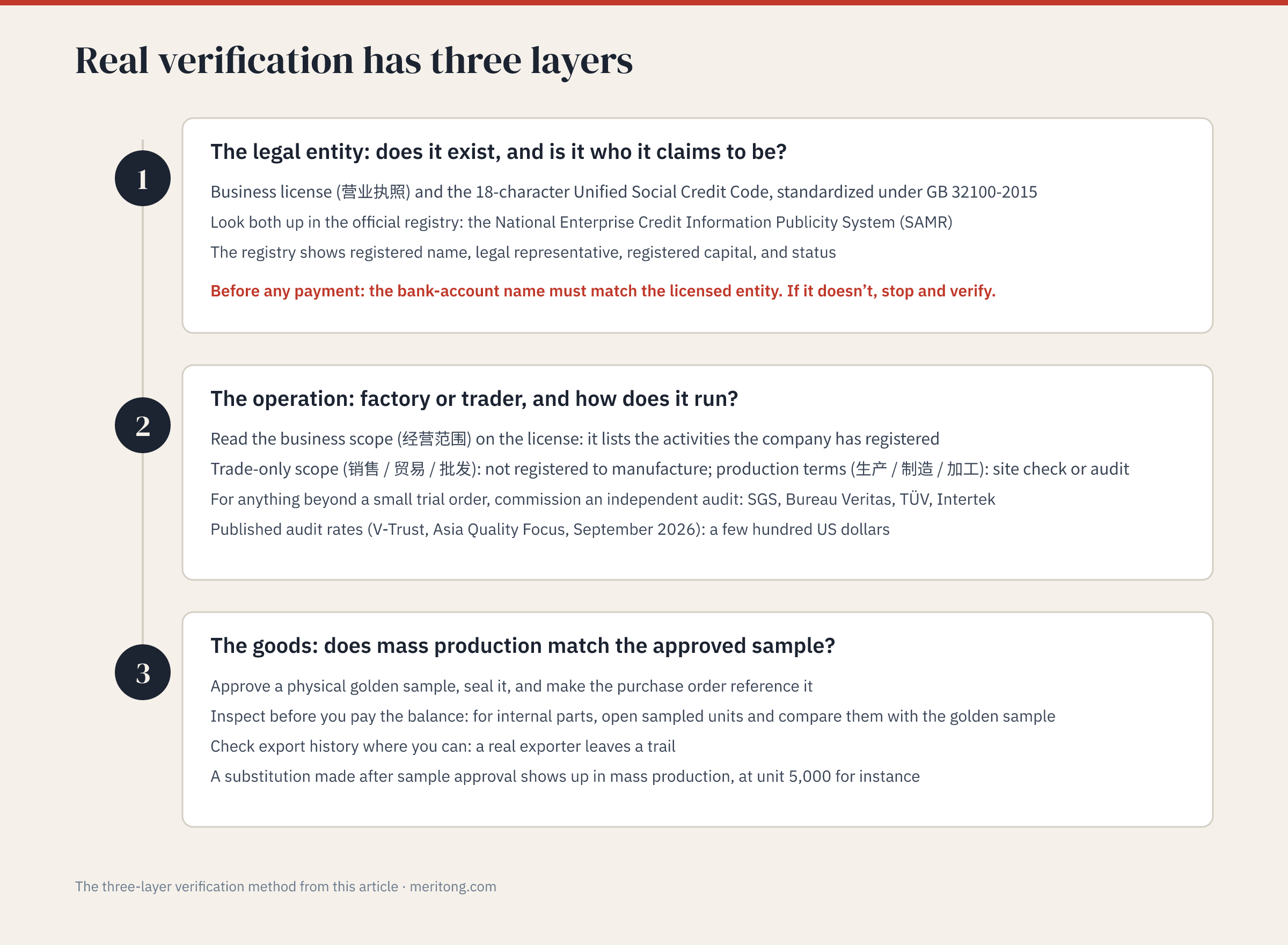
Real verification has three layers, and each has its moment: the legal entity and the operation before you wire a deposit, and the goods at sample approval and again before you pay the balance. The legal entity: does this company exist, and is it who it claims to be? The operation: do they actually make the thing, and how do they run? The goods: does the product match the sample?
Layer 1: Verify the legal entity
Every legitimate company on the Chinese mainland has a business license (营业执照) and an 18-character Unified Social Credit Code, the national company ID standardized under GB 32100-2015 (section 4.1). You can look both up in the official company registry for the Chinese mainland, the National Enterprise Credit Information Publicity System (国家企业信用信息公示系统), which is run under the State Administration for Market Regulation (SAMR), the authority that China's interim regulations on enterprise information disclosure task with building it. The entry shows the registered company name, the legal representative, the registered capital, and the company's status.
Three checks matter here:
Does the entity exist and is it active? Search the exact registered Chinese name rather than the English trading name, or search by the credit code.
Does the name on the bank account match the licensed entity? If a "manufacturer" asks you to pay a differently named company or a personal account, stop and verify before you pay.
What are the registered capital and the company's age? Neither is decisive, but a brand-new company with tiny registered capital taking a large order is worth a second look.
If you cannot read Chinese, this is exactly the layer where a check in the original language pays for itself: the registry and the license are in Chinese, and a machine translation can blur the exact company name that this layer turns on.
Beyond these three, one further entity check is quick and worth making: confirm that the company you are contracting with is the same one that will invoice and ship. Chinese groups can run several affiliated entities (a manufacturing arm, a trading arm, a holding company), and the entity quoting you is not always the one that exports the goods in its own name or owns the factory. What this check settles is identity across the transaction: whether the entity that quotes you, the entity that invoices you, and the entity that ships your goods are one and the same. Pin down the contracting entity up front and you avoid the "that was a different company" conversation when a problem finally needs an owner. If you cannot get a clear answer to "which registered entity am I buying from, and does it match the bank account?", that is itself the answer.
Layer 2: Verify the operation
Factory or trader: read the license's business scope (经营范围), which lists the activities the company has registered. A manufacturer's scope includes production, manufacturing or processing terms (生产 / 制造 / 加工); a trading company's reads sales, trade and wholesale (销售 / 贸易 / 批发). The test works in one direction: a scope limited to trade shows that the entity is not registered to manufacture, whereas a manufacturing term shows only that it is registered to manufacture, and a site check or an audit confirms whether it does. Neither type is automatically bad, since a good trading company can be the right partner, but you should know which you are dealing with, because the answer changes your price, your control over quality, and who holds the tooling.
The consequences are real. Buy direct from the factory and you can get lower prices, direct control over quality and tooling, and a straight line to fix problems; you also take on more of the sourcing, quality-control, and communication burden yourself. Buy from a good trading company and you get a coordinator who speaks your language, consolidates suppliers, and manages the factories, at a markup and with an intermediary layer between you and what is happening on the line. The choice trades price and control against coordination, and either side of it can be sound. The mistake is to make the trade unknowingly, and to discover three orders in that "the factory" was a sales office all along.
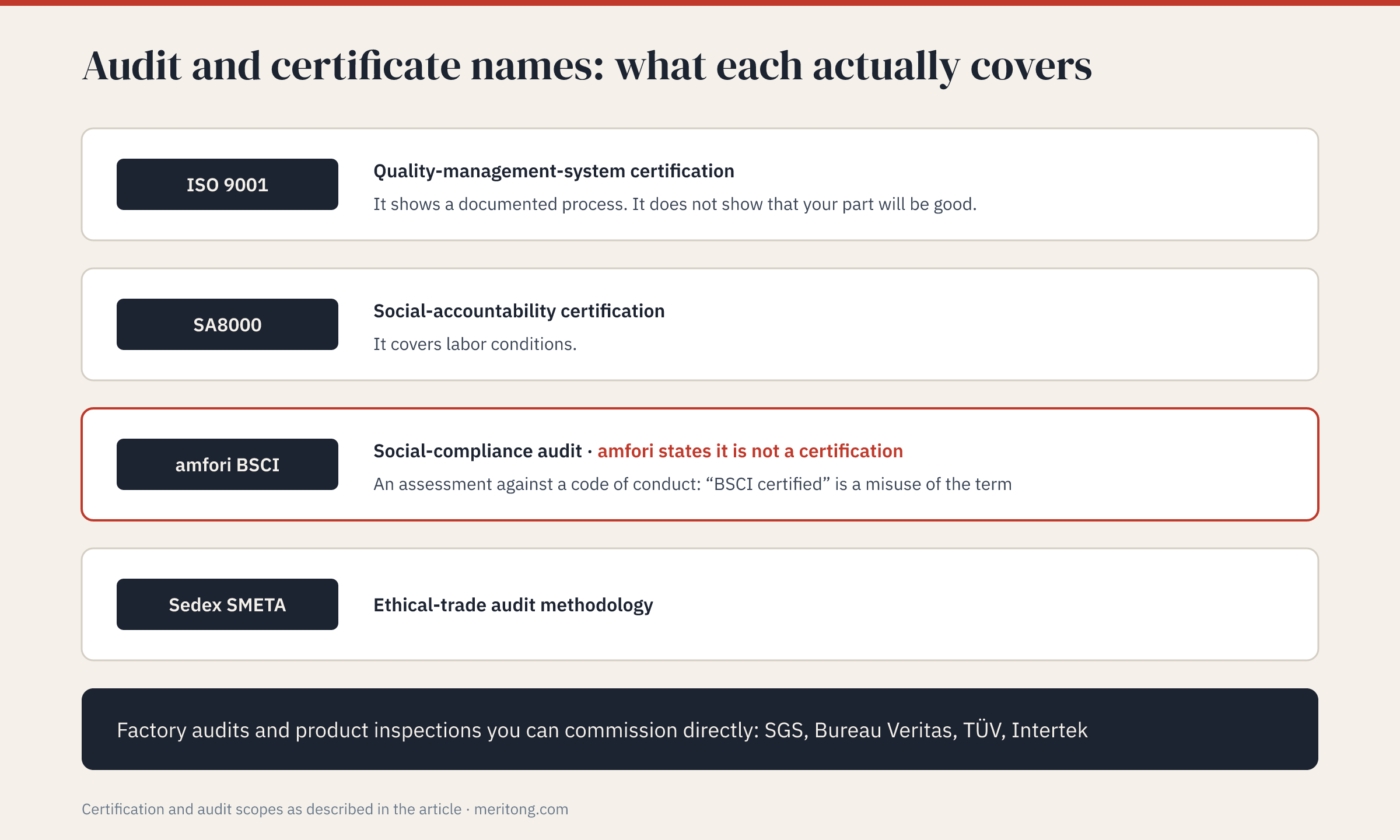
Third-party audits: for anything beyond a small trial order, an independent audit is worth its cost. The names in common use are instruments of different kinds; know what each one covers:
| Name | What it is | What it covers |
|---|---|---|
| ISO 9001 | A certification | The quality-management system. It shows that the factory has a documented process; it does not show that your part will be good. |
| SA8000 | A certification | Social accountability, covering labor conditions. |
| amfori BSCI | A widely used audit against a code of conduct | Social compliance. amfori states that BSCI is not a certification, so "BSCI certified" is a misuse of the term worth noticing. |
| Sedex SMETA | An audit methodology | Ethical trade. |
The big inspection houses (SGS, Bureau Veritas, TÜV, Intertek) perform China factory audits and product inspections you can commission directly. A live-video or onsite audit that puts eyes on the actual production line rather than on a borrowed showroom is money well spent before a first order.
A proper factory audit checks a specific set of things: that the legal entity matches the physical site; that the production equipment for your process actually exists on the floor; how the quality-management system runs in practice, beyond the fact that a certificate exists; real capacity and current utilization; and the workforce and conditions. Two inspection firms that publish their rates price a factory audit at a few hundred US dollars: V-Trust lists US$398 per auditor-day with no travel surcharge in major manufacturing clusters, and Asia Quality Focus lists audits from US$298 all-inclusive (both checked September 2026). A deeper audit takes more auditor-days. Set against the cost of a first production run from a "factory" that turns out to be a trading office with a rented meeting room, that price is trivial.
Layer 3: Verify the goods
Order samples, then seal a golden sample: approve a physical reference unit, and make the purchase order reference it. Your incoming inspection then runs against a standard both sides agreed to instead of against a description.
Inspect before you pay the balance: a pre-shipment inspection (yours or a third party's) against the golden sample can catch substitution between sample and mass production; for internal components, its checklist should include opening sampled units and comparing the critical components with the golden sample, because an external visual and dimensional check cannot see them.
Check export history where you can: a supplier that exports your product category leaves a trail; one that cannot show any is a question mark.
These steps belong to ordinary purchasing discipline, and deadline pressure makes them easy to skip. A substitution made after sample approval shows up in mass production, at unit 5,000 for instance, when a cheaper component or a thinner housing quietly appears. A sealed golden sample plus a pre-shipment inspection that opens sampled units can catch it, and the pair costs a fraction of a container of parts you cannot use.
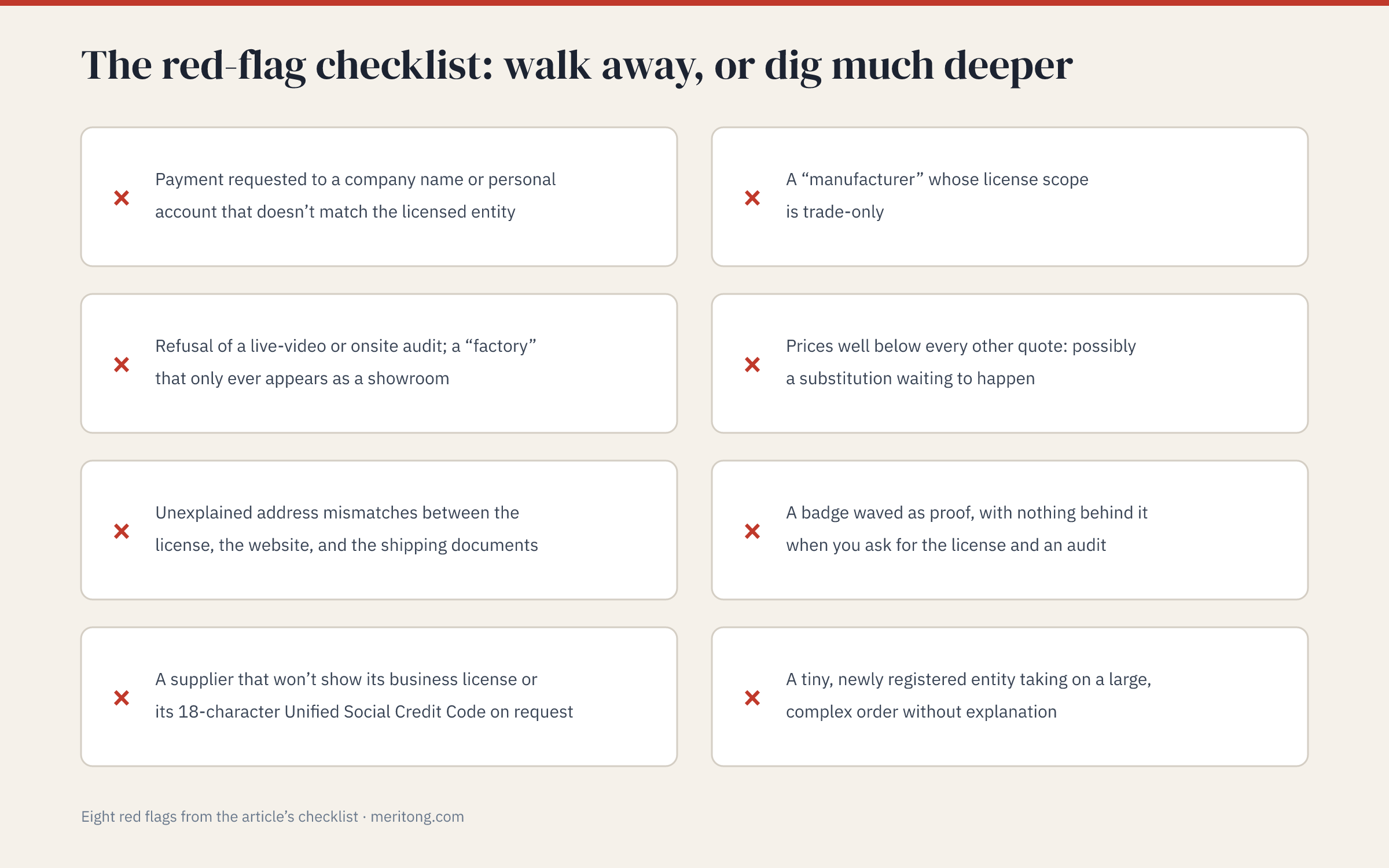
The red-flag checklist
Walk away, or dig much deeper, if you see:
Payment requested to a company name or personal account that doesn't match the licensed entity.
A "manufacturer" whose license scope is trade-only.
Refusal of a live-video or onsite audit, or a "factory" that only ever appears as a showroom.
Prices well below every other quote: possibly a substitution waiting to happen.
Unexplained address mismatches between the license, the website, and the shipping documents.
A badge waved as proof with nothing behind it when you ask for the license and an audit.
A supplier that won't show the business license or its Unified Social Credit Code when you ask.
Registered scope, capital, or age that doesn't fit the order: a tiny, newly registered entity accepting a large, complex job without explanation.
How much verification is enough?
Match the depth to the stakes. For a small trial order of a commodity part, the registry check plus approved samples may be plenty. For a critical part, a large first order, or a long-term relationship, work through all three layers and commission an onsite or live-video audit. The principle is simple: verify in proportion to what a failure would cost you. The arithmetic is lopsided: a proper check costs what an audit costs, while a failure costs a first production run or a container of parts you cannot use. The mismatch to avoid is a registry lookup alone on a €200,000 relationship, or no check at all because a badge and a slick catalog felt like enough. Verification is rarely wasted. Either it confirms a good supplier or it saves you from a bad one, and both outcomes are worth the modest cost.
Where reading the records in Chinese makes the difference
The documentary steps above are easier and more reliable in Chinese. The registry is published in Chinese and searched by the company's legal Chinese name or its credit code, and the license and the registry entry have to agree on that name character for character. Wire instructions for payments in US dollars or euros usually give the account name in Latin script, so ask the supplier for a letter from its bank confirming the company name, the account number, and the credit code, and compare the company name on it with the license character for character. A translated or transliterated name can hide the difference between two similarly named entities, which a comparison in the original characters exposes.
FAQ
Isn't a "Verified Supplier" badge enough?
It is not. Alibaba disclaims liability for the accuracy of the third-party assessments behind the badge, even though, by its own comparison, the Verified Supplier inspection covers whether the company is a factory or a trader, a question the Gold Supplier tier leaves open. Treat a badge as a starting filter, then verify the entity, operation, and goods yourself.
How do I check that a company on the Chinese mainland actually exists?
Look up its registered Chinese name or its 18-character Unified Social Credit Code in the official National Enterprise Credit Information Publicity System (under SAMR). Confirm that the entity is active and that the name on its bank account matches its registered name.
Factory or trading company: how can I tell?
Read the business scope on the license. A scope limited to sales, trade and wholesale terms (销售 / 贸易 / 批发) shows that the company is not registered to manufacture, whereas manufacturing or processing terms (生产 / 制造 / 加工) show only that it is registered to, and a site check or audit confirms whether it does. A trading company can still be the right partner, so the point is to know which one you are buying from.
Which audit or certificate should I ask for?
Ask for ISO 9001 certification for the quality-management system, SA8000 or an amfori BSCI audit for labor and social conditions, and SMETA for a general ethical audit. It is rare, though, that a Chinese factory holds all of these. Here it makes sense to work with an experienced auditor to help you decide which certifications to ask for in your individual case. For your actual parts, commission a factory audit and a pre-shipment inspection from a house like SGS, Bureau Veritas, TÜV, or Intertek.
Which fraud check must happen before any payment?
Before any payment, match the bank-account name to the licensed entity name, and treat a mismatch as a reason to stop and verify.
Do I need to visit China to verify a supplier?
A visit is not always necessary. Much of the work (registry lookup, license and business-scope review, third-party audit, a live-video factory walk-through) can be done remotely, especially with someone on your side who reads Chinese. An onsite visit or a commissioned audit earns its cost for a large first order or a critical part.
What does a factory audit actually cost?
Two inspection firms that publish their rates price a factory audit at a few hundred US dollars (V-Trust at US$398 per auditor-day with no travel surcharge in major manufacturing clusters, Asia Quality Focus from US$298 all-inclusive, both checked September 2026), and a deeper audit takes more auditor-days. Set that against the order value and the cost of a failed first run; for anything beyond a small trial order, it is cheap insurance.
What the three layers settle
The three layers answer three different questions. The registry establishes who the company is; the license scope shows what it has registered, and the audit establishes what it actually does; the golden sample and the pre-shipment inspection check what it ships. A badge starts the search. The verification itself runs on the primary records.
When the supplier of a critical part does not hold up under these checks, replacing it can mean changing the part as well as the source. That decision is easier to get right with hardware, firmware, and sourcing in view together; if it is on your desk, get in touch.
Meritong is a China-sourcing and supply-chain strategy practice, and I am not a lawyer or a licensed customs broker. This article offers general information on supplier due diligence. It does not constitute legal advice. Verify each supplier against primary records for your specific situation, and take qualified legal advice before you rely on a contract or pursue a dispute.
Get the next pattern by email
One dependency pattern from real hardware audits, occasionally. No schedule promised yet.
Working through this right now? Book a call → or write to me →