Regulation
CBAM for Electronics Importers: Do You Actually Need an Authorised Declarant?
A finished electronic device falls under none of CBAM's six covered sectors, so most electronics importers do not need an authorised CBAM declarant. The obligation arises when you import a covered good itself, such as aluminium or steel under its own tariff heading, and for cement, iron and steel, aluminium and fertilisers it applies above 50 tonnes a year.
Last updated: September 2026. CBAM's scope and thresholds are set by EU law that was amended in 2025, and a further expansion is before the co-legislators. The answer below is current as of 30 September 2026; confirm the live scope for your goods before you rely on it.
The short version
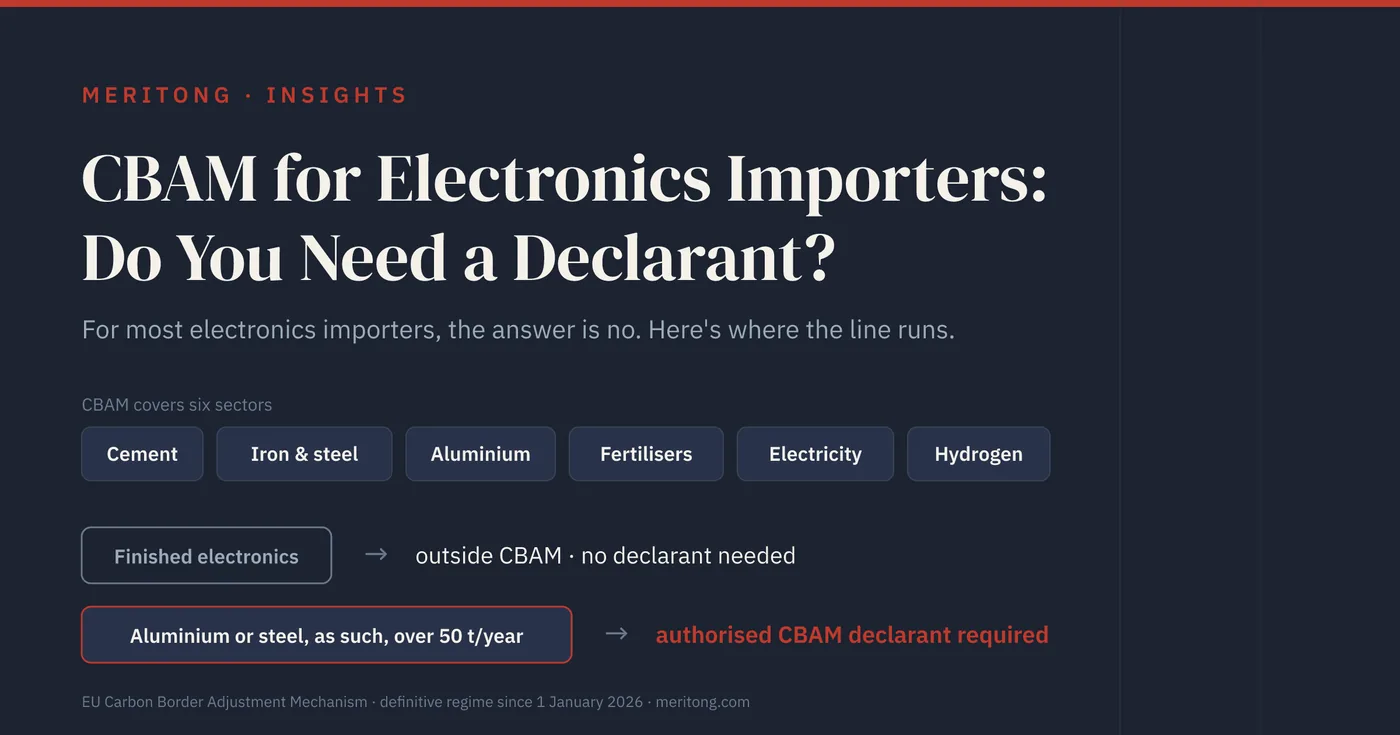
For most electronics importers, the answer is no — you don't need an authorised CBAM declarant. The EU Carbon Border Adjustment Mechanism (CBAM) applies to six covered sectors: cement, iron and steel, aluminium, fertilisers, electricity, and hydrogen. A finished electronic device is none of those, so importing gadgets, boards, or modules doesn't pull you into CBAM.
For an importer, CBAM compliance starts with one question: do you bring an Annex I covered good across the EU border? You need an authorised CBAM declarant only if you import a CBAM good itself (for example, aluminium enclosures or steel brackets brought in as those materials, under their own tariff heading). For cement, iron and steel, aluminium and fertilisers a second test follows, and you need one only above the new 50-tonne annual threshold. Electricity and hydrogen have no such threshold: Article 2a(4) excludes them from the de-minimis exemption, so the general rule of Article 4 applies and an importer of either needs an authorised declarant at any quantity. The boundary is drawn by tariff classification, and the two tests apply in sequence: first the nature of the goods, then the mass of the imports. Here's how to tell which side of the line you're on.
What CBAM actually covers
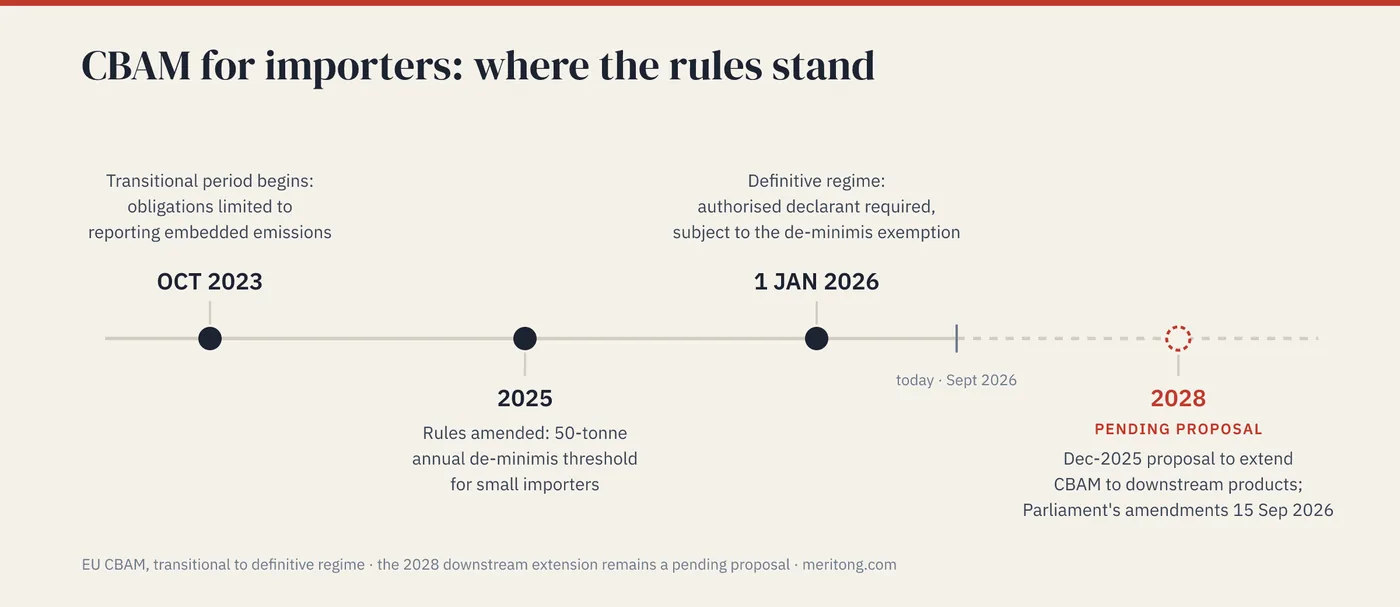
CBAM entered its definitive regime on 1 January 2026, after a transitional reporting period that ran from October 2023. The definitive regime places the obligation on one role: only an authorised CBAM declarant may import CBAM goods into the EU (Article 4, subject to the de-minimis exemption discussed below), and it is the declarant who reports the embedded emissions of those goods and surrenders CBAM certificates for them. Authorisation, reporting and surrender belong together, which is why the practical question for any importer is whether the goods it brings in are CBAM goods at all.
The logic behind the mechanism is carbon leakage. The EU prices carbon for its own producers, and without a border adjustment an importer could sidestep that cost by buying the same steel or aluminium from a producer that pays no equivalent carbon price. The Regulation's stated purpose is to close that gap by charging imports for their embedded emissions. Its scope began deliberately narrow: the Commission's December 2025 proposal describes the Regulation as having been "initially designed with a limited scope, covering those goods that are most exposed to the risk of carbon leakage and that are most carbon intensive." A finished electronic device classified under its own product heading is outside that scope today, and the same proposal now seeks to extend the mechanism down the value chain.
CBAM's covered goods are listed by tariff code in Annex I to Regulation (EU) 2023/956. The list targets carbon-intensive basic materials at risk of "carbon leakage." The covered sectors are:
- Cement
- Iron and steel (including certain downstream articles such as screws, bolts, and other iron/steel items under their own headings)
- Aluminium (including certain aluminium articles)
- Fertilisers
- Electricity
- Hydrogen, which Annex I lists under a "Chemicals" sector whose only entry is hydrogen itself
Finished electronics are not on that list: they are typically classified in Chapter 85 of the tariff (electrical machinery and equipment) or, for computers, in Chapter 84. A company importing finished electronic products is therefore, as a rule, outside CBAM. Where such a company is drawn in nonetheless, it is drawn in through inputs imported as covered goods in their own right: aluminium enclosures or steel brackets imported under their own headings can qualify as covered goods even though the finished products they will eventually house do not. Separately, the Regulation does not apply at all to goods originating in Iceland, Liechtenstein, Norway or Switzerland (Article 2(4) and point 1 of Annex III).
The 50-tonne threshold
Even if you import cement, iron and steel, aluminium or fertilisers, there is now a quantity below which the obligation does not apply. Regulation (EU) 2025/2083 introduced a de-minimis exemption for small importers: a single mass-based threshold of 50 tonnes of net mass per year (Article 2a, with the figure itself set in point 1 of Annex VII). Import no more than that in total, and you fall under an exemption designed to keep small-quantity importers out of the full obligation. Unlike the downstream extension discussed below, the threshold is settled EU law as of 2026, and for hardware companies that bring in modest quantities of, say, aluminium parts, it is meaningful relief. The figure can change: under Article 2a(3) the Commission reviews it by 30 April each year and amends it by delegated act where the recalculated threshold deviates from the applicable one by more than 15 tonnes, with effect from the following 1 January. No such act had been adopted as of 30 September 2026.
Six practical notes qualify the threshold. It is a total across your covered-goods imports for the calendar year, aggregated across all tariff codes per importer, so a series of small imports adds up against it. The exemption also stops short of two sectors: Article 2a(4) provides that the Article does not apply to imports of electricity or hydrogen, so those imports neither benefit from the threshold nor count toward it, and the 50 tonnes is in practice one total across your cement, iron and steel, aluminium and fertiliser imports. Crossing it has a whole-year effect: Article 2a(2) of Regulation (EU) 2023/956, inserted by Regulation (EU) 2025/2083, subjects an importer who exceeds the threshold to all obligations under the Regulation in respect of every covered good imported during that calendar year, including the tonnes brought in before the threshold was reached. The authorisation therefore has to be in place before the crossing: Article 5(1b) has the importer apply once it expects to exceed the threshold, and under Article 26(2a) an importer that exceeds it without authorisation is liable to a penalty. Article 17(7a) makes one exception: an importer that applied by 31 March 2026 may provisionally keep importing until its application is decided; if the application is refused, the Article 26(2a) penalty is calculated on the emissions embedded in the goods it imported from 1 January 2026 until that decision.
The exemption also has to be claimed, since Article 2a(1) requires an importer relying on it to declare that exemption in the customs declaration. An indirect customs representative is treated differently: under Article 5(1a) it must hold the status of authorised CBAM declarant before importing, even if you yourself are exempt. And the exemption comes into play only after the scope test: you only ever count toward the 50 tonnes if you are importing a covered good in the first place, which is why an electronics importer that brings in no aluminium or steel as such never even reaches the question.
Does this apply to me?
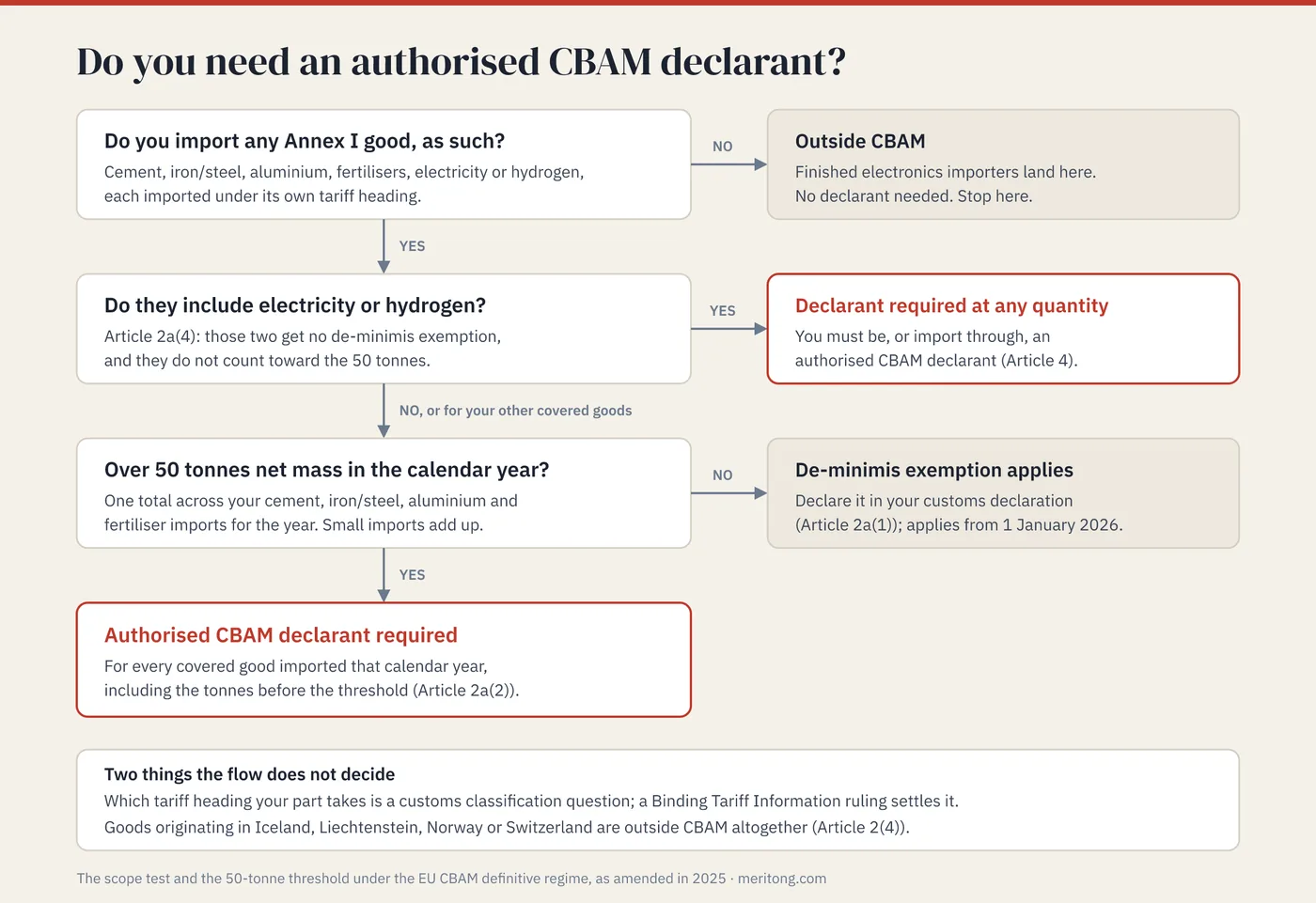
Run the decision:
Do you import any Annex I covered good (cement, iron/steel, aluminium, fertiliser, electricity, or hydrogen) as such? If you only import finished electronic products, the answer is no, and you don't need a CBAM declarant. Stop here. Goods originating in Iceland, Liechtenstein, Norway or Switzerland are outside CBAM altogether (Article 2(4)).
Do those imports include electricity or hydrogen? If so, you need an authorised CBAM declarant at any quantity: Article 2a(4) excludes those two from the de-minimis exemption, so the general rule of Article 4 applies. Any cement, iron and steel, aluminium or fertiliser you also import still goes through step 3.
If not, or for your other covered goods (e.g., you import aluminium enclosures or steel parts under their own material heading), do you exceed the 50-tonne annual threshold? At or below that threshold, the de-minimis exemption applies, and you declare it in your customs declaration; an indirect customs representative importing for you still needs authorised-declarant status (Article 5(1a)). Above it, you need to be, or use, an authorised CBAM declarant and report embedded emissions for that whole calendar year's covered imports.
Not sure which heading your part falls under? That is a tariff-classification question, and the CBAM Regulation will not answer it for you: see below.
The classification trap
The difficult case for an electronics importer is a part that admits two classifications. An aluminium enclosure is both a piece of aluminium and a part of the device it will eventually house, and the Combined Nomenclature (CN) forces a choice between those descriptions: under an aluminium heading the part is within CBAM's scope, while under a "parts of…" heading for the finished product it is outside. CBAM's scope is defined by tariff code, yet the Regulation does not tell you which code your specific part takes; that is a CN classification question. If you're near the line, get the classification right first — a Binding Tariff Information ruling is the way to settle it — because your CBAM position follows the code.
One thing on the horizon
CBAM's "electronics are out" answer is current; whether it remains so is a live legislative question. On 17 December 2025 the Commission proposed to extend CBAM to downstream products in COM(2025) 989, adding 180 steel- and aluminium-intensive products from 1 January 2028. The Commission's list also reaches into Chapter 85 of the tariff, electrical machinery and equipment: it includes certain electric motors and transformers, and inductors, winding wire and insulated cable containing steel or aluminium. The file has moved since: the Council agreed its general approach on 12 June 2026, and on 15 September 2026 Parliament adopted amendments to the proposal (T10-0276/2026) and referred the matter back to the committee responsible for interinstitutional negotiations; its first-reading position is still outstanding (procedure 2025/0419(COD)). As of 30 September 2026 the Legislative Observatory records no later step; the expansion is not yet law and doesn't change today's answer. Watch it if you import anything with significant aluminium or steel content, electrical components or household electrical appliances: the three institutions' texts differ on how far the list extends. The Council and Parliament both add, among others, small electric motors, rectifiers and ferrite cores. Parliament goes further: its amendments would put the whole of heading 8504 (transformers, static converters and inductors) into the iron-and-steel list and add, among others, coaxial cable, insulated conductors fitted with connectors, and finished appliances such as certain vacuum cleaners, electric water heaters, liquid-filled radiators and convection heaters, cookers and built-in ovens. Parliament's amendments would also set the mass-based threshold for aluminium products at 5 tonnes of net mass, well below today's 50. The Council's general approach contains no such provision.
FAQ
Do I need a CBAM declarant to import electronics?
As a rule, no. CBAM covers cement, iron/steel, aluminium, fertilisers, electricity, and hydrogen; finished electronic products are outside its scope. Importing devices, boards, or modules doesn't require a CBAM declarant.
When would I need one?
You need one if you import an Annex I covered good as such (for example aluminium or steel parts under their own material heading) above the 50-tonne annual threshold. Then you must be, or import through, an authorised CBAM declarant. Goods originating in Iceland, Liechtenstein, Norway or Switzerland are outside CBAM. For electricity and hydrogen there is no threshold to clear: a declarant is required at any quantity. An indirect customs representative importing covered goods on your behalf needs authorised-declarant status whatever your tonnage (Article 5(1a)).
What's the 50-tonne threshold?
It is a de-minimis exemption (introduced by a 2025 amendment and now in force) that keeps small importers out: at or below 50 tonnes of net mass of cement, iron and steel, aluminium or fertiliser per calendar year, the full CBAM obligation doesn't apply, though you declare the exemption in your customs declaration. Exceed it and the obligation covers that entire year's covered imports.
My part is made of aluminium and is also a component: am I in or out?
It depends on its tariff classification. Customs law answers that question; the CBAM Regulation says nothing about it. If it classifies under an aluminium heading, it's likely in scope; under a finished-product "parts" heading, likely out. Get a Binding Tariff Information ruling if you're near the line.
Could this change?
Yes. A proposed extension could bring more downstream goods into CBAM from 2028. It isn't law yet as of September 2026, with Parliament and the Council still to negotiate the text, but it's worth tracking if your products are aluminium- or steel-heavy or you import components such as motors, transformers, inductors, power converters or cable, or appliances such as vacuum cleaners and electric cookers.
Close
CBAM is a good example of a compliance question that's mostly answered by getting your tariff classification right: the same classification work that drives your duty rate and your landed cost. If one of your parts falls near that line and the code changes what it costs you to land it, I would be glad to look at it with you: I work on product-architecture and hardware-component problems, especially where China sourcing is involved, across hardware, firmware and sourcing together.
Meritong is a China-sourcing and landed-cost strategy practice. I am not a licensed customs broker or attorney. This article provides general information only and does not constitute legal or customs advice. CBAM scope is defined by tariff classification and the rules were amended in 2025 with further changes proposed. Confirm the current scope and your goods' classification with qualified customs counsel or a binding ruling before acting.
Typical dependencies by email
Examples from real hardware audits, sent occasionally.
Working through this right now? Free intro call → or write to me →
Is this question on your desk right now?
In the free potential check you tell me the type of components you use. After 30 minutes you know whether an audit is worth it.
Free intro call