Customs
Tariff Engineering: 7 Legal Ways to Redesign a Product So It Clears at a Lower Duty
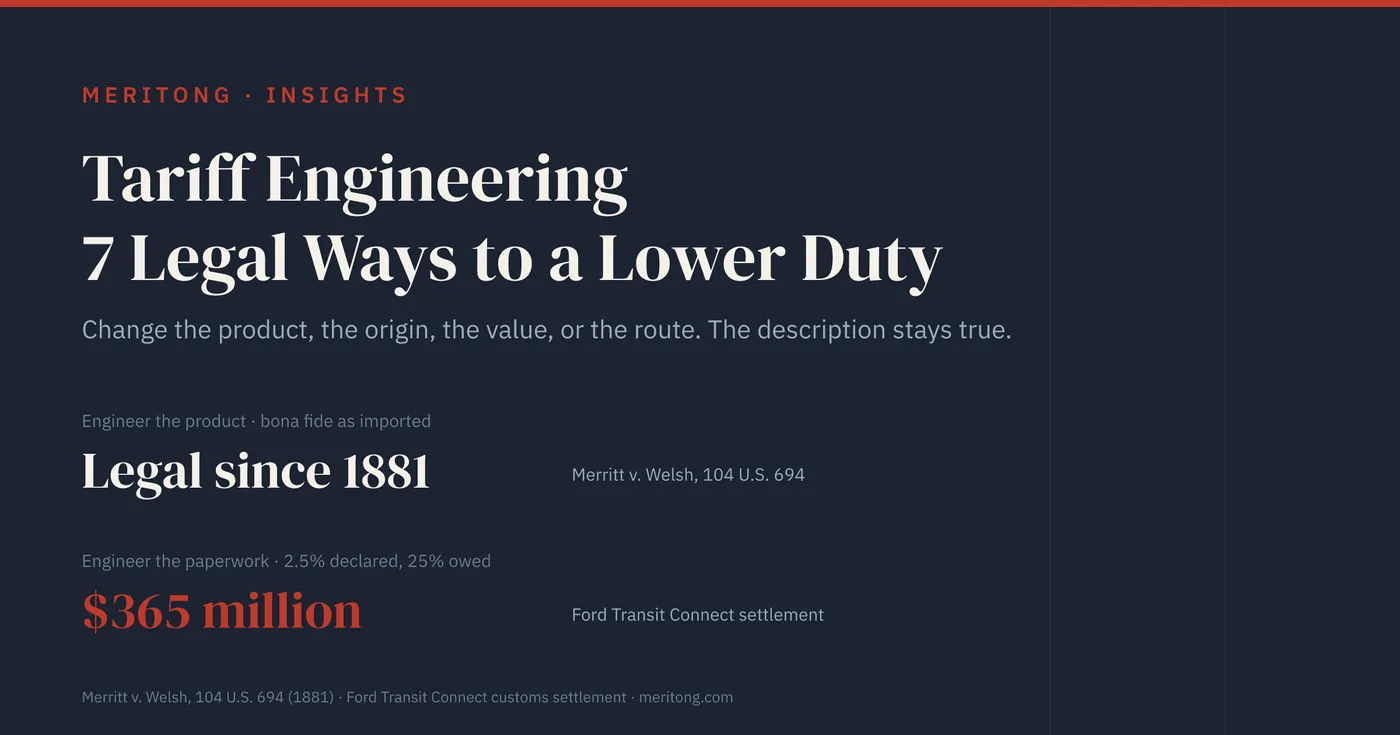
Tariff engineering is legal, and has been since 1881, on one condition: the article has to be bona fide as imported. Seven levers that change the classification, the origin, the value or the timing, each with the limit that keeps it lawful.
Last updated: September 2026. Duty rates and trade measures below are stated as of this date and are changing fast. Re-verify current rates before you rely on any number here.
The short version
Tariff engineering is the practice of deliberately designing, sourcing, valuing, or routing a product so that it lawfully clears customs at a lower duty. It is legal, and has been since the U.S. Supreme Court blessed it in 1881, on one condition: the article has to be bona fide as imported. You can change what you make, where it is transformed, how it is valued, and how it moves, and the duty will follow the facts you have changed. What you cannot do is misdescribe what you actually import, because the law's tolerance extends to the product and stops at the paperwork. The moment you engineer the paperwork instead of the product, you have crossed from tariff engineering into fraud.
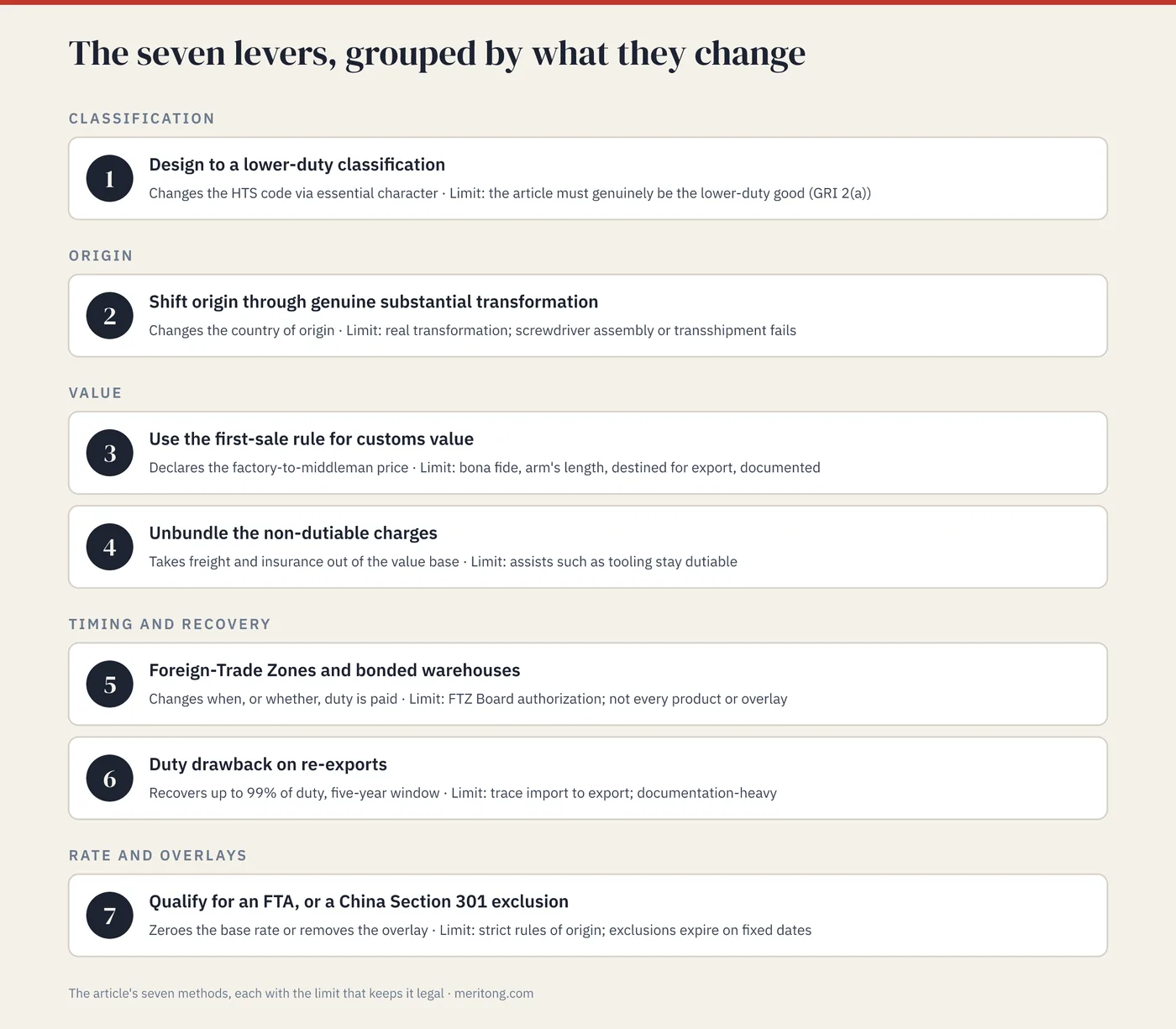
What follows are seven legal levers a hardware importer can pull, working variously on the classification, the origin, the value, the timing or recovery of the payment, and, in one case, the applicable rate itself. Each is stated with the limit that keeps it legal, and all of them answer to the single guardrail, reasonable care, that governs how an importer classifies, values, and declares.
Legal or fraud? The one distinction that matters
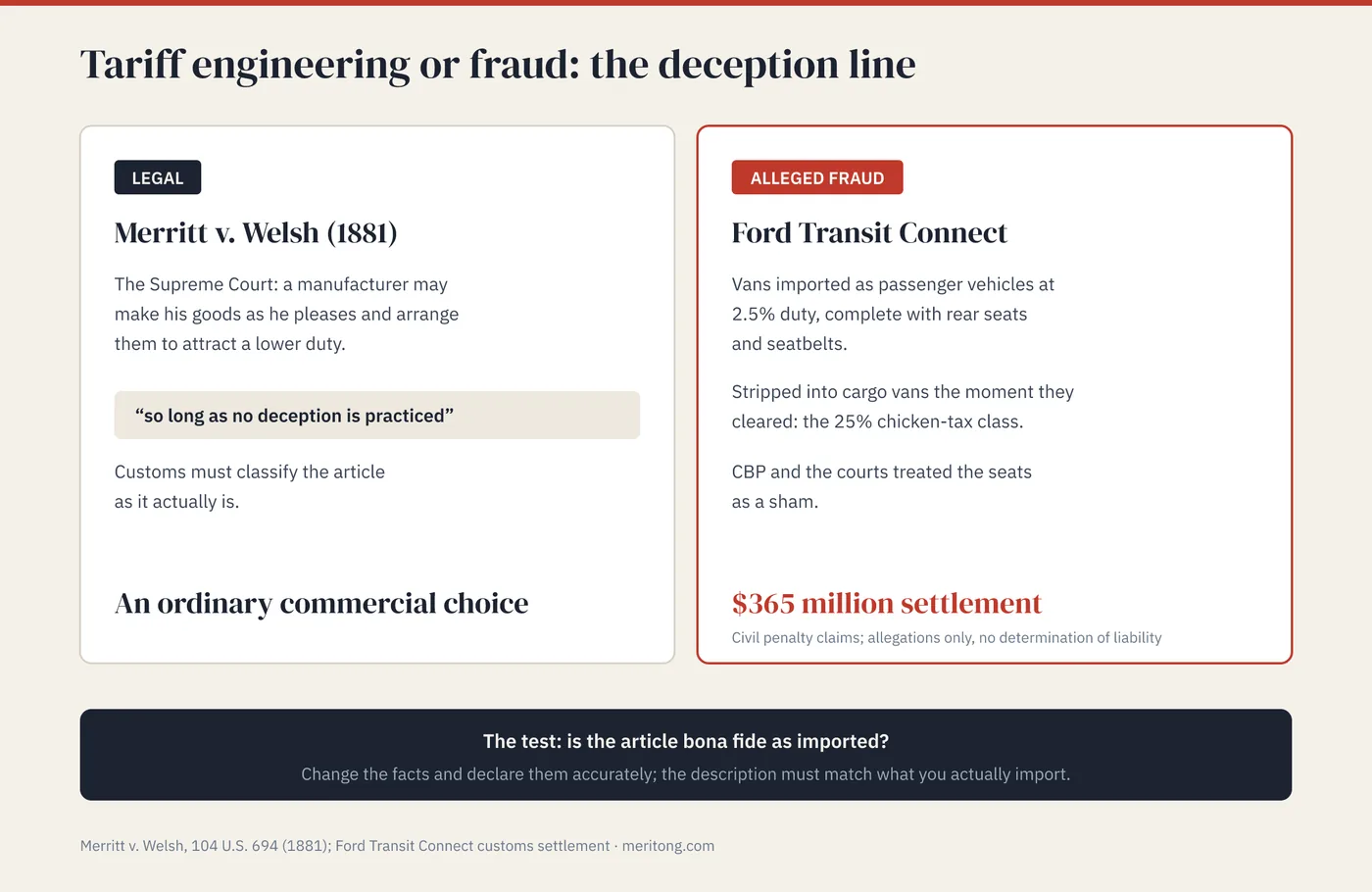
The founding principle is old and blunt. In Merritt v. Welsh, 104 U.S. 694 (1881), the Supreme Court held that an importer may arrange his goods to attract a lower duty: a manufacturer has the right to make his goods as he pleases, and "so long as no deception is practiced," customs must classify the article as it actually is. The holding joins a broad commercial liberty to a single condition of candor: the goods may be engineered, and the description may not be. Within that liberty, a design decision made to reduce duty is an ordinary commercial choice, and nothing in the motive makes it sinister; the tariff schedule takes the article as it finds it.
The line is deception, and the cautionary tale of where that line runs is Ford's Transit Connect. Ford imported vans as "passenger vehicles" (2.5% duty), complete with rear seats and seatbelts, then stripped them into cargo vans the moment they cleared. U.S. Customs and Border Protection (CBP) and the courts treated the seats as a sham to dodge the 25% "chicken tax," and Ford settled for $365 million. The vans were not, as imported for their real commercial purpose, what the paperwork said. The principle applied was the same as in Merritt; the outcome was the opposite, because the article as imported was not genuine.
Everything that follows works only if the thing crossing the border is the thing you declare.
Why duty varies at all
Two facts set your rate: how the good is classified (its Harmonized Tariff Schedule, or HTS, code) and where it originates. Classification answers what the article is; origin answers where it became what it is. Get those two right and you know your base duty; change either one legitimately and the duty changes with it. On top of the base rate come trade "overlays," and for China-origin electronics imported into the US these currently dominate the bill.
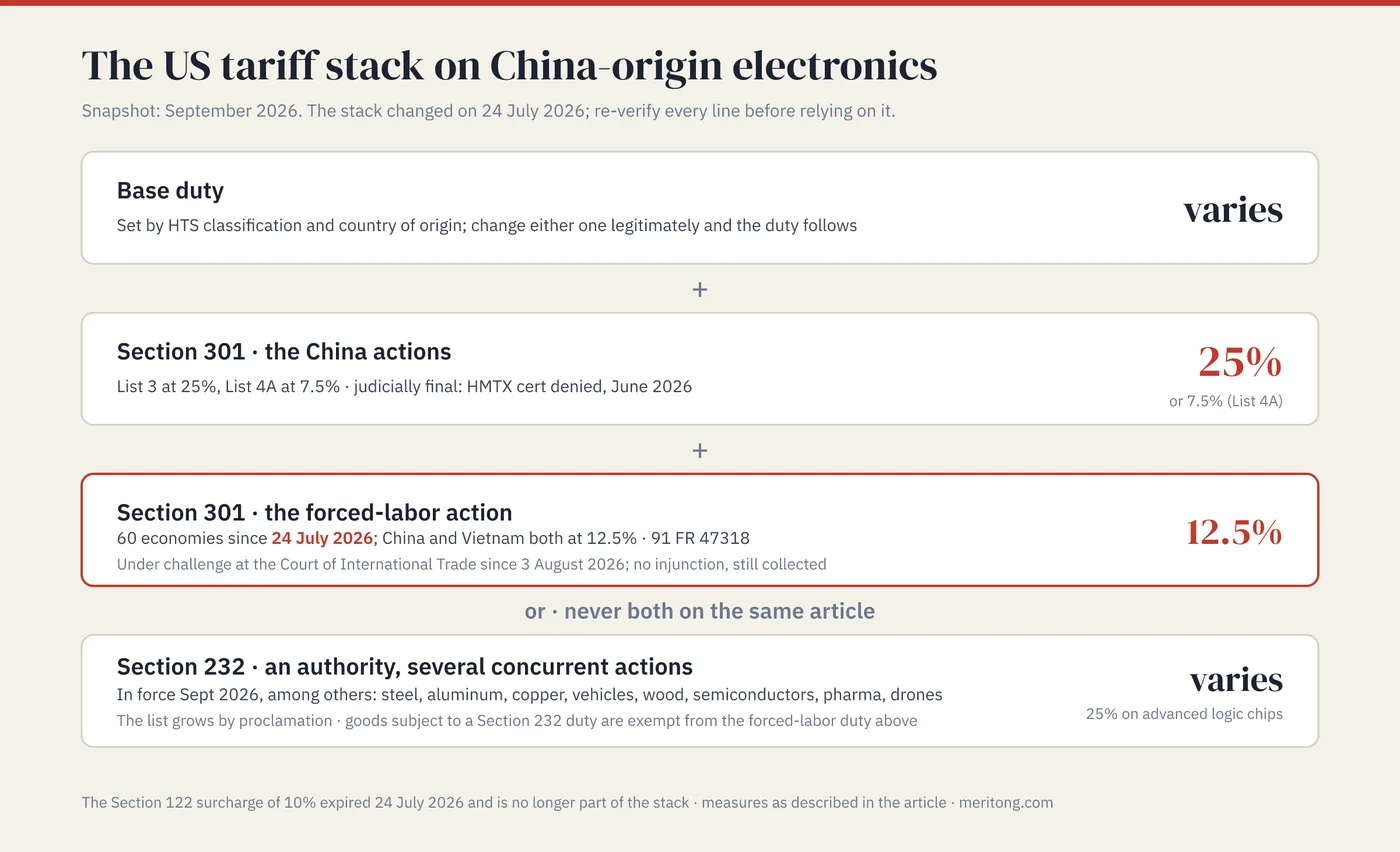
As of September 2026, that US overlay stack looks like this, and it changed materially over the summer, so treat every figure as a snapshot:
The China Section 301 actions remain in force: List 3 at 25% and List 4A at 7.5%, now judicially final after the Supreme Court declined to hear the last challenge (HMTX Industries, cert denied June 2026).
A second Section 301 action, on forced labor, has applied since 24 July 2026: goods from 60 economies are dutiable at an additional 10% or 12.5%, according to how far each economy has gone toward prohibiting imports made with forced labor (91 FR 47318). China is at 12.5%, and so is Vietnam. The duty applies on top of the China actions above rather than in place of them; the notice itself does not settle that interaction, so confirm it for your own entry before you price the difference. Each covered economy has its own subheading in the 9903.05 range. Twenty-five states filed suit in the Court of International Trade on 3 August 2026 to have the action set aside; no injunction has issued, and CBP continues to collect.
Section 232 is an authority rather than a single measure, and several actions run under it at once. In force as of September 2026, among others: steel, aluminum and copper and their derivatives; passenger vehicles, light trucks and parts; medium- and heavy-duty vehicles and parts; timber and wood products; semiconductors; pharmaceuticals; and, since 3 September 2026, unmanned aircraft systems and certain of their components. The semiconductor action reaches certain advanced logic chips at 25%, on a scope set by processing-performance and memory-bandwidth thresholds. The list grows by proclamation, so check the current one against your own headings. Goods subject to a Section 232 duty are exempt from the forced-labor duty above, so an aluminum enclosure or an imported drone pays its Section 232 rate instead of the 12.5%.
The Section 122 10% surcharge is gone: it ran from 24 February 2026 and expired on 24 July 2026, at the end of the statute's 150-day maximum. Whether it was lawfully imposed at all is still before the Federal Circuit, which matters for refunds of what was already collected; it does not change what a new entry costs today.
For the most part, the levers below do not touch the overlays directly. They change, instead, what the overlays are applied to: the classification, the origin, the value, or the duty-recovery position.
The 7 methods
1. Design to a lower-duty classification
Duty follows the HTS code, and the code follows the product's genuine identity under the General Rules of Interpretation (GRI), chiefly its essential character. Redesign the product so that it belongs in a lower-duty heading, and the lower rate is yours. One well-used lever is configuration: a device imported as a complete "machine" of one heading may fall in another when its incompleteness or its different configuration is real. Because "essential character" is undefined and decided case by case, the same openness that creates the opportunity also creates the uncertainty, and this is the lever on which an honest classification opinion earns its keep.
Risk/limit: the imported article must actually be the lower-duty good; the higher-duty good with a fig leaf does not qualify, because GRI 2(a) classifies an "incomplete" unit that has the essential character of the finished one as finished anyway.
2. Shift origin through genuine substantial transformation
If a penalized country's duties are the problem, moving real manufacturing to a third country can change the country of origin, and with the origin the China Section 301 exposure. The change is conditional, however: origin moves only when the third-country processing substantially transforms the inputs into a new article. Since 24 July 2026 the move also buys less than it once did, because the forced-labor action reaches 60 economies and puts Vietnam at the same 12.5% as China: a successful shift removes the List 3 or List 4A duty and leaves the forced-labor duty where it was. The doctrine is its own deep topic (see the companion article on country of origin), so it appears here only as a lever.
Risk/limit: final assembly or "screwdriver" kitting is usually not substantial transformation. Route Chinese parts through Vietnam for a bit of assembly, and CBP can rule that the origin is still China, which restores the China duties and adds a transshipment problem on top of them. Get a binding ruling before you rely on the move.
3. Use the first-sale rule for customs value
Duty is charged on the customs value, and in a multi-tier sale (factory → middleman → you) the same goods change hands at more than one price. US law lets you declare the first sale (the factory's price to the middleman) rather than the higher price you paid, provided it was a bona fide sale for export. Courts have long recognized first-sale valuation, and on a typical importer margin the dutiable base can drop meaningfully.
Risk/limit: the first sale must be genuine and arm's-length, and the goods must be clearly destined for export to the US at that sale. You need the factory's invoice and proof of the transaction, because a paper "first sale" you cannot document is not one.
4. Unbundle the non-dutiable charges from customs value
The dutiable value is the price for the goods, which is not necessarily everything on your invoice. International freight and insurance, for instance, are generally excluded from US transaction value. If your supplier bundles ocean freight into a single "landed" price, separating the price of the goods from the cost of moving them can shrink the base on which the duty is calculated.
Risk/limit: this lever cuts both ways, because the rules that exclude some charges from the value add others in. Certain additions ("assists" you provide to the factory free or below cost, such as tooling and dies, or design work undertaken outside the US) are dutiable and must be added to value. Unbundling means declaring the value correctly; it is no license to hide a dutiable element. Strip out an assist and you have under-declared.
5. Foreign-Trade Zones and bonded warehouses
A US Foreign-Trade Zone (FTZ), authorized under 19 U.S.C. §§ 81a–81u, lets you hold, assemble, or process imported goods without paying duty until they enter US commerce, and never if they are re-exported, since goods that never enter US commerce owe no duty at all. Where the finished good is dutiable at a lower rate than its imported components (an "inverted tariff"), FTZ status can let you pay the lower finished-good rate.
Risk/limit: zones require FTZ Board authorization and real record-keeping, and the inverted-tariff benefit is not available for every product or every overlay. An FTZ is a cash-flow and structural tool; it defers, and sometimes removes, the duty payment, and it works no magic on the rate itself.
6. Duty drawback on re-exports
If you import components, pay duty, and later export the goods (or products made from them), duty drawback (19 CFR Part 190) lets you recover up to 99% of the duties paid, within a five-year window. For a company that imports to build and then ships abroad, the sums recoverable this way can be substantial.
Risk/limit: drawback is documentation-heavy: you must trace the imported merchandise to the export under the direct-identification or substitution rules. The money is real, but only if the paper trail is.
7. Qualify for an FTA, or a China Section 301 exclusion
Free-trade agreements can zero the duty on goods that meet their rules of origin, and specific exclusions under the China Section 301 actions can remove that tariff from a narrowly defined product (covered in the companion how-to on exclusions). The forced-labor action runs its own separate exemption architecture, with economy-specific annexes and a set of general exemption subheadings.
Risk/limit: FTA rules of origin are strict and product-specific, and the China Section 301 exclusions are narrow and expire on fixed dates. An exclusion your product does not precisely match is not yours to claim.
The seven at a glance
| # | Method | What it changes | Main limit |
|---|---|---|---|
| 1 | Design to classification | The HTS code (essential character) | Article must genuinely be the lower-duty good |
| 2 | Substantial transformation | Country of origin | Real transformation required; assembly or transshipment fails |
| 3 | First-sale rule | Dutiable value (first sale) | Bona fide arm's-length sale for export, documented |
| 4 | Unbundle non-dutiable charges | The value base | Assists and additions stay dutiable |
| 5 | Foreign-Trade Zone | When/whether duty is paid | FTZ Board authorization; not all overlays |
| 6 | Duty drawback | Recovers duty on re-exports | Trace import→export; documentation |
| 7 | FTA / China §301 exclusion | Base rate / overlay | Strict rules of origin; exclusions expire |
The guardrail: reasonable care
US importers owe a legal duty of reasonable care in how they classify, value, and declare goods. Get it wrong (especially in a way that understates duty) and you face liability under 19 U.S.C. § 1592, whose penalties scale with culpability (negligence, gross negligence, fraud): the same underpayment costs more the more careless the conduct behind it was. The relief valve is a prior disclosure: correct an error to CBP before they find it and the penalty exposure drops sharply.
The mental model is simple. Legitimate tariff engineering changes the facts (the product, the origin, the transaction, the route) and then declares them accurately. Fraud leaves the facts alone and changes the description. The seven levers above are all of the first kind. None of this is legal advice (see the note below): before you restructure around any of them, get a binding ruling or customs counsel on your specific product.
FAQ
Is tariff engineering actually legal?
Yes, when the imported article is bona fide. The Supreme Court affirmed in 1881 that arranging goods to attract a lower duty is lawful "so long as no deception is practiced." It becomes illegal when you misdescribe what you actually import, which is the line the Ford Transit Connect case marks.
Does the first-sale rule really lower duty?
It can. US law allows the dutiable value to be the first bona fide sale for export (the factory-to-middleman price) rather than what you paid, if the sale is genuine, arm's-length, and the goods are destined for export. You must be able to document it.
FTZ or drawback: which do I want?
An FTZ helps if you hold or process imports before they enter US commerce, or re-export them (you defer or avoid duty). Drawback helps after the fact: you paid duty, then exported, and you recover up to 99%. Importers who build-to-export often use both.
Will moving assembly to Vietnam dodge the China tariffs?
The origin changes only if the work done in Vietnam is a genuine substantial transformation. Light assembly usually is not, and a failed origin claim brings the China duties back plus a transshipment problem. A successful move is also worth less than it was before 24 July 2026, since the Section 301 forced-labor action puts Vietnam at the same 12.5% as China; what the move removes is the List 3 or List 4A duty. Confirm with a binding ruling first.
What happens if I get it wrong?
Under 19 U.S.C. § 1592 you can owe the duty plus penalties scaled to how careless it was. A prior disclosure (telling CBP before they find it) substantially reduces the exposure. Reasonable care is the standard you are held to.
Close
Mapping which of these levers a bill of materials (BOM) actually qualifies for takes the whole BOM, line by line. Without that map, an importer overpays duty on some lines and claims relief on others that would fail a challenge.
The design and origin levers change what you build and where you build it, so pulling either one is also a design or sourcing decision. That is the kind of product-architecture problem I help with, particularly where China sourcing is involved, and I look at hardware, firmware, and sourcing together; get in touch if that decision is open at your company.
Meritong is a China-sourcing and landed-cost strategy practice. I am not a licensed customs broker or attorney, and this article is general information and not legal or customs advice. Duty rates and trade measures change frequently and are product- and fact-specific: obtain a binding ruling from CBP (or the equivalent in your jurisdiction) and consult qualified customs counsel before acting on anything here.
Typical dependencies by email
Examples from real hardware audits, sent occasionally.
Working through this right now? Free intro call → or write to me →
Is this question on your desk right now?
In the free potential check you tell me the type of components you use. After 30 minutes you know whether an audit is worth it.
Free intro call