Customs
Country-of-Origin & Substantial Transformation: Will Your "Made in Vietnam" Survive a CBP Challenge?
Substantial transformation decides whether "Made in Vietnam" survives a CBP challenge. The test, three real CBP rulings, and the China+1 origin trap.
Last updated: August 11, 2026 · ≈10-minute read · Enforcement postures and penalty instruments in this area are shifting month to month. The doctrine below is stable, but verify any current rate or penalty before you rely on it.
The short version
For a hardware company doing China+1, "Made in Vietnam" is a legal conclusion, one that a label can assert but only a production process can earn. Under US law, country-of-origin determination for a good made from parts of several countries turns on substantial transformation: did the work in the last country create a new article with a different name, character, or use? Final assembly, on its own, usually does not clear that bar.
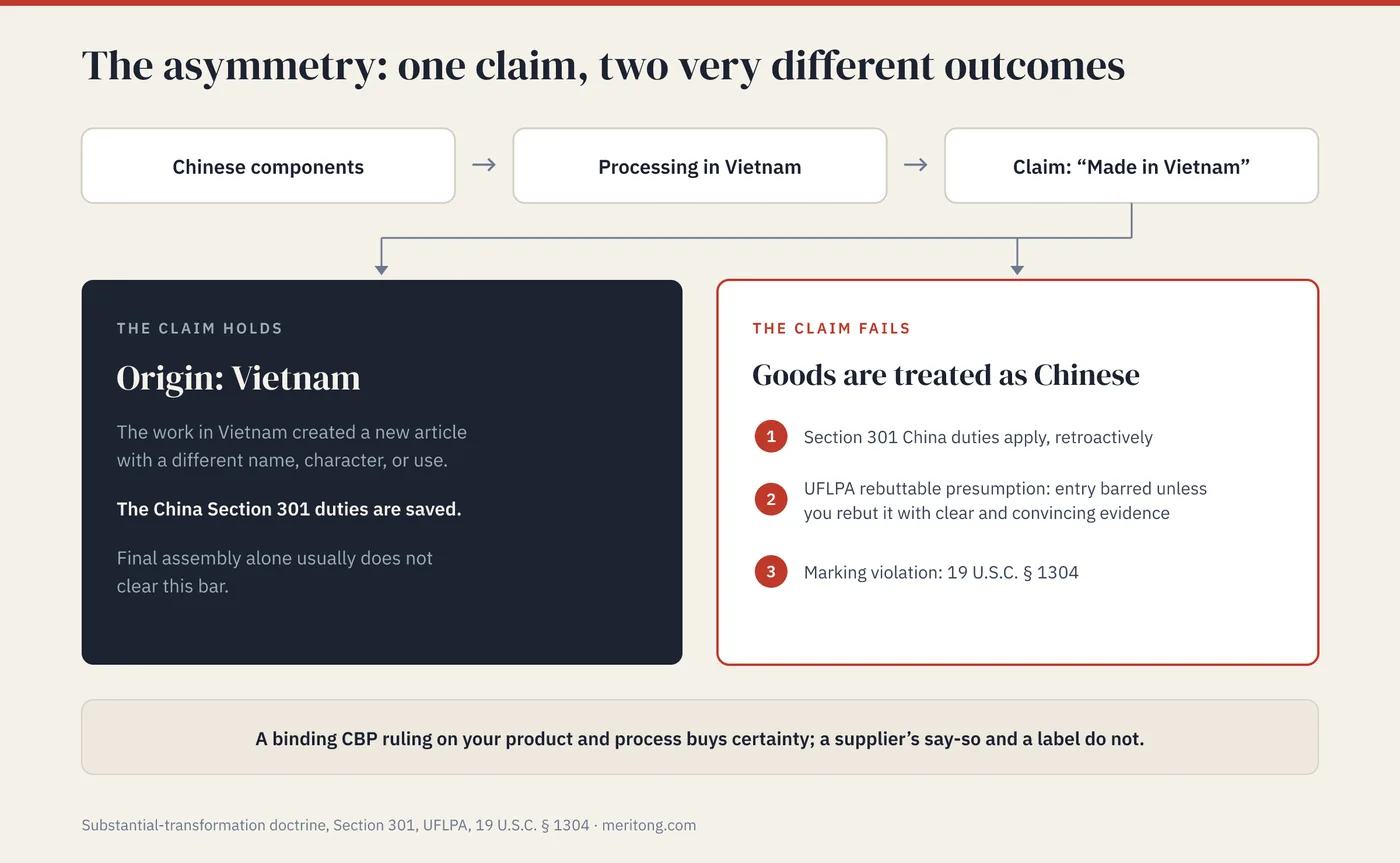
The stakes are asymmetric. A Vietnam claim that holds saves you the China Section 301 tariffs; one that fails means the goods are treated as Chinese, so those tariffs apply and the goods fall under the forced-labor scrutiny of the Uyghur Forced Labor Prevention Act (UFLPA). U.S. Customs and Border Protection (CBP) decides the question case by case and publishes its decisions, and three of those decisions, read together, show where the line runs.
What "substantial transformation" actually means
The test is over a century old. In Anheuser-Busch Brewing Ass'n v. United States, 207 U.S. 556 (1908), the Supreme Court set the bar: "There must be transformation; a new and different article must emerge, 'having a distinctive name, character, or use.'" That three-part phrase (name, character, or use) is still the spine of every US non-preferential origin analysis.
The idea behind it is essence: has the processing changed what the thing fundamentally is, or has it merely finished, cleaned, or combined things that were already themselves? Cutting, programming, and integrating components into a functionally new device tends to transform them. Screwing a finished motor into a housing does not turn the motor into something else.
The case law draws the edges. Courts have found substantial transformation where components lose their separate identity in a new article, and denied it where they do not. In National Hand Tool Corp. v. United States (Ct. Int'l Trade 1992, aff'd Fed. Cir. 1993), imported tool parts that were heat-treated, electroplated, and assembled into finished hand tools were held not substantially transformed, because each part entered the process already dedicated to its final use. The recurring question is whether the third-country work changed the article's essence or merely completed it. A claim built on light assembly tends to founder on exactly that phrase, since parts that arrive already dedicated to their final use leave the assembly step little to transform.
One caveat, which CBP itself repeats: substantial transformation is decided case by case, on the specific facts. There is no percentage threshold and no bright line, which is exactly why binding rulings exist.
The decision: does your process transform the good?
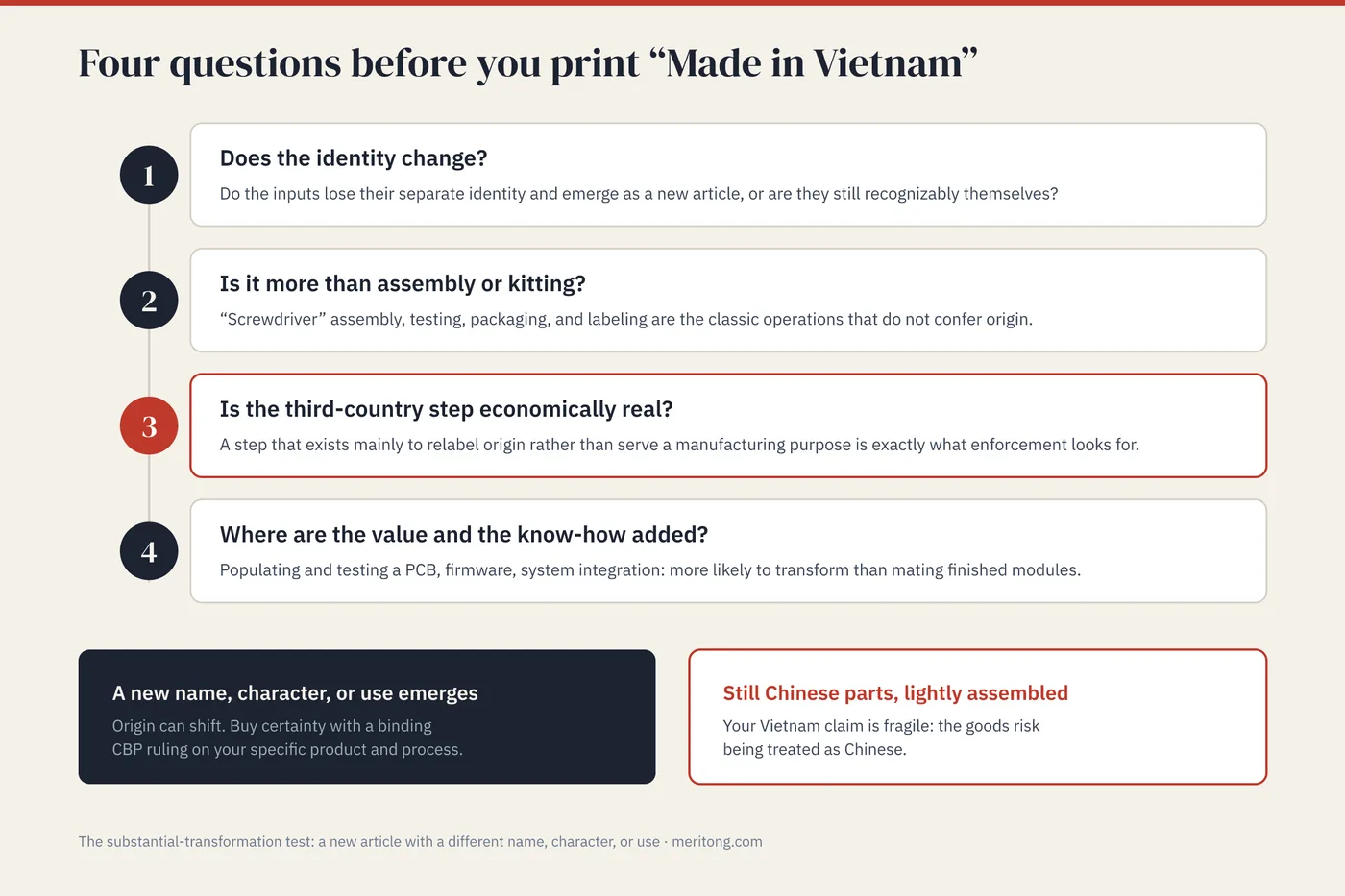
Before you print "Made in Vietnam," test your own process against these questions:
Does the identity change? Do the inputs lose their separate identity and emerge as a new article with a new name, character, and use, or are they still recognizably themselves, merely assembled?
Is it more than assembly or kitting? Simple or "screwdriver" assembly, testing, packaging, and labeling are the standard examples of operations that do not confer origin.
Is the third-country step economically real? A processing step that exists mainly to relabel origin rather than for a genuine manufacturing reason is exactly the pattern enforcement looks for.
Where are the value and the know-how added? Complex operations are more likely to transform than the final mating of finished modules: populating and testing a printed circuit board (PCB), programming firmware, integrating a system.
If the honest answers point to "still basically Chinese parts, lightly assembled," your Vietnam claim is fragile.
Three real CBP outcomes
CBP publishes its rulings, and the contrast among them teaches the test better than any abstract definition could.
| Ruling | What happened | Outcome |
|---|---|---|
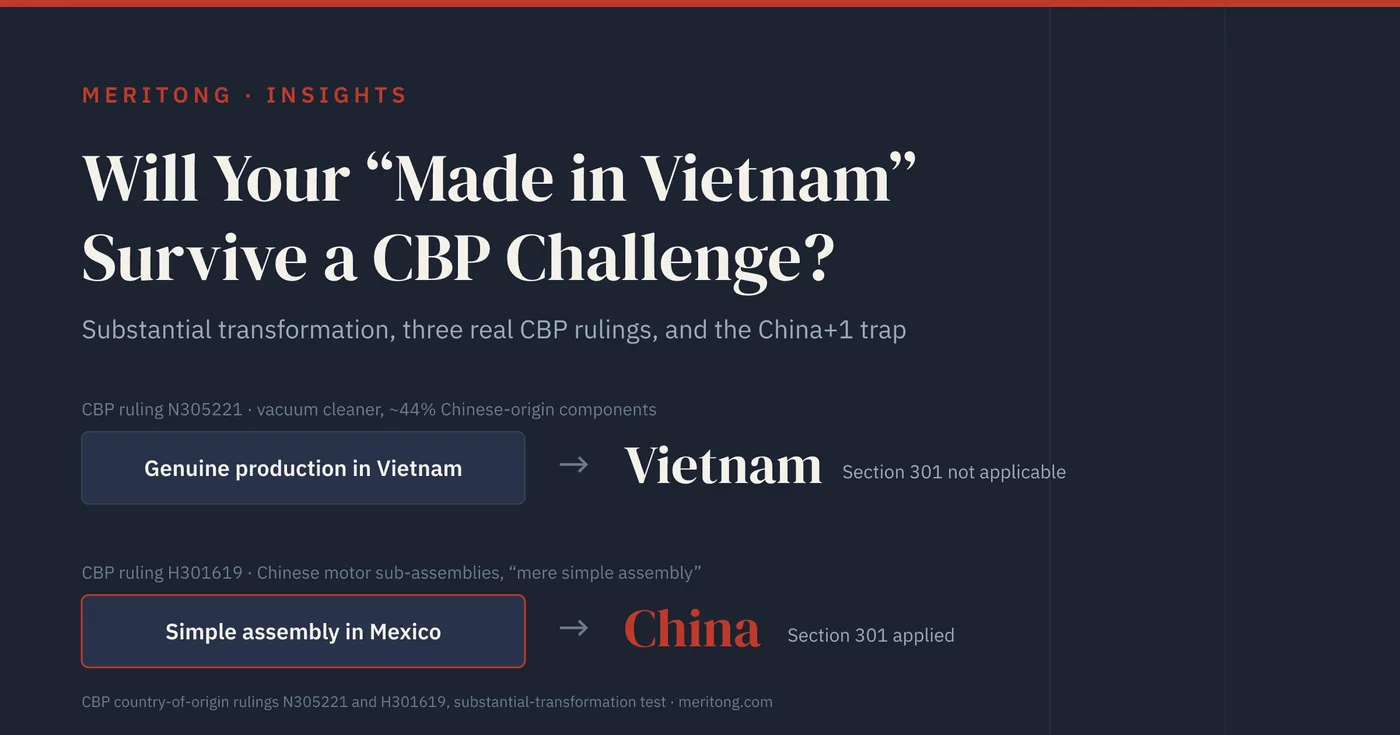
| H301619 | Chinese motor sub-assemblies given "mere simple assembly" in Mexico | Not substantially transformed: remained a product of China (Section 301 applied) |
| N305221 | Vacuum cleaner produced in Vietnam from Chinese components (~44% Chinese-origin) via genuine production | Substantially transformed: Vietnam origin, Section 301 not applicable |
| HQ 733690 | Printed circuit board populated and integrated into a system | Substantially transformed: origin of the country where the PCB was populated/integrated |
The pattern is consistent with modern case law, too: in Energizer Battery, Inc. v. United States, 190 F. Supp. 3d 1308 (Court of International Trade, 2016), assembling Chinese-origin components into a finished flashlight was held not to be a substantial transformation, because the components entered the assembly with their end-use already fixed. What separates the winners from the losers is whether the third-country work created a new article in fact. The share of Chinese parts settles little on its own; the vacuum cleaner in N305221 kept its Vietnam origin with roughly 44% Chinese-origin components.
In practice that means looking past the bill of materials (BOM) to the operations. The vacuum-cleaner ruling turned on real production in Vietnam (sub-assembly manufacture, integration, and testing that yielded a functionally new machine), while the motor ruling turned on a Mexican step confined to final assembly of parts that already amounted, in substance, to the finished motor. The share of Chinese content is a red herring; the nature and complexity of the local operation is the test. That is also why contemporaneous manufacturing evidence matters so much: two products with identical BOMs can land on opposite sides of the line purely on what was actually done, and where, and why.
China+1 in 2026: the "Made in Vietnam" trap
This is where China+1 sourcing meets enforcement reality. As tariffs on Chinese-origin goods rose, a great deal of "China → Vietnam → US" routing appeared, and CBP scrutiny of Vietnamese and other third-country origin claims has risen with it. The asymmetry is the point: a Vietnam claim that holds saves you the China Section 301 duties; a Vietnam claim that fails means those duties apply retroactively, and because the true origin is China, any input that traces back to the Xinjiang region or to a UFLPA-listed entity can trigger the UFLPA's rebuttable presumption, under which the goods are barred from entry unless you rebut it with clear and convincing evidence.
The penalty instrument itself has been unusually unstable. In Learning Resources, Inc. v. Trump (February 20, 2026), the Supreme Court held that the International Emergency Economic Powers Act (IEEPA), the statute behind the 2025 tariff orders and their transshipment penalties, does not authorize the President to impose tariffs, and the successor measures have changed legal basis more than once since. As of August 2026, do not rely on any specific transshipment-penalty rate you read anywhere without confirming the instrument currently in force. What is not in flux is the exposure structure: get origin wrong on a China+1 line and you can owe the China duties, face UFLPA detention, and be exposed on marking at the same time. The honest way to buy certainty here is a binding CBP ruling on your specific product and process. A supplier's assurance does not bind CBP, and neither does a label.
Marking is its own obligation
Separately from duty, US law (19 U.S.C. § 1304 and 19 CFR Part 134) requires most imported articles to be marked with their country of origin so the ultimate purchaser knows where the good came from. Origin for marking generally follows the same substantial-transformation test; where the last processing doesn't transform, the marking must still reflect the true origin. A "Made in Vietnam" mark on a good that is legally Chinese is both a duty problem and a marking violation.
One boundary is worth knowing about. For goods finished in Canada or Mexico, marking origin is determined under the tariff-shift rules of 19 CFR Part 102 rather than by substantial transformation, which is how the motor ruling above could mark Mexico for origin while the Section 301 duties followed China. For processing in Vietnam and other countries outside the United States–Mexico–Canada Agreement (USMCA), the substantial-transformation test governs both questions.
The EU side
If you import into the EU, the framework differs but the spirit is similar. Under Article 60(2) of the Union Customs Code (UCC), a good whose production involved more than one country originates where it underwent its "last, substantial, economically-justified processing or working... resulting in the manufacture of a new product or representing an important stage of manufacture." The Commission's guidance reinforces two familiar ideas: processing carried out only to circumvent origin rules is disregarded (economic justification), and a list of minimal operations (simple assembly, packaging, labeling, and the like) never confers origin on its own. As in the US, the way to get certainty is a ruling: an EU Binding Origin Information (BOI) decision.
FAQ
Is final assembly in Vietnam enough to make a product "Made in Vietnam"?
Usually it is not. Simple or "screwdriver" assembly of finished components is the textbook example of an operation that does not substantially transform the goods. Origin changes when the work creates a new article with a different name, character, or use.
How do I prove my product's origin?
With records: the bill of materials and the origins of inputs, a description of the actual processing done in the third country, and, for certainty, a binding origin ruling from CBP (or Binding Origin Information in the EU). Contemporaneous manufacturing evidence is what survives a challenge.
What happens if CBP disagrees with my origin claim?
The goods can be treated as originating in the true country. For China that means Section 301 duties apply, the UFLPA's rebuttable presumption can attach, and you may have a marking violation, potentially with penalties. It is decided on your specific facts.
Does a "Made in Vietnam" label settle the question?
No. The label follows the legal origin; the origin never follows the label. If the substantial-transformation test says China, the label must say China.
Are non-preferential origin and an FTA's preferential origin the same thing?
No. Non-preferential origin (what this article covers: marking, Section 301, UFLPA) is a different determination from qualifying for a free-trade agreement's preferential tariff, which uses that agreement's own rules of origin. A good can pass one test and fail the other.
Origin risk is decided line by line
Origin risk hides on specific BOM lines: the ones where "China+1" is in truth "China, lightly assembled elsewhere." Moving production out of a single country of origin can be a real de-risking step where the third-country operation is genuine manufacture, and the same move creates origin and UFLPA exposure where it is not; which side of the line a product falls on is a question of process facts, and it deserves an answer before CBP supplies one.
Establishing those facts for your own product means reading the bill of materials, the origins of its inputs, and the processing done in the third country against one another. That is the kind of product-architecture problem I help with, particularly where China sourcing is involved, and I look at hardware, firmware, and sourcing together; get in touch if those facts are not yet established for one of your products.
Meritong is a China-sourcing and supply-chain strategy practice. I am not a licensed customs broker or attorney; this article is general information, and it is not legal or customs advice. Country-of-origin determinations are fact-specific and legally consequential: obtain a binding ruling from CBP (or Binding Origin Information in the EU) and consult qualified customs counsel for your specific product and process.
Typical dependencies by email
Examples from real hardware audits, sent occasionally.
Working through this right now? Free intro call → or write to me →
Is this question on your desk right now?
In the free potential check you tell me the type of components you use. After 30 minutes you know whether an audit is worth it.
Free intro call