Last updated: September 2026. Dates below follow Regulation (EU) 2023/1542 as amended to 13 August 2026. Several still depend on Commission acts not yet in force, and some have already moved, so confirm the current requirement for your battery category before you rely on it.
The short version
If your product contains a battery — a rechargeable pack, a coin cell, a power tool battery, anything — the EU Battery Regulation (Regulation (EU) 2023/1542) applies to that battery when the product is placed on the EU market. It replaced the old Batteries Directive, and the replacement enlarged the subject matter considerably. Where the Directive concerned itself mainly with collection and hazardous substances, the Regulation legislates for the battery's entire lifecycle: sustainability, labeling, carbon footprint, recycled content, supply-chain due diligence, collection and recycling, and a new digital Battery Passport.
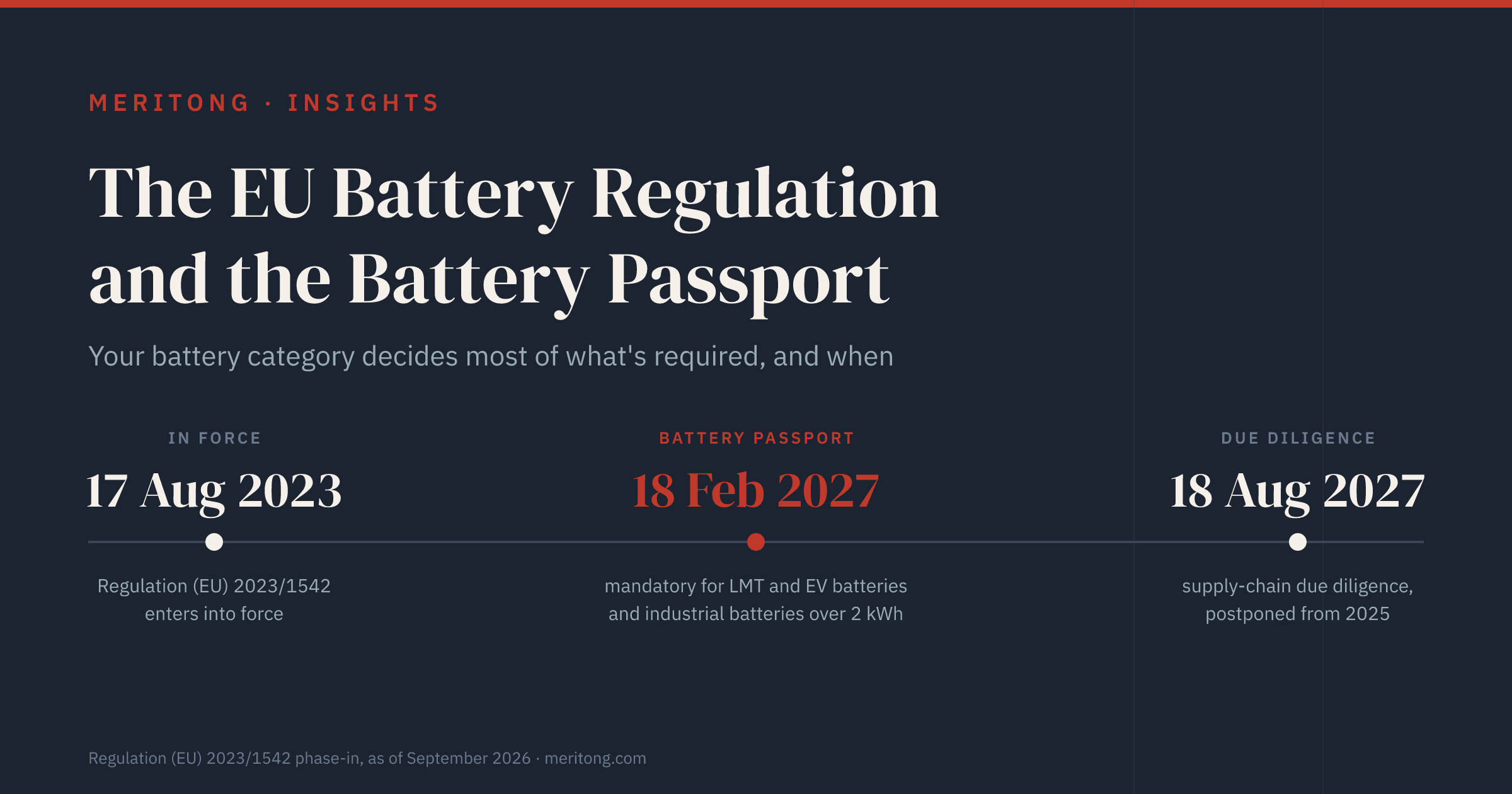
The Regulation entered into force on 17 August 2023, yet that date settles less than it appears to, because the obligations arrive in waves rather than all at once. The headline obligation is the Battery Passport, mandatory from 18 February 2027 for the categories it covers. Several other duties land before and after that date, however, so no single deadline can stand in for the timetable. The practical task is to establish which battery category you are in and then to read the timeline for that category rather than for the Regulation as a whole.
First: which battery category are you in?
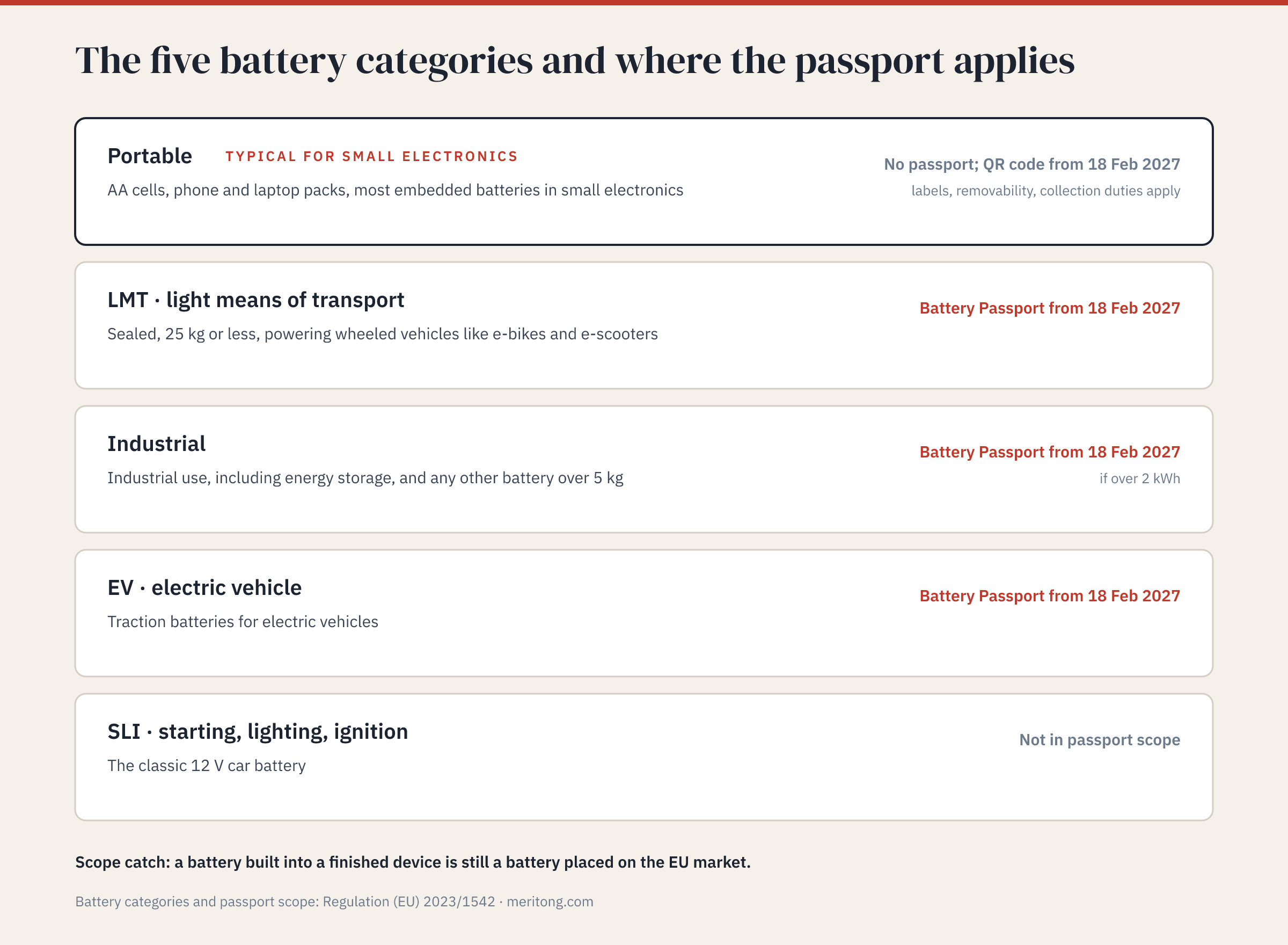
The Regulation sorts every battery into one of five categories, and the category determines most of the obligations that follow:
Portable: sealed batteries of 5 kg or less that fall under none of the other four categories (AA cells, phone and laptop packs, most embedded batteries in small electronics).
Light means of transport (LMT): sealed batteries of 25 kg or less that power wheeled vehicles like e-bikes and e-scooters.
Industrial: batteries designed specifically for industrial use, including energy storage, and any other battery over 5 kg that fits no other category; the passport threshold is set by capacity here (over 2 kWh).
Electric vehicle (EV): traction batteries for electric vehicles.
Starting, lighting, and ignition (SLI): batteries such as the classic 12 V car battery.
For small electronics the relevant category is usually portable, and for e-bikes and e-scooters it is usually LMT. One scope point is easy to miss. The Regulation applies to the battery itself, and a battery built into a finished device is still a battery placed on the EU market; the objection that a company sells a gadget rather than a battery therefore earns no exemption.
Getting the category right is worth a moment, because the Regulation treats the categories differently in substance. A coin cell in a sensor, an e-bike pack, and a grid-storage unit face different labeling, passport, and design duties, and a product that spans categories — say, a portable device sold with an optional larger add-on pack — may be subject to obligations under more than one. For its sustainability and safety requirements, the Regulation assigns a battery that could fit more than one category to the strictest one (Article 1(3)). Classify conservatively elsewhere too, and confirm.
What's required, and when
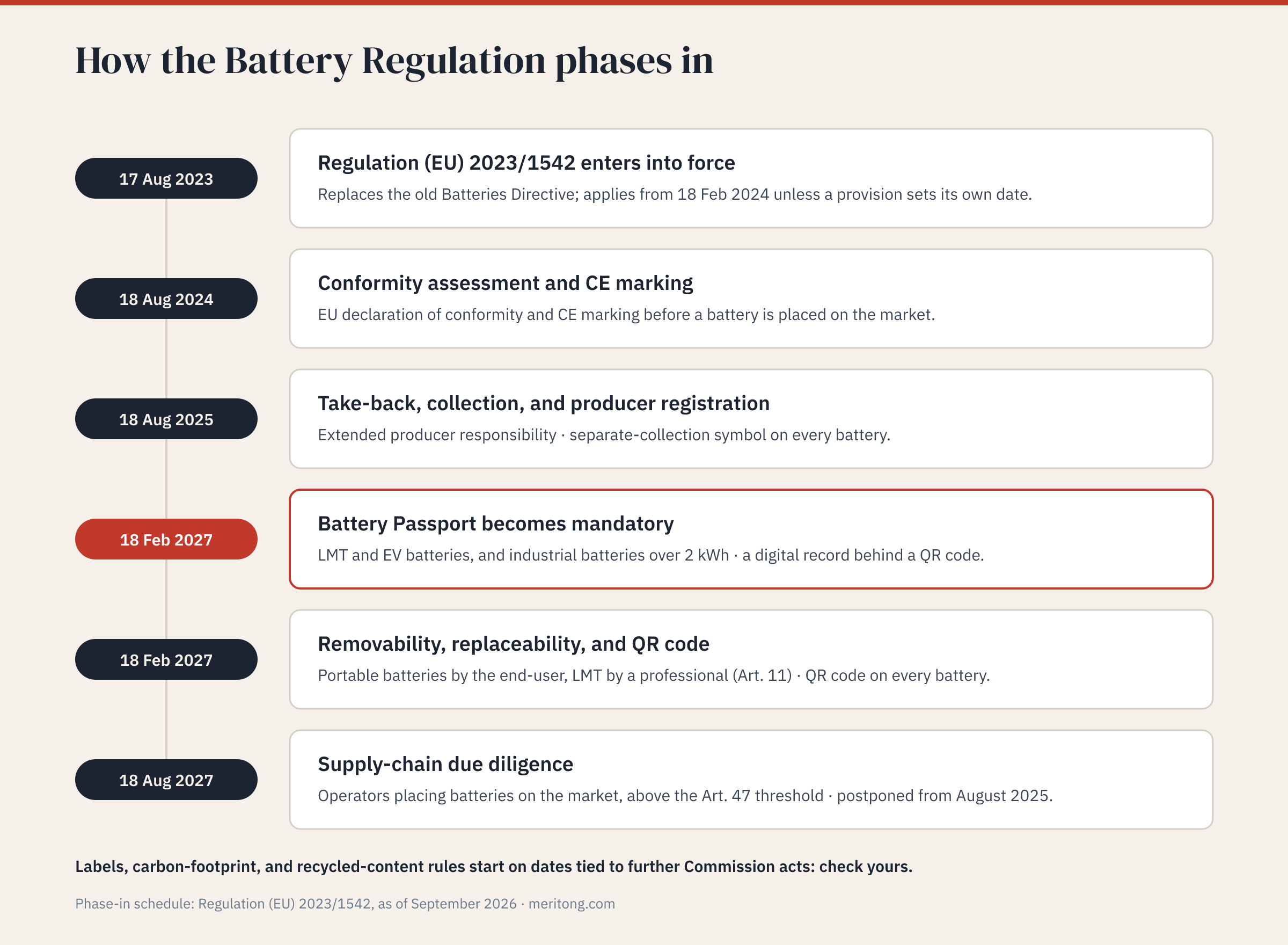
The obligations phase in on different dates. Set out by requirement, the shape is this:
| Requirement | Who / what | Timing |
|---|---|---|
| Entry into force; general application | All batteries | In force 17 August 2023; applies from 18 February 2024 unless a provision sets its own date |
| Conformity assessment, EU declaration of conformity, CE marking | Batteries placed on the market; importers must verify | Since 18 August 2024 |
| Separate-collection symbol | All batteries | Since 18 August 2025 |
| Producer registration, take-back, and collection | Producers, including importers of devices with built-in batteries | Since 18 August 2025 |
| Removability & replaceability | Portable batteries in products (by the end-user); LMT batteries (by an independent professional) | From 18 February 2027 (Art. 11) |
| QR code | All batteries | From 18 February 2027 |
| Battery Passport | LMT and EV batteries, and industrial batteries over 2 kWh | From 18 February 2027 |
| Labels (general information, plus capacity or minimum duration) | All batteries, by type | 18 August 2026 or 18 months after the Commission's label specifications enter into force, whichever is later |
| Supply-chain due diligence | Economic operators placing batteries on the market, including inside products, with a net turnover of EUR 40 million or more, alone or as a group | From 18 August 2027 (postponed from 2025) |
| Carbon-footprint declaration; recycled-content documentation | EV, industrial over 2 kWh (carbon footprint: rechargeable only), and LMT batteries; recycled content also SLI | Staggered by category from 2025 onward; most start dates also depend on Commission methodology acts |
| Collection targets | Producers or their producer responsibility organisations | Portable: 63% by end-2027, 73% by end-2030; LMT: 51% by end-2028, 61% by end-2031 |
Two dates deserve particular attention. The Battery Passport (18 February 2027) is a digital record, accessible through a QR code on the battery, of the battery's identity, its composition, its carbon footprint, and the responsible sourcing of its raw materials. It is mandatory for LMT and EV batteries, and for industrial batteries over 2 kWh. If that describes your product, the data collection behind the passport starts now, because no one can publish a passport for information that was never gathered.
The passport's purpose extends beyond compliance. It is meant to accompany the battery through its life, so that a repairer, a recycler, or a regulator can read from a machine-readable record what the battery is and where it came from. For a manufacturer, that design has a consequence worth dwelling on: the passport can only ever be as good as the data you can pull from your cell supplier — capacity, chemistry, carbon footprint, due-diligence status — and a distributor selling you a finished pack may not hold that information. That is why the passport is best understood as a supply-chain-transparency requirement wearing a QR code.
The supply-chain due-diligence obligation is the one whose date recently moved. Originally set for August 2025, it was postponed to 18 August 2027 by Regulation (EU) 2025/1561, so an older guide telling you it applied in 2025 is out of date on that point. The postponement moved the date without relieving the substance: from that date, a company in scope must set up and implement a due-diligence policy covering the raw materials listed in Annex X (cobalt, natural graphite, lithium, nickel, and their compounds) and have it verified by a notified body (Article 48). In scope are companies that place batteries on the market, including inside products, with a net turnover of EUR 40 million or more, alone or as a group (Articles 47 and 48(1)). A June 2026 provisional agreement on the EU's "Omnibus IV" simplification package would raise that threshold to EUR 200 million once formally adopted, so check which figure applies.
Does this apply to me?
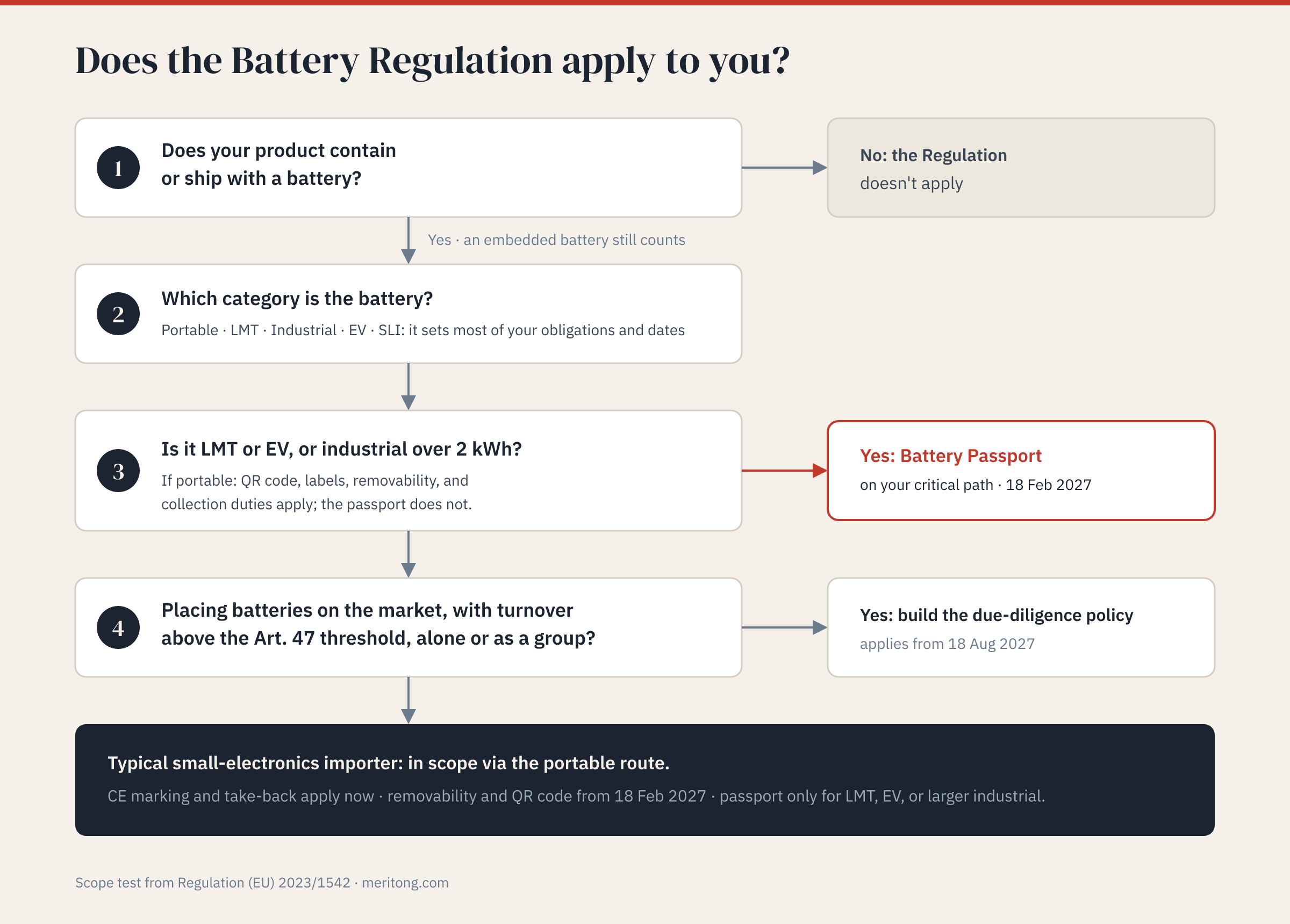
Work it through in order:
Does your product contain or ship with a battery? If not, the Regulation does not apply. If it does, continue, because the battery is in scope even when it is embedded.
Which category is the battery? Portable, LMT, industrial, EV, or SLI: this sets most of your obligations and dates.
Is it an LMT or EV battery, or an industrial battery over 2 kWh? If so, the Battery Passport (18 February 2027) is on your critical path. If it is a portable battery, no passport is required, but the removability rule and the QR code (both from 18 February 2027), the labels, and the collection duties still apply.
Does your company place batteries on the EU market, including inside products, with a net turnover of EUR 40 million or more, alone or as a group? Then the supply-chain due-diligence duty (from 18 August 2027) is yours to build, unless the pending increase of the threshold to EUR 200 million takes you out of scope.
For a small-electronics importer whose products contain batteries, the upshot is this: you are in scope through the portable-battery route; CE marking and take-back already apply; removability and the QR code follow on 18 February 2027, and the full label follows later; and the passport becomes your problem only if you move into LMT, EV, or larger industrial batteries.
Why the compliance work is supply-chain work
The passport and the due-diligence duty share a direction: both reach up your supply chain, into the cell maker, the cathode chemistry, the raw materials. You cannot publish a Battery Passport's composition and carbon-footprint data, and you cannot run a credible due-diligence policy, if you do not know who makes your cells and what is in them. For companies that buy finished packs from a distributor and have never traced the cell origin, that tracing is where the real work of the Regulation is done: in turning an opaque "battery, 3.7 V, from our supplier" line into a documented chain. That tracing is the same dependency-mapping that good sourcing needs anyway; what the Regulation adds is compulsion and a set of dates.
There is a strategic reading as well: a compliance gap and a sourcing dependency can be the same fact seen from two sides. A battery you cannot trace is both at once, since a company that does not know who makes its cells cannot easily second-source them, cannot populate the passport, and cannot move when the price does. A company that treats the Battery Regulation as the prompt to map its cell supply can solve a sourcing-resilience problem and a compliance problem with the same piece of work.
What to do now
The Commission acts still outstanding are no reason to wait, because what the early work requires is the foundational data. Three moves recommend themselves. Identify your battery category (portable, LMT, industrial, EV, or SLI), because most obligations and dates depend on it. Trace your cell supplier and cell chemistry, because the passport, the carbon-footprint and recycled-content rules, and due diligence all draw on that same information. And check the duties that already apply or arrive next, above all portable-battery removability and the QR code on 18 February 2027, the same day as the passport. If you make wearables, electric toys, or equipment for explosive atmospheres, check whether the Commission's July 2026 delegated act has taken effect: where safety requires it, the act lets certain such products restrict battery removal and replacement to independent professionals. If you are heading toward the passport — LMT or EV, or industrial over 2 kWh — begin assembling the passport data set now, since it is a data-collection project, and those run longer than the deadline implies.
FAQ
My product just has a small built-in battery: am I really in scope?
Almost certainly, you are. The Regulation applies to batteries placed on the EU market, and an embedded battery counts. The specific obligations depend on the battery's category, which for small electronics is usually portable, but the fact that the battery is built in does not take you out of scope.
When is the Battery Passport actually required?
The passport is required from 18 February 2027 for LMT batteries, EV batteries, and industrial batteries over 2 kWh. Portable batteries need no passport, but from the same date they need a QR code that leads to their label information and declaration of conformity (Article 13(6)).
Didn't the due-diligence rule apply in 2025?
It was originally scheduled for August 2025 but was postponed to 18 August 2027 by Regulation (EU) 2025/1561, so older guidance citing 2025 is out of date. It applies only to companies with a net turnover of EUR 40 million or more, alone or as a group, and a pending amendment would raise that threshold to EUR 200 million. If you are in scope, plan for the 2027 date, but start building the policy now.
What's the difference between the categories for me?
It decides most of your obligations and their timing. Small-electronics makers are usually in portable; e-bike and e-scooter makers in LMT; energy-storage makers in industrial, where the 2 kWh passport threshold applies. Confirm your category first, because most of what follows depends on it.
What should I do first?
Identify your battery category, then trace your cell supplier and cell chemistry, since that information underpins the passport, the carbon-footprint and recycled-content rules, and due diligence.
Is this the same as the old Batteries Directive?
No: the Regulation replaced the Directive and is much broader. Where the Directive focused mainly on collection and hazardous substances, the Regulation adds carbon footprint, recycled content, due diligence, and the digital passport, and it tightens removability: the Directive's Article 11, which applies until 18 February 2027, accepts designs in which only an independent professional can remove a waste battery; from that date the Regulation requires portable batteries to be removable and replaceable by the end-user throughout the product's life, with limited exemptions (Article 11). Compliance built on the old Directive therefore needs revisiting.
Do the rules apply to a battery inside a finished product I import?
Yes: the Regulation applies to batteries placed on the EU market, including batteries built into imported devices. An importer must verify the declaration of conformity, the CE marking, and the labels before placing the product on the market (Article 41), and it counts as a producer, with registration and take-back duties, where it first makes the batteries available. It cannot push that responsibility entirely onto an overseas maker.
Close
When a battery enters a hardware bill of materials (BOM) as a finished pack and is traced no further than the distributor who sold it, the Battery Regulation turns that opacity into a compliance liability with dates attached.
If you cannot yet say who makes the cells inside your packs, that is the place to start. It is the kind of hardware-component and product-architecture problem I help with, particularly where China sourcing is involved, and I look at hardware, firmware, and sourcing together; get in touch if the question is open at your company.
Meritong is a China-sourcing and supply-chain strategy practice. I am not a lawyer; this article is general information, and it is not legal or compliance advice. Several of the Battery Regulation's dates depend on Commission acts that are not yet in force, and pending amendments may change others. Confirm the current requirement for your specific battery category with qualified counsel before acting.
Get the next pattern by email
One dependency pattern from real hardware audits, occasionally. No schedule promised yet.
Working through this right now? Book a call → or write to me →