Obsolescence
When a Part Goes End-of-Life: Buy or Redesign? A 90-Day Decision Tree
When a component goes end-of-life, you have three options: a bridge buy, a drop-in or second source, or a redesign. This 90-day decision tree shows how to compare their real costs, including carrying cost and requalification, and when to commit to each.
Last updated: October 2026. Standards and cost figures are dated where they appear. Check the source before you rely on a number.
The short version
A discontinuation notice is a decision with a clock on it. It does not amount to an emergency, because the notice itself sets the runway. When a component you ship goes end-of-life (EOL), three real options are open to you. You can place a bridge buy (a last-time buy sized to take you to the product's own end). You can qualify a drop-in or second source. Or you can redesign around the part. All three answer the same underlying question: does it cost less to hold stock or to engineer your way out of the dependency? The expensive mistake is choosing by reflex before you have costed the alternatives. Panic-buying a large quantity of stock is one form of that reflex; launching a redesign is the other.
The right branch turns on five inputs. Two concern the product: how much longer you will ship it and your annual volume. A third is how long the last-order window actually runs. A fourth is whether a swap forces requalification or compliance re-testing. The fifth is what it costs (and risks) to hold bridge stock. My advice is to run the decision inside the first 90 days of the last-order window, using the tree below, so that you commit while the window is still open. For most products the answer is a combination: a small bridge buy placed up front, with a drop-in, second source or redesign qualified behind it.
First, start the clock
Before you decide anything, validate the notice against three facts: the dates, the scope and the where-used list. A product-discontinuance notice (PDN), sometimes issued as a product change notification (PCN), supplies the first two; the third you assemble yourself:
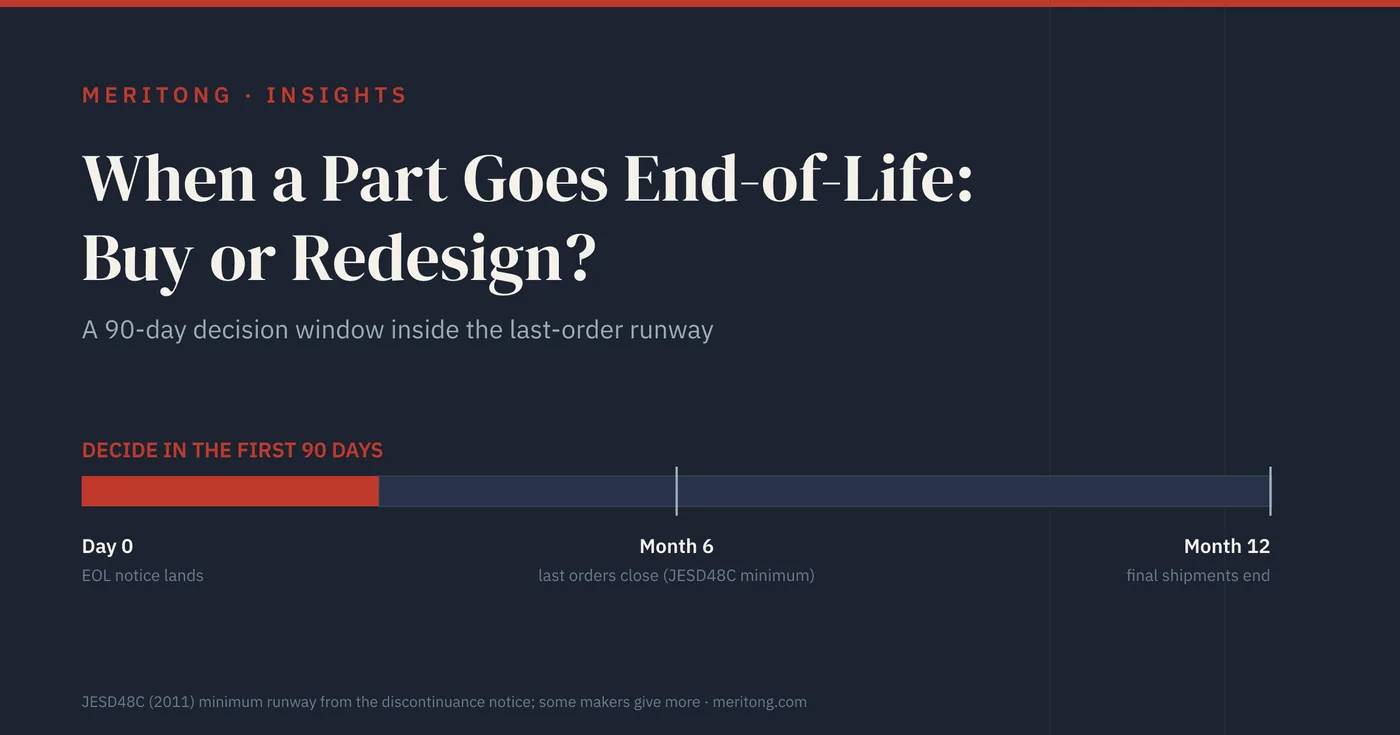
Dates: the notice gives the last-order date and the last-shipment (last-delivery) date. These two dates set your runway: everything downstream is measured from them, and the 90-day tree runs against the last-order date.
Scope: the notice lists the exact manufacturer part numbers affected, including any date- or lot-code qualifiers. Confirm that your specific orderable variant is on the list. Check the packaging, temperature grade and tape-and-reel suffixes as well.
Where-used: you assemble the list of every product and bill of materials (BOM) that contains the part. One EOL part can appear in several products, which means you are deciding for all of them at once.
How much runway does a notice usually give you? The JEDEC discontinuance standard JESD48C (December 2011, read here in a manufacturer-hosted copy of the JEDEC original) sets the floor at clause 3.1: notice "allowing a minimum of 6 months from the notice to place final orders, and 12 months from the notice for final shipments." Those figures are JESD48C's own text. The standard has been revised twice since: it was superseded by J-STD-048 in November 2014 and by J-STD-048A in December 2025. The current revision is behind JEDEC registration, so confirm the wording in force before you rely on it. Texas Instruments is one published example. It states that its schedule "allows 12 months for the last order and an additional six months to take final delivery of obsolete products." TI describes this as a longer lead time than the industry standard. The standard sets a minimum, and a manufacturer may commit to more, as TI's published schedule above does. You therefore typically have somewhere between six and twelve-plus months. The 90-day decision window I recommend is the first sprint inside that runway. It is a discipline that keeps you from spending the whole window deliberating. No standard sets it as a deadline.
The five inputs that decide it
Everything comes down to weighing the cost of holding stock against the cost of engineering your way out. These five inputs tell you which way the balance tips. For each input, the table pairs the condition that favors stock with the condition that favors engineering:
| Input | Leans BUY (bridge stock) | Leans REDESIGN / second source |
|---|---|---|
| Remaining production life | Short: the product retires soon; a finite buy can cover it | Long: you'd be buying stock for years, or forever |
| Annual volume | Low: a full bridge buy is affordable and storable | High: bridge stock ties up too much cash and space |
| Last-order window | Long: time to size and place a considered buy | Short: too little time to size a full-life buy with confidence, so a stopgap buy covers you while you engineer |
| Requalification / re-cert exposure | High: a swap would trigger costly re-testing | Low: a like-for-like part needs little re-qualification |
| Carrying cost + storage risk | Low: cheap part that is neither moisture- nor age-sensitive; easy to store | High: expensive, moisture- or age-sensitive part |
No single input decides it. A cheap, low-volume part in a product with two years left is an easy bridge buy. A high-volume part in a platform you will ship for a decade usually justifies the engineering. The tree is for the cases in the middle, where the inputs lean in different directions.
The 90-day decision tree
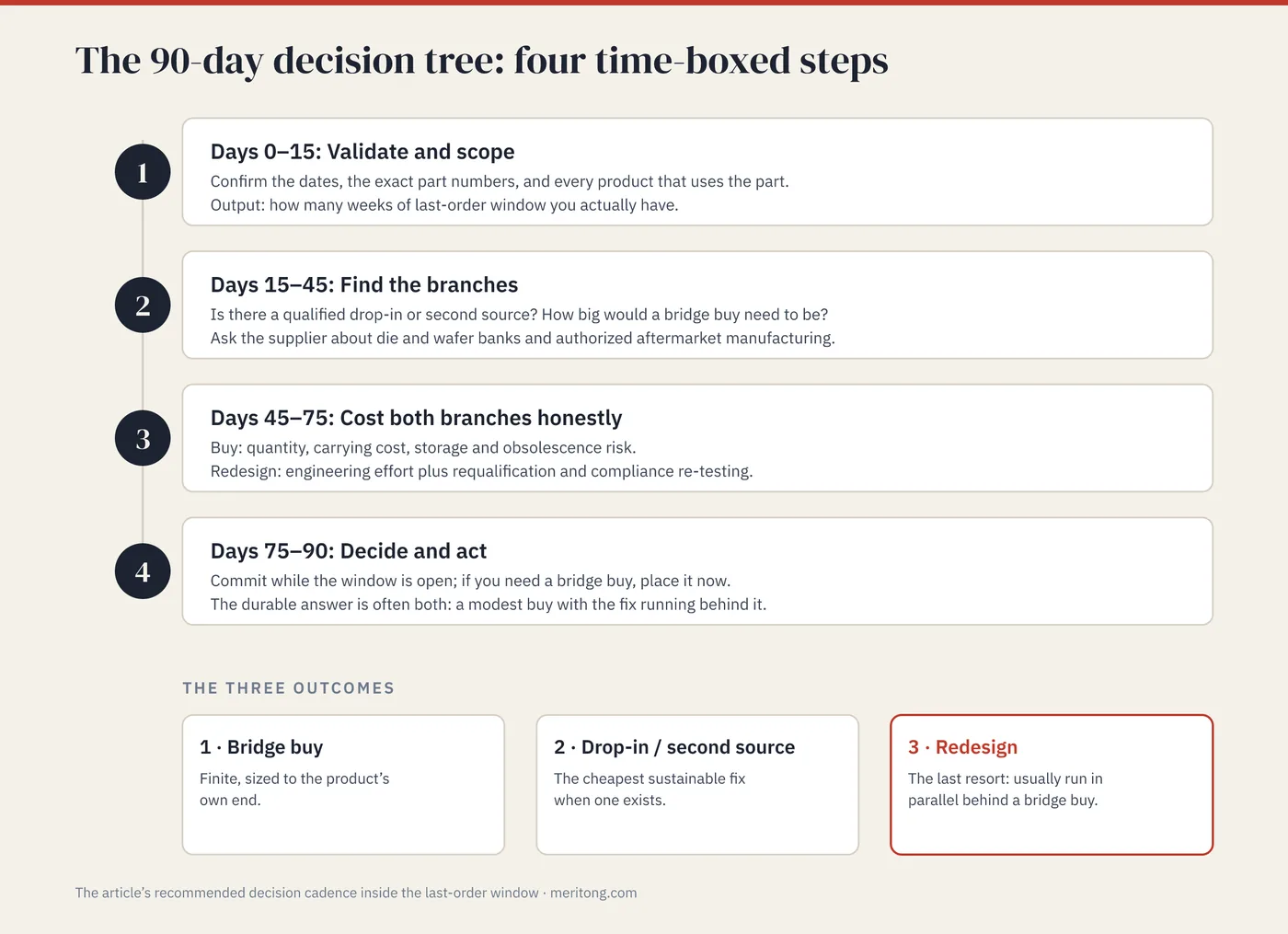
Work through it in four time-boxed steps. The point of the boxes is to force a decision while you still have last-order window left. The branching happens at step 2 and resolves at step 4. Where a qualified drop-in or second source exists, it is the first branch to test. The five inputs above then size the bridge stock you need while it is qualified. Where none exists, the same five inputs decide between a finite bridge buy and a redesign. For most products the durable answer is the combination named at the top of this article. A bridge buy is placed up front, and the drop-in, second source or redesign is qualified behind it.
Days 0–15, validate and scope: pin down the dates, the part numbers and the where-used list from the section above. The output is exactly how many weeks of last-order window you have, and for which products.
Days 15–45, find the branches:
Is there a qualified drop-in or second source? Check the manufacturer's own cross-reference tools and any pin-compatible alternates first. Where a qualified drop-in or second source exists, it is the cheapest sustainable fix. Verifying a candidate is its own job, and the companion how-to on drop-in replacements covers it.
Roughly, how big would a bridge buy have to be? Size it twice. The first quantity covers remaining production plus a service reserve. The second is a smaller stopgap quantity that only has to last until a drop-in or redesign is qualified.
Ask the supplier which further options it will negotiate. JESD48C clause 3.4.1 says that, upon customer request, the supplier "will negotiate with the customer other feasible options, such as the sale or transfer of technology and tooling, and the establishment of wafer or die banks to support on-going requirements." That option, together with authorized aftermarket manufacturing, can turn a discontinued part back into a supplied one.
Days 45–75, cost both branches honestly: put real numbers on both branches. The buy needs numbers for quantity, carrying cost, storage and obsolescence risk. The redesign needs numbers for engineering effort plus any requalification and compliance re-testing. Neither is free, and the two sections below show where the hidden costs are.
Days 75–90, decide and act: commit. If you need a bridge buy, place it now, because the window is closing. In practice the durable answer is often both. Place a modest bridge buy to keep the line running, and start the drop-in qualification or redesign behind it, so that you are not doing this again next quarter. The stock buys the time, and the qualification or redesign uses that time to fix the dependency properly.
The three outcomes: (1) Bridge buy: finite, sized to the product's own end. (2) Qualified drop-in / second source: the cheapest sustainable fix when one exists. (3) Redesign: the last resort, usually run in parallel behind a bridge buy.
What the buy branch costs
A last-time buy looks like the safe choice. Yet sizing it and holding it both cost more than the purchase price suggests, and both costs are easy to leave out of the comparison.
You cannot size it precisely: there is no formula that removes the guesswork. You estimate remaining demand and subtract stock on hand. Remaining demand is annual usage times the years you will keep shipping, plus a service and warranty reserve. The result rests on forecasts of future volume and field reliability, and both forecasts are uncertain. The US Department of Defense's SD-22 obsolescence guidebook puts it bluntly: "because reliability and end of system life are estimates, accurately determining the quantity of an item to buy is nearly impossible" (January 2016 edition, p. 105, note 82; read here in a NASA-hosted copy). SD-22 was revised again in January 2026. You will over- or under-buy, and the question is which error you can afford. The surplus of an over-buy ends as a write-off. An under-buy ends as a shortage.
An illustrative example (numbers invented to show the method): take a part used at 8,000/year with 4 years of production left. Assume a 5,000-unit service reserve and 3,000 units in stock. The bridge buy is then 8,000 × 4 + 5,000 − 3,000 = 34,000 units. At €0.80 each that's about €27,000 of inventory, before you've paid to hold it.
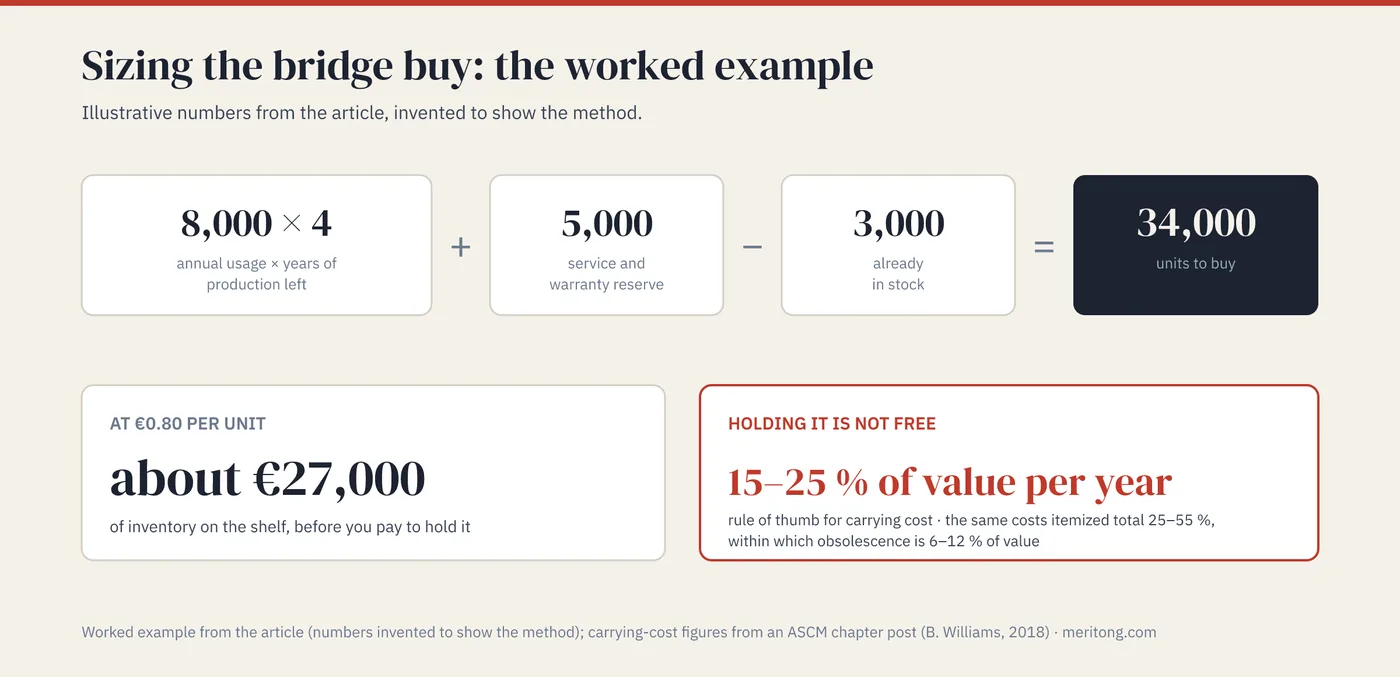
Holding it is not free: the working 15–25% rule of thumb puts inventory carrying cost at roughly 15–25% of the stock's value per year. Blair Williams (CFPIM, CSCP, CLTD) stated it in a May 2018 post on a chapter site of the Association for Supply Chain Management (ASCM). The same page quotes logistics experts placing it between 18% and 75% depending on the type of products and business. The itemized breakdown on that page reaches 25–55% in total, with cost of money at 6–12% and obsolescence at a further 6–12%. Hold that €27,000 buy for years and the carrying cost alone can run into five figures. If you over-bought, the surplus is a write-off.
The stock also has to survive storage physically. SD-22 records two relevant mechanisms, though each in another context. The first is moisture: "[m]any plastic-encapsulated electronic items absorb moisture over time" and are "easily damaged by the expanding gas as it exits the device" if excess heat is applied before the moisture can be baked out. SD-22 writes this about salvaged and counterfeit parts (Appendix F.1.2). The second is tin whiskers: lead-free finishes are prone to tin-whisker growth, which SD-22 discusses under the transition away from lead. Both apply to parts held in long-term storage. Cheap parts without these sensitivities store for years, whereas fine-pitch or moisture-sensitive parts are a liability. That is why the table's last row leans toward engineering for an expensive, moisture- or age-sensitive part.
Die and wafer banking and authorized aftermarket manufacturing can both keep a discontinued part supplied without buying on the open market. Die and wafer banking stores wafers or unpackaged die for later packaging, which extends supply well past the last finished-goods buy. Long-life programs in aerospace, defense and medical electronics take this route. Authorized aftermarket manufacturers keep obsolete parts in production under license. Rochester Electronics, for instance, states that it is "licensed to manufacture devices no longer produced by the original component manufacturer," using "information transferred directly to Rochester from the original component manufacturer (OCM)." Both give you genuine parts without the counterfeit exposure of the open market, and both belong in the step-2 conversation with the supplier. The JESD48C options quoted above belong there too; the standard says a discontinuing supplier will negotiate them on customer request.
What the redesign branch costs
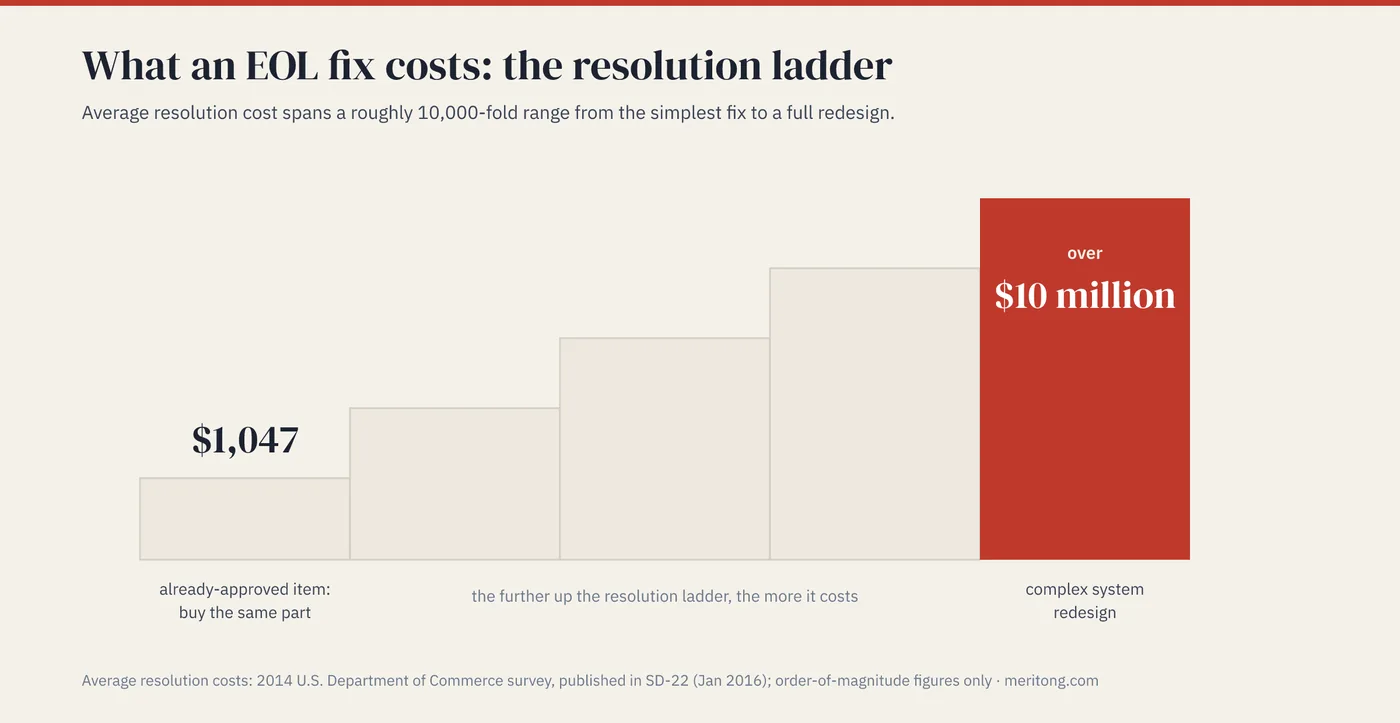
Redesign is a powerful option and a costly one: it changes the board itself, so that the product no longer depends on the discontinued part. How much more costly depends on how far the fix has to reach. A 2014 US Department of Commerce survey was published as Table 12 of the January 2016 edition of the SD-22 guidebook. It put the average resolution cost at $1,047 for the cheapest route, an already-approved item. For a complex redesign or system replacement, the average rose to $10,473,148. That is a roughly ten-thousand-fold spread. Treat those figures as order-of-magnitude only. The guidebook's own caution is aimed at the averages its earlier editions published. Those averages "did not consider all of the applicable cost elements", so that "budgets based on these averages usually underfunded resolution implementation." In my reading, the same caution applies to this table, although the guidebook does not say so. SD-22 has been revised several times since, most recently in January 2026, so confirm the figures against the current edition before you rely on them. The further you climb the resolution ladder from "buy the same part" to "redesign the board," the more it costs.
Engineering hours are easier to forecast than test and certification effort. Requalification and re-certification can be the larger cost in a redesign, because a design change can restart formal test programs.
In automotive electronics, the Automotive Electronics Council's AEC-Q100 standard (Rev-J1, 24 March 2026) requires requalification of an automotive integrated circuit whenever its supplier "makes a change to the product and/or process that impacts (or could potentially impact) the form, fit, function, quality and/or reliability of the device" (§3.2). The requalification it describes is a stress-test program drawn from the standard's own test tables. Wherever generic data is lacking, the program is sampled across non-consecutive wafer and assembly lots (§2.5.1). Parts in the same product qualification family "are qualified by association when one family member successfully completes qualification." The exception is the device-specific requirements, which the standard keeps outside that allowance (Appendix 1, cross-referring to §4.2). AEC-Q100 governs the chip supplier's qualification of its own device and leaves your approval of a part for your application outside its scope (§1.3.3, §3.4). A drop-in from the original supplier's qualification family is qualified by association, apart from those device-specific requirements. A part from a second manufacturer relies on that manufacturer's own AEC-Q100 data, which cannot draw on the original supplier's family. Your own module-level validation follows your customer's requirements in either case, and AEC-Q100 does not set it.
For electromagnetic compatibility (EMC), the European Commission's guide to the EMC Directive addresses changed products. Where a product has been "subject to substantial changes that may have a significant impact on its compliance with the EMCD," the apparatus "becomes a new product entering the market." The original EU type-examination certificate "is then not valid anymore." The guide is non-binding, since the Commission says it "has no weight in law." The edition cited is dated April 2025 (pp. 48–49). The Commission posted it in October 2026 in place of the December 2018 edition, and so far it is available in English only. It is cited by page because its table of contents and its body give the number 7.2 to different subsections. The guide sets no bright-line threshold for "substantial," so the question is a judgment call. The passage addresses apparatus that took the EU type-examination route with a notified body. It does not address apparatus the manufacturer self-assessed. Even so, a significant hardware change can put you back into conformity assessment. In the US the analogue is the Federal Communications Commission (FCC) rule for equipment authorized under a Supplier's Declaration of Conformity. The rule states that "the responsible party must reevaluate the equipment if any modification or change adversely affects the emanation characteristics of the modified equipment" (47 CFR § 2.931(e), as in force in October 2026). Equipment authorized under the stricter Certification procedure follows the permissive-change rules of 47 CFR § 2.1043 instead.
In functional safety, an EOL swap in safety-related electronics can trigger a documented impact analysis. The IEC 61508 functional-safety standard is currently at Edition 2.0 (2010). It sets out a dedicated modification phase (part 1, clause 7.16; parts 2 and 3, clause 7.8). The functional-safety certification body exida (2013) quotes part 3, clause 7.1.2.9. In exida's rendering, the clause applies where a modification "pertaining to an earlier lifecycle phase" is needed at any phase of the software safety lifecycle. In that case it requires that "an impact analysis shall determine (1) which software modules are impacted, and (2) which earlier safety lifecycle activities shall be repeated." IEC 61508 is not published free of charge, so confirm the clause text against your own copy.
I am a sourcing and supply-chain consultant, and I do not stand in for your compliance authority. The cases above show that a redesign can force re-testing. It does not follow that every swap does. You need your compliance lead to scope that exposure before you compare branches. Miss it, and the "cheap" redesign turns out to include a certification bill nobody costed.
FAQ
Does "not recommended for new designs" (NRND) mean I have to redesign now?
No, it does not. NRND means the manufacturer will not recommend the part for new designs and may discontinue it later. Existing designs can still order it. Any longevity commitment the manufacturer has published still holds. It is a signal to start planning. A discontinuation is a different event, and the buy-vs-redesign decision belongs at the actual EOL notice.
How long do I really have?
Read the notice for the last-order and last-shipment dates. The published floor is a minimum of 6 months from notice for final orders and 12 months for final shipments. That floor comes from JESD48C (2011), which has since been superseded, so confirm the revision in force. A maker may give more, as TI's published schedule does. The 90-day tree in this article is my recommended decision cadence inside that window, and nobody sets it as a deadline for you.
How big should the bridge buy be?
The formula is remaining annual demand times remaining production years, plus a service reserve, minus stock on hand. Accept that the result is an estimate: SD-22 calls sizing it exactly "nearly impossible." Then weigh the cost of over-buying against the cost of running short. The cost of over-buying is carrying cost of roughly 15–25% of value per year, plus write-off risk.
Does a drop-in replacement avoid re-testing?
Often it reduces the re-testing. At component level, a part from the original supplier's AEC-Q100 qualification family may be qualified by association. The device-specific requirements that the standard keeps outside that allowance still apply. At board level, a genuine form-fit-function match limits how much of your own validation has to be repeated. A redesign with a new footprint and layout repeats more of it. AEC-Q100 governs only the component level.
Buy and redesign: is that normal?
Yes, and it is usually the smart answer. A modest bridge buy keeps the line running while a drop-in, second source or redesign is qualified behind it. You spend a little on stock to buy the time to fix the dependency properly.
Close
Buy-or-redesign is a decision about a single dependency. It feels like a fire drill because the exposure was invisible until the notice landed. Typically, a part had been single-sourced without anyone noticing, and nobody had costed its alternatives. If you would rather find dependencies like that before the next notice, I help hardware companies work through product-architecture and component problems of this kind. I do this particularly where China sourcing is involved, evaluating hardware, firmware and sourcing together.
Meritong is a China-sourcing and supply-chain strategy practice. I am not a lawyer and not a licensed customs broker. This article offers general guidance and does not constitute legal, compliance, or certification advice. Qualification, certification and conformity-assessment questions belong with your compliance lead or another qualified professional, who should assess your own product before you act on anything here.
Typical dependencies by email
Examples from real hardware audits, sent occasionally.
Working through this right now? Free intro call → or write to me →
Is this question on your desk right now?
In the free potential check you tell me the type of components you use. After 30 minutes you know whether an audit is worth it.
Free intro call