Customs
HS Code Classification for Electronic Components: A Step-by-Step Guide (and Where One Wrong Digit Costs You)
Every product that crosses a border gets classified under a commodity code, and that code — not your invoice description — decides your duty rate, your overlay tariffs, and which regulations apply. Classifying an electronic component comes down to seven steps.
Last updated: July 3, 2026 · ≈19-minute read · Nothing here is legal advice; always consult a licensed professional when unsure. Where a decision is expensive, this guide tells you when to get a binding ruling or a licensed customs broker involved.
The short version
Every product that crosses a border is classified under a commodity code, and that code decides your duty rate, your overlay tariffs, and which regulations apply. The description on your invoice decides none of them.
Two propositions govern everything below. The first is that classification is a legal determination about the object in the container, reached through a fixed hierarchy of rules, and the obligation to reach it correctly is the importer's. The second is that much of electronics trades at low or zero base rates, while the cost appears further down, in the digit-level splits and in the overlays.
Classifying an electronic component comes down to seven steps:
Describe the item as it crosses the border: its function, composition, and physical state at the moment of import, regardless of what it becomes after assembly.
Find the four-digit heading first: work from the section and chapter notes, since typing a product name into a search box is not the legal method.
Answer the parts question: many electronic "parts" have their own heading and must be classified there, whatever machine they go into.
Break ties in the prescribed order: most specific description, then essential character, then last in numerical order.
Extend the six-digit code to your national system: 10 digits in the US, 8 or 10 in the EU, 11 for a German import.
Verify against published rulings and check the overlay tariffs your code triggers for your country of origin.
Lock down anything expensive or ambiguous with a binding ruling, and record your reasoning.
Published rulings and current rates run through the steps below, along with one worked example: a barcode scan engine whose single assembly produces three different duty outcomes.
What an HS code actually is
The Harmonized System (HS) is the international product nomenclature maintained by the World Customs Organization. It sorts everything tradable into more than 5,000 commodity groups, each identified by a six-digit code, and more than 200 countries and economies use it, covering over 98% of world merchandise trade.
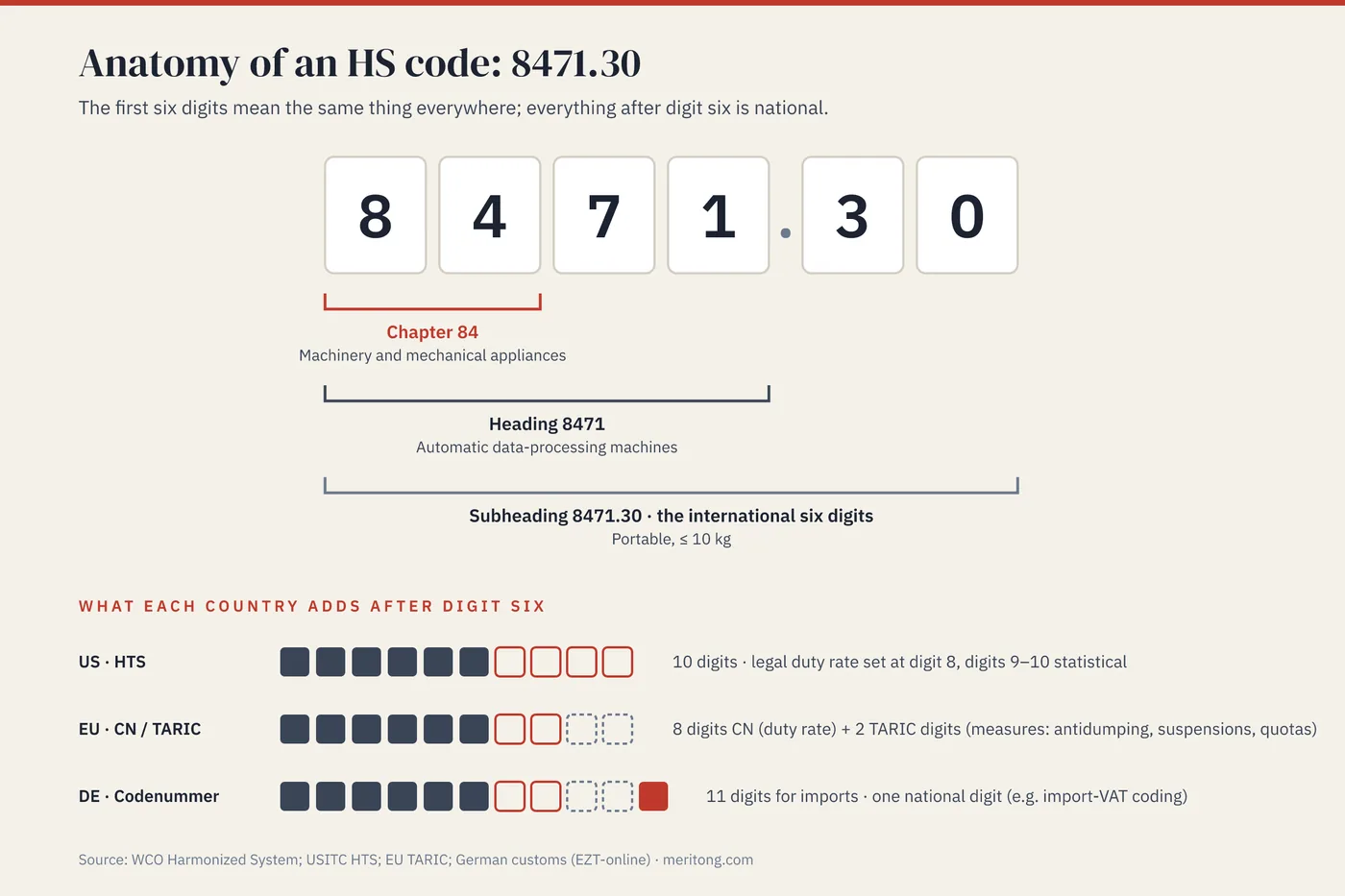
The six digits are built in layers. Take 8471.30, where chapter 84 is the machinery chapter, heading 8471 is the one for automatic data processing machines, and subheading 8471.30 narrows that to the portable machines at ≤10 kg. The first six digits mean the same thing in Hamburg, Shenzhen, and Chicago. Harmonization stops at that point, yet the duty rate is set past it, in digits each jurisdiction writes for itself:
| System | Digits | What the extra digits specify | Lookup tool |
|---|---|---|---|
| US: Harmonized Tariff Schedule (HTS) | 10 | Legal duty rate set at digit 8; digits 9–10 are statistical | hts.usitc.gov |
| EU: Combined Nomenclature (CN) | 8 | EU conventional duty rate | TARIC consultation |
| EU: TARIC (the EU's integrated tariff) | 10 | Measures: antidumping, suspensions, quotas | same |
| Germany: import Codenummer | 11 | One national digit (e.g., import-VAT coding) | EZT-online |
The decision space expands quickly inside those national layers. The HS has 5,612 six-digit subheadings, while the 2026 US tariff schedule expands them into 11,414 eight-digit lines and 19,738 ten-digit reporting numbers, which works out at roughly 3.5 lines for every international subheading. The six digits are agreed internationally; the number that actually goes on a US entry is chosen from a space three and a half times as large.
Editions matter as well. HS 2022 has been in force since January 1, 2022, and HS 2028 takes effect on January 1, 2028 with 299 sets of changes. Codes you classified once will move, which makes a classification an answer with a date attached, kept current by the refresh discipline in Step 7.
Where one wrong digit costs you
Much of electronics trades at low or zero base rates. Under the World Trade Organization (WTO) Information Technology Agreement, 84 participants covering about 97% of IT-product trade have bound many IT tariffs at zero, and those bindings encourage complacency. What a zero headline rate settles is the base rate on one line of the schedule; the cost appears further down, in the digit-level splits and in the overlays.
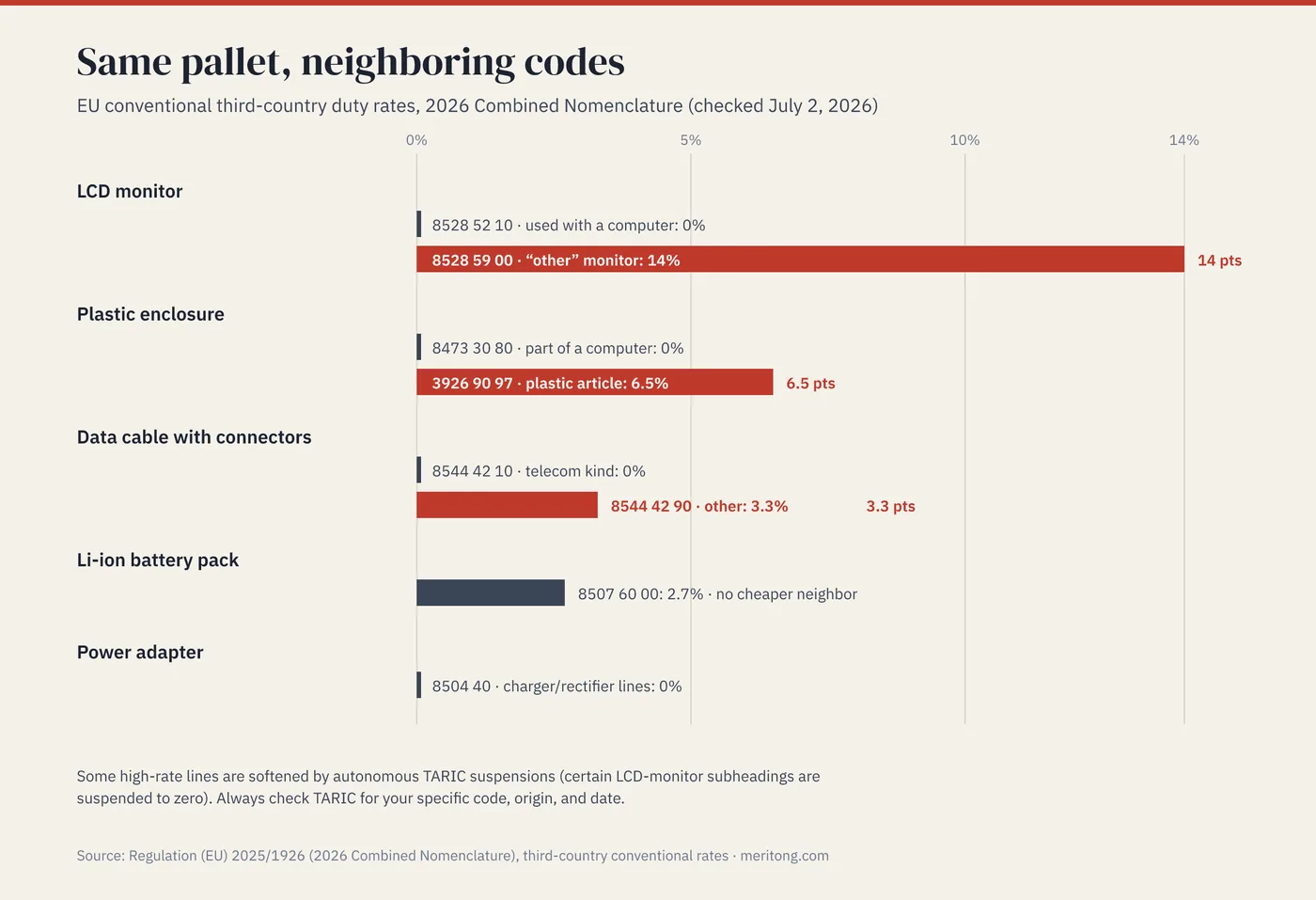
EU conventional rates, straight from the 2026 CN regulation (third-country rates, checked July 2, 2026):
| On the pallet | One code path | The neighboring path | Spread |
|---|---|---|---|
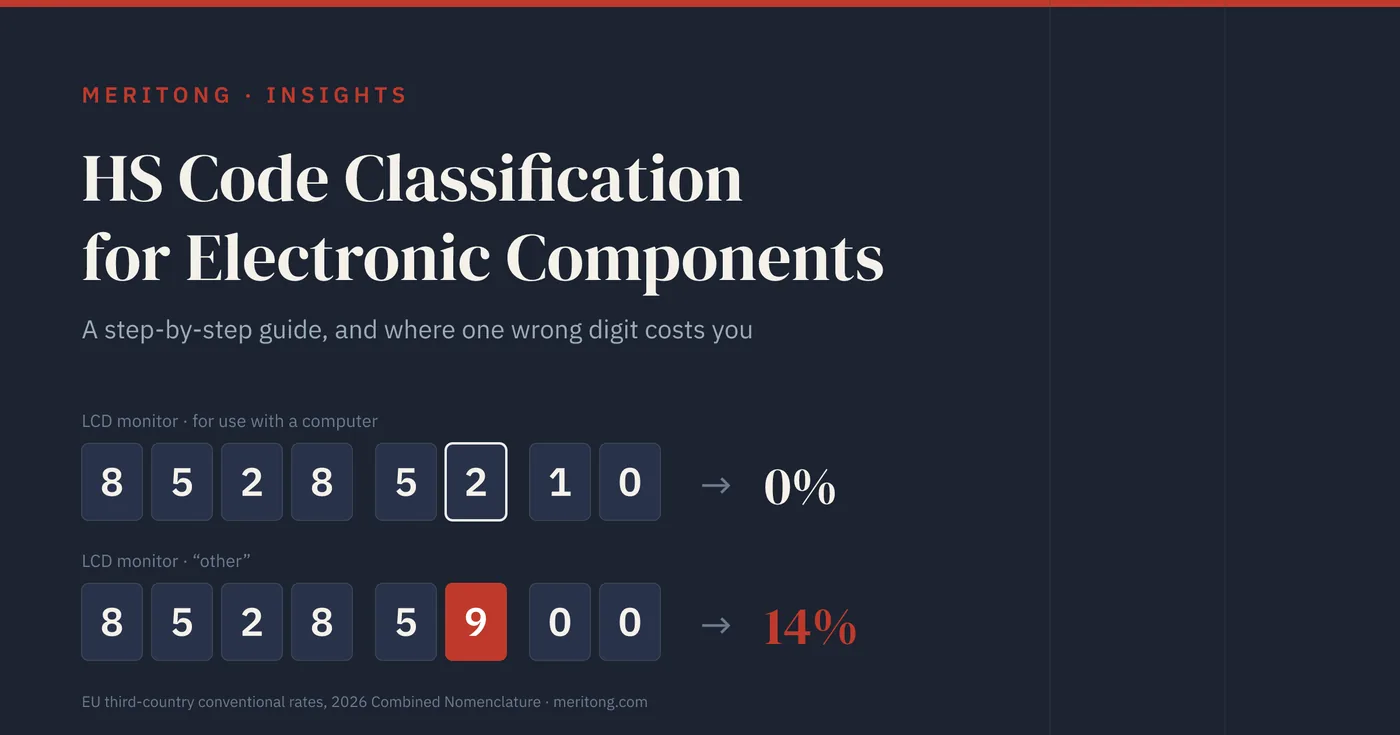
| LCD monitor | 8528 52 10, used with a computer: 0% | 8528 59 00, "other" monitor: 14% | 14 pts |
| Data cable with connectors | 8544 42 10, telecom kind: 0% | 8544 42 90, other: 3.3% | 3.3 pts |
| Plastic enclosure | 8473 30 80, part of a computer: 0% | 3926 90 97, plastic article: 6.5% | 6.5 pts |
| Li-ion battery pack | 8507 60 00: 2.7% | n/a | n/a |
| Power adapter | 8504 40 (charger/rectifier lines): 0% | n/a | n/a |
The first three rows each describe one physical object on one pallet, with two code paths open to it and a different rate at the end of each. Autonomous suspensions soften some of those 14% lines; certain LCD-monitor subheadings, for example, are suspended to zero. That is exactly why you check TARIC for your specific code and your date; a table is not the place to settle it, this one included.
The spreads are not theoretical. The Court of Justice of the EU spent years on set-top boxes because, in the Sky+ cases, one provision was duty-exempt while a competing heading was subject to 13.9% at the time, and on LCD monitors at 0% versus 14% in Kamino. The European Court of Auditors lists misclassification among the main channels of customs-duty evasion it expects member states to police.
The record holder: In March 2024, Ford agreed to pay $365 million to settle allegations that it imported Transit Connect vans with temporary rear seats so they would enter as passenger vehicles at 2.5% instead of cargo vehicles at 25%. One heading separated those two rates, and the settlement that followed is what U.S. Customs and Border Protection (CBP) called "one of the largest customs penalty settlements in recent history." It was settled without a determination of liability.
US overlays, with status as of July 2, 2026: this block moves, so verify it before relying on it. For a US importer the base most-favored-nation (MFN) rate is often the smallest number in the stack; what classification actually selects, code by code and origin by origin, is which overlays apply:
Section 301 duties on China-origin goods remain in force at list-dependent rates: 25% on List 3, 7.5% on List 4A. The 2024 four-year review raised semiconductors to 50% from January 1, 2025, and non-EV lithium-ion batteries to 25% from January 1, 2026.
A 25% Section 232 tariff applies to specified advanced computing chips since January 15, 2026, covering logic integrated circuits under 8471.50, 8471.80 or 8473.30 that meet defined performance parameters, with carve-outs. It does not apply to chips generally.
The 2025 "fentanyl" and "reciprocal" tariffs, based on the International Emergency Economic Powers Act (IEEPA), were ruled unlawful by the Supreme Court on February 20, 2026. A 10% global surcharge under Section 122 replaced them on February 24, 2026, with carve-outs that include certain electronics and Section 232-covered articles. That surcharge reached its statutory 150-day limit and expired on July 24, 2026, after litigation over it had run for months. The Office of the United States Trade Representative then took final action in its Section 301 forced-labor investigations covering 60 economies, at 12.5% for the investigated economies generally and at 10% or 12.5% net of the most-favored-nation rate for certain products of the European Union, Taiwan, Japan, Korea and Switzerland, published in the Federal Register on July 28, 2026. Verify what is actually being collected against your own code and origin when you read this.
One 2025 CBP ruling shows the mechanics: four subheadings in a single ruling, each with its own overlay stack, 25% Section 301 on three lines and 7.5% on the fourth. The product family was one; the digits differed, and so did the money.
What happens when the code is wrong? The exposure widens with the degree of fault. In the EU, customs can recover underpaid duties three years back, up to ten where the act was liable to criminal proceedings, plus interest at the European Central Bank's main refinancing rate plus 2 points. In Germany, a recklessly wrong declaration risks fines up to €50,000 under § 378 of the German Fiscal Code (Abgabenordnung, AO), whereas an intentional one is criminal tax evasion (§ 370 AO), which expressly covers import duties. In the US, 19 U.S.C. § 1592 grades it by degree of fault: negligence up to 2× the duties lost, gross negligence 4×, fraud up to the domestic value of the merchandise. The unpaid duties themselves are owed regardless of the grade. Since the 1993 Customs Modernization Act, "reasonable care" in classification is legally the importer's job; the obligation does not pass to your freight forwarder.
The seven steps
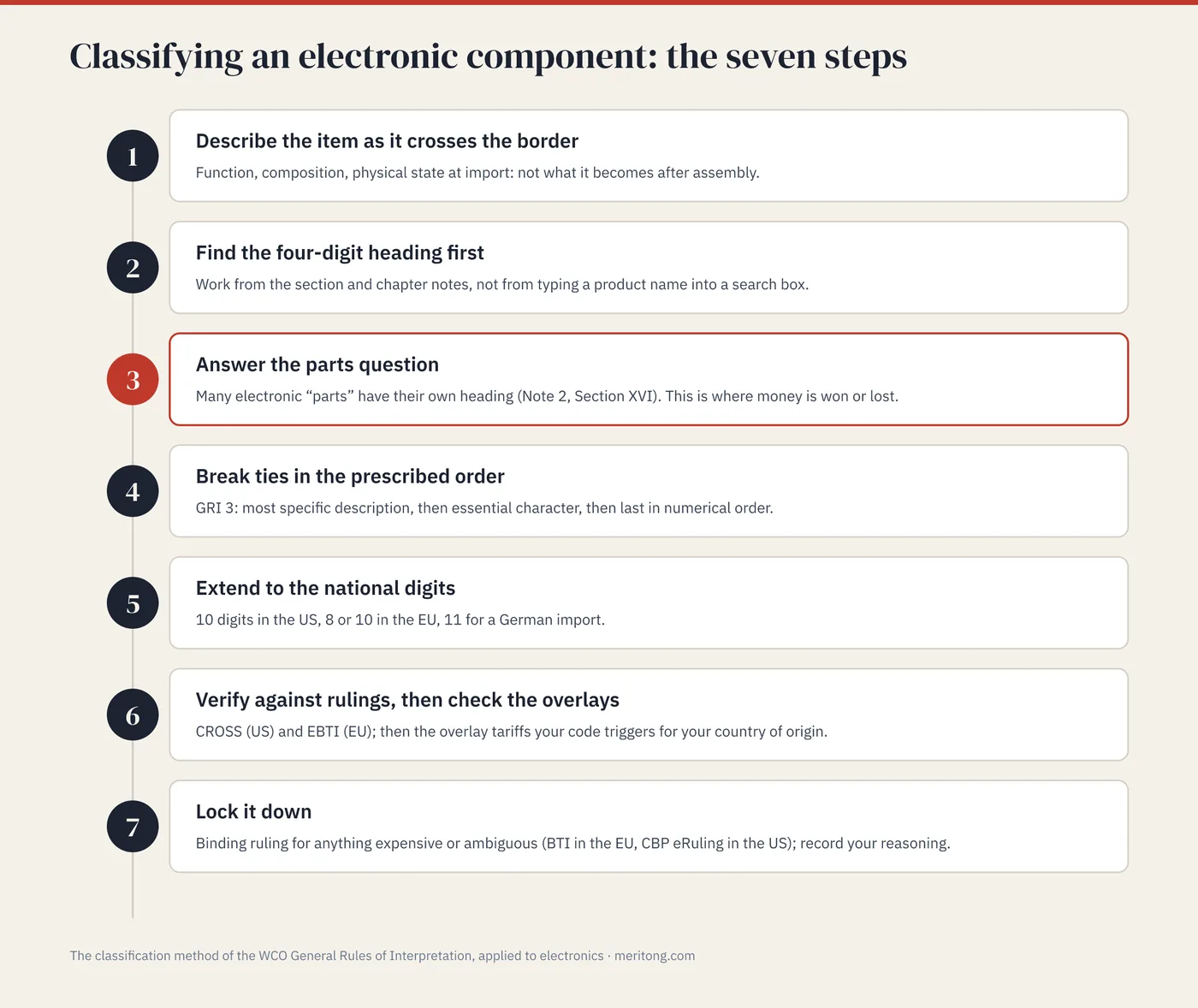
Steps 1 through 4 produce the six-digit answer, working through the General Rules of Interpretation and the legal notes in the sequence those rules prescribe. Step 5 extends that answer into the national digits, where the rate is set. Steps 6 and 7 test it, first against what customs has already decided for other importers, then, where the sums justify it, against what customs will decide for you.
Step 1: Describe the item as it crosses the border
Classification looks at the object in the container: its function, composition, and state at the moment of import. It does not look at the marketing name, and it does not look at what the object becomes after assembly. Two consequences matter. An incomplete article that already has the essential character of the finished one is classified as the finished article under General Rule of Interpretation (GRI) 2(a); CBP has ruled that a mower deck imported with its powerhead installed is an "incomplete machine," classified as a finished mower, whereas the same deck without it is a part. An unassembled kit is likewise classified as the assembled article.
Write one sentence per stock-keeping unit (SKU) recording what the item is, what it is made of, and what state it ships in. That sentence drives everything else.
Step 2: Find the heading before the code
The legal method (GRI 1) is that classification is determined by the terms of the four-digit headings and the section and chapter notes. Everything else comes later. In practice you identify the chapter (electronics live mostly in Chapters 84–85, together "Section XVI"), list the candidate headings, and read the notes before you commit.
Do not start with keyword search. The U.S. International Trade Commission (USITC), which publishes the HTS, warns in its own FAQ that searching "phone charger" in the official HTS tool returns "No matching results found". The reason is that chargers are legally "static converters" under 8504. The difficulty is that the search tool indexes tariff language, whereas the name on your invoice is product language, so a description that is obvious in the market may not appear in the tariff at all. Use the tool to find neighborhoods; never let it settle a final answer.
Step 3: Answer the parts question
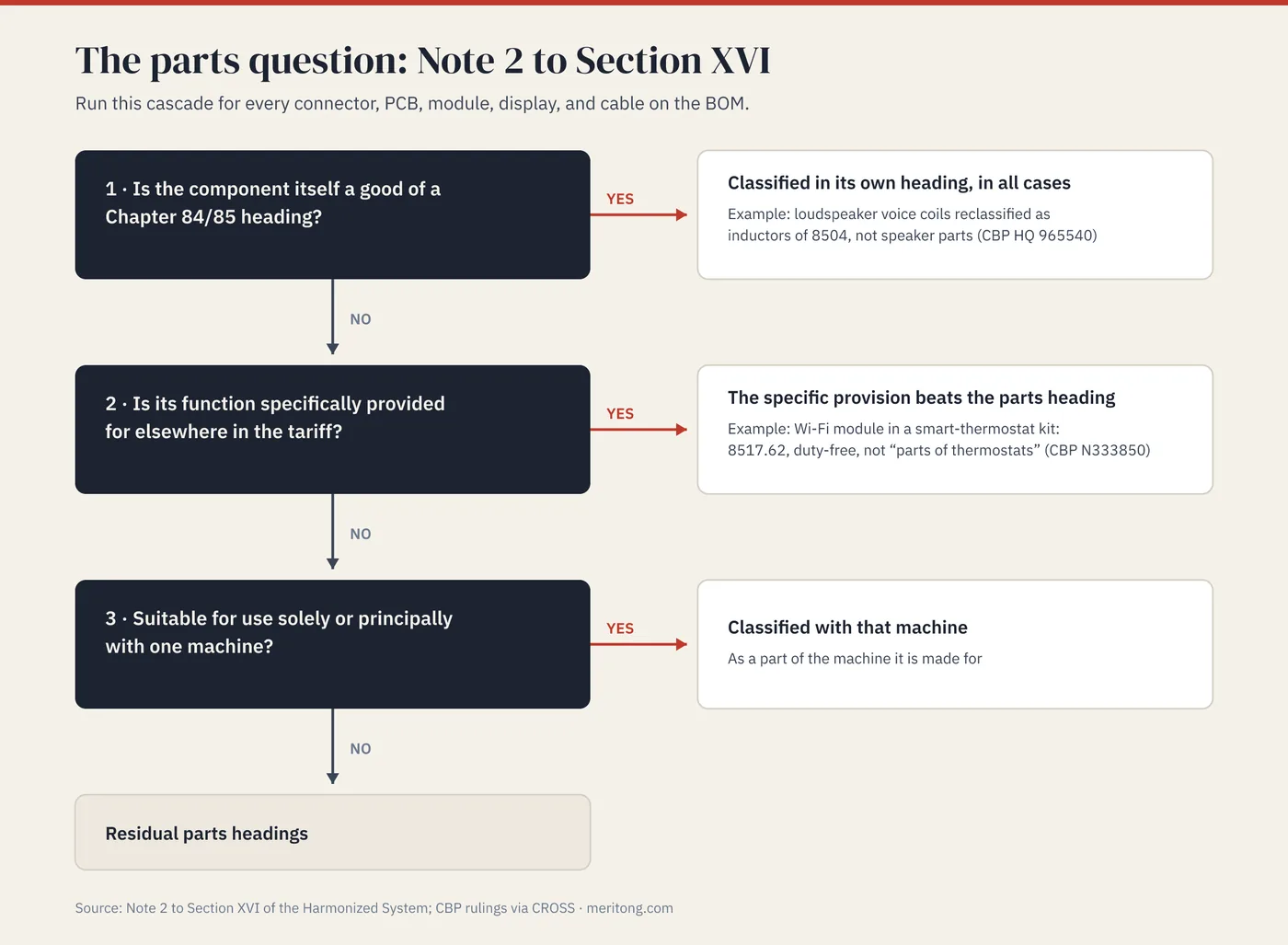
Here is where electronics classification is won or lost. Intuition says a component is a "part of" the machine it goes into. The law says otherwise, in a fixed cascade (Note 2 to Section XVI):
Is the component itself a good of a Chapter 84/85 heading? If it is, it is classified in its own heading, in all cases. CBP once reclassified loudspeaker voice coils as inductors of heading 8504 instead of speaker parts under 8518.90, and granted the importer's protest against its own earlier decision.
Is the component's function specifically provided for elsewhere in the tariff? The specific provision beats the parts heading, and it is a rule the tariff repeats across its chapters. An importer proposed "parts of thermostats" for a Wi-Fi module inside a smart-thermostat kit; CBP classified it under 8517.62 as wireless transmission/reception apparatus, duty-free, because Wi-Fi connectivity is separately provided for in the tariff.
Only if neither applies: is the component suitable for use solely or principally with one machine? If it is, it classifies with that machine. Otherwise it falls to the residual parts headings.
Read as a whole, the cascade asks what the component is before it asks what the component is used with, so that "part of a machine" comes last. A parts classification applies insofar as the component's own heading and any specific provision elsewhere in the tariff have both been ruled out, and no further. Run this tree for every connector, printed circuit board (PCB), module, display, and cable on your bill of materials (BOM). In the audits I run, "it's a part of our device" is the most common (and most expensive) wrong answer.
Step 4: Break ties in the prescribed order
When two headings actually compete, GRI 3 resolves them in strict sequence: (a) the most specific description wins; (b) failing that, composite goods classify by the component giving their essential character, an undefined term weighed by material, bulk, weight, value, or role; (c) failing that, the heading last in numerical order wins. The order is itself part of the rule, since each tie-break becomes available only once the one before it has failed. The same logic repeats at subheading level (GRI 6), comparing only subheadings of the same level.
In practice, most component questions settle at GRI 1. Reaching 3(c) honestly, which is coin-flip territory, is a signal to get a binding ruling (Step 7) rather than an invitation to pick the cheaper rate.
Step 5: Extend to the national digits
Six digits are an international answer; a customs entry needs a national one.
US: at hts.usitc.gov, navigate to your heading and walk the indentation down to the 8-digit legal rate line and the 10-digit statistical suffix, since the 10-digit number goes on the entry. Read all three duty columns: General for most countries, Special for free-trade-agreement preferences, and Column 2, which currently covers Belarus, Cuba, North Korea, and Russia.
EU: in the TARIC consultation tool, enter the code or browse down from your six digits, set origin country and date, and hit Retrieve Measures for the full measure stack: conventional duty, antidumping, suspensions, quotas, updated daily. (Access2Markets wraps the same data in a friendlier interface.)
Germany: an import declaration needs the 11-digit Codenummer, which is TARIC's ten digits plus one national digit, resolvable in EZT-online. Exports need only the 8-digit Warennummer from the Destatis goods list.
Step 6: Verify against rulings, then check the overlays
Before trusting your answer, check whether customs has already answered it for someone else. The US has the Customs Rulings Online Search System (CROSS), searchable by plain product words, and the EU has the public European Binding Tariff Information (EBTI) database of issued binding decisions.
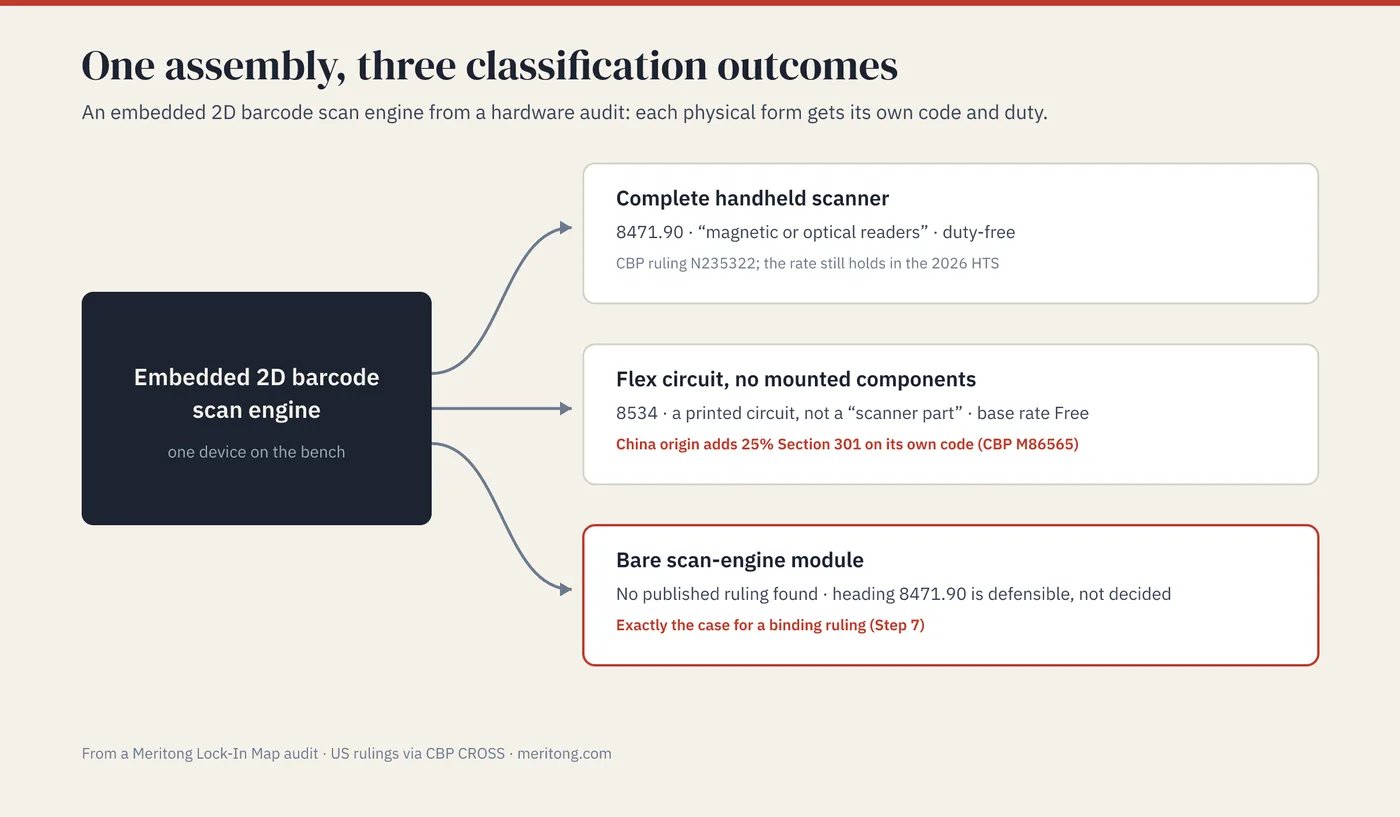
Here is the worked example, from an audit I ran for a hardware client. Their access-control device used an embedded 2D barcode scan engine, bought as a retail SKU at €33.61 a unit from a European reseller, and tracing it back to its Guangzhou manufacturer cut the landed cost by about a quarter. Classifying it turned out to be three separate questions:
The complete handheld scanner the reseller also offered: this one was already answered. CBP classified a handheld 2D barcode scanner under 8471.90.0000, "magnetic or optical readers," duty-free, a rate that still holds in the 2026 HTS.
The flex circuit connecting the scan engine to the main board: this one was also answered, and instructively. CBP ruled that a scan-engine flex cable with connectors but no mounted components is a printed circuit of heading 8534, at 4.9% at the ruling's 2006 date. Today that base rate is Free, though for China-origin boards the applicable Section 301 overlay adds 25%. The lesson survived the rate change: the flex circuit does not classify as a "scanner part," and its duty is set by its own code.
The bare scan-engine module itself: no published ruling I could find answers it. Heading 8471.90 is a defensible GRI-1 candidate. A defensible reading is still an undecided one, and nobody at the border owes you your reading. That is precisely the situation Step 7 exists for.
One device on the bench produced three classification outcomes at the border. That result is normal, which is why per-SKU verification beats copying the code from your supplier's invoice. The supplier's code is at best correct to six digits, and it says nothing about your national line or your overlays.
Step 7: Lock it down
The rulings consulted at Step 6 were issued to other importers. The decisions below, by contrast, are issued to you. For anything with real money or real ambiguity attached, get the answer in writing:
EU, Binding Tariff Information (BTI): the decision is free of charge, valid three years, and binding on every EU customs administration and on you, applied for via the EU Customs Trader Portal. In Germany the decision (verbindliche Zolltarifauskunft, vZTA) is issued centrally by the Hauptzollamt Hannover.
US, binding ruling: file through CBP's eRulings portal for prospective shipments, up to five items per request. The National Commodity Specialist Division generally issues within 30 calendar days, and the ruling binds CBP until modified or revoked.
Then write it down internally: code, GRI path, notes relied on, date, ruling numbers checked. That record is your "reasonable care" evidence, and it is your refresh list. Recheck each January 1 for the new EU CN, on HTS revisions (the 2026 schedule reached Revision 10 by June), and before HS 2028 takes effect on January 1, 2028.
The ruling and the record answer different questions, which is why Step 7 asks for both: the ruling settles the code with the authority that will collect the duty; the record shows how the code was reached.
FAQ
What's the difference between an HS code, an HTS code, and a CN code?
The three share the same first six digits and differ in their national tails. The HS is the international six-digit core, the US Harmonized Tariff Schedule (HTSUS) extends it to ten digits, and the EU's Combined Nomenclature (CN) extends it to eight, with TARIC adding two more for EU measures. Quote six digits internationally; on entries, quote your full national code.
Are HS codes the same in every country?
Only the first six digits are, since those are standardized across 200+ countries and economies. Everything past six is national. On that reasoning, a code that clears customs in one market can be wrong in another, at the digit level where duty is set.
Which code applies to a PCB: bare versus assembled?
A bare printed circuit is heading 8534; the scan-engine flex-cable ruling turned on the absence of mounted components. Once components are mounted, the board is no longer a "printed circuit" in the tariff's sense, and you are back in the Step 3 cascade: own heading, specific function, or machine part. There is no single PCBA answer, which is why assembled boards are frequent binding-ruling material.
Is a binding ruling worth the effort?
In the EU it costs nothing, lasts three years, and removes classification risk EU-wide. The trade-off is that it binds you too. In the US the target turnaround is about 30 days. The arithmetic runs as follows: if the duty spread on your code question exceeds the cost of a few weeks' wait, rule it.
We've been using the wrong code for years. What now?
Correction mechanisms exist. Prior disclosure in the US sharply caps penalties; Germany has correction and voluntary-disclosure routes (§ 378(3), § 371 AO); the EU recovery window is normally three years. These are legal remedies with strict conditions and blocking rules, so quantify the exposure, then have a customs attorney or licensed broker execute the disclosure. Moving before an audit finds it is what keeps the outcome administrative.
How often do codes change?
Three clocks govern the answer. A new EU CN arrives every January 1, the HTS is revised several times a year, and a new HS edition appears every five to six years, the next on January 1, 2028, with 299 sets of changes already accepted. Put all three on your compliance calendar.
Classification is one line of your landed cost
The scan-engine story did not end at the code. The same audit also found the retail markup (about a quarter of landed cost), the single-source risk, and a software quote built on a wrong assumption about the part. Classification errors rarely travel alone. They appear in BOMs alongside unexamined sourcing paths and dependencies nobody has priced; the same audit that found the code found those as well.
A classification question on your own bill of materials may turn out to come with dependencies like these. Those dependencies are the kind of hardware-component problem I help with, particularly where China sourcing is involved, and I look at hardware, firmware, and sourcing together; get in touch if they are still unpriced at your company.
Duty rates and tariff measures cited above were verified against primary sources on July 29, 2026. Tariff overlays (the US stack especially) change quickly; verify current rates in TARIC and the HTS before acting. This article is general information. It is not legal or customs-brokerage advice.
Typical dependencies by email
Examples from real hardware audits, sent occasionally.
Working through this right now? Free intro call → or write to me →
Is this question on your desk right now?
In the free potential check you tell me the type of components you use. After 30 minutes you know whether an audit is worth it.
Free intro call