Sourcing
Dual-Sourcing Strategy: How to Build a Second Source Before You Need One
A second source built the week the first one fails is built at the most expensive moment to do it and the one with the fewest options. A dual-sourcing strategy reverses that order: you build the second source while you do not need it. Done properly, it is a deliberate build project with four parts: find a genuine alternate, vet the supplier behind it, qualify it properly, and keep it warm with a real share of the volume.
Last updated: September 2026.
The short version
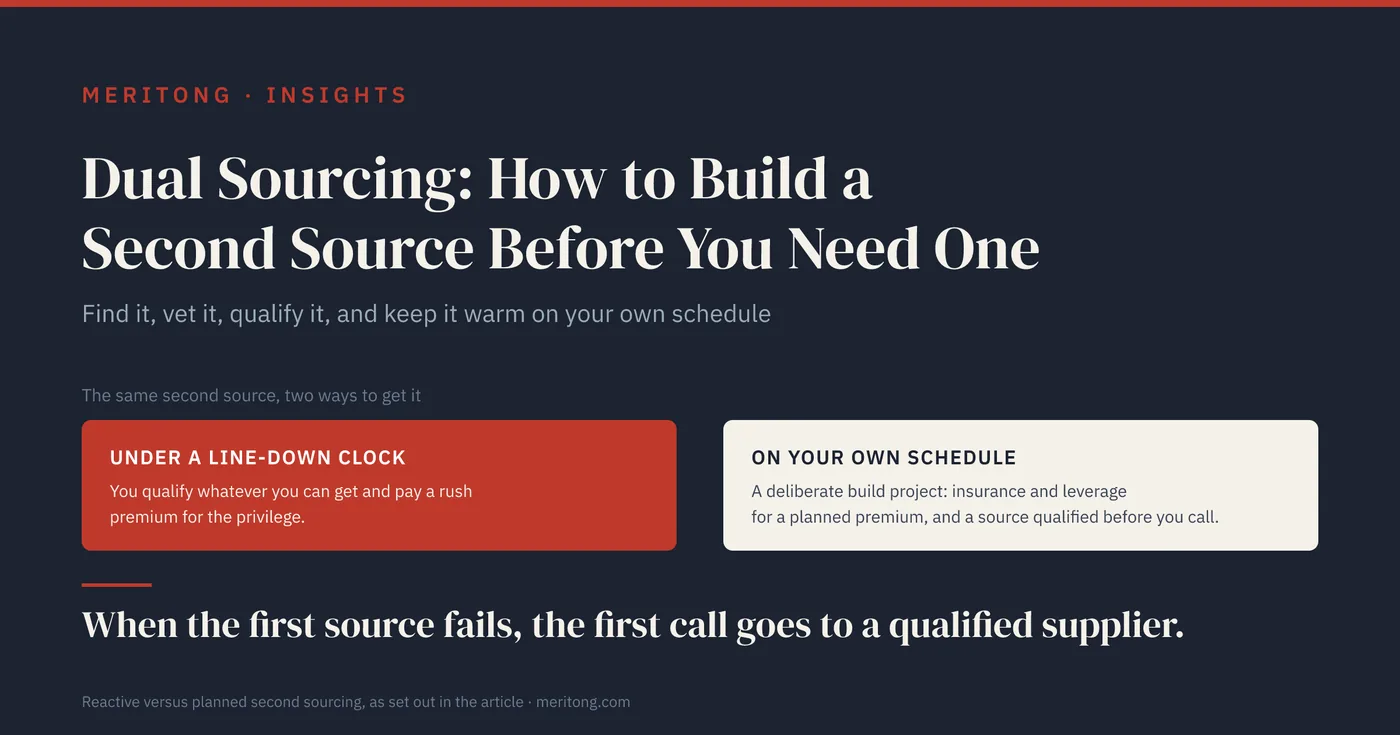
A second source built the week the first one fails is built at the most expensive moment to do it and the one with the fewest options. Even so, a 2023 George Mason University white paper on US defense acquisition found that second sourcing is "often turned to in a reactive rather than proactive fashion." Under a line-down clock you qualify whatever you can get, and what you would have chosen no longer comes into it; you pay a rush premium for the privilege. A dual-sourcing strategy reverses that order: you build the second source while you do not need it, so that when you do, the response starts with a phone call to a supplier already qualified, and the fire drill shrinks to a ramp-up you have planned for. Both routes end with a second source. They differ in who holds the clock, in what it costs, and in whether it was chosen or merely available.
Done properly, dual-sourcing is a deliberate build project with four parts. You find a genuine alternate, matched on form, fit, and function, which is a standard that a shared pinout alone does not meet. You vet the supplier behind it as carefully as the part. You qualify it properly, with samples, a qualification build, first-article or production-part approval, and requalification when something changes. And you keep it warm by giving it a real share of the volume. Each of the four has to be done in earnest, and doing so is what separates a second source from a pin-compatible part on a distributor's website.
Why "before you need one" is the whole point
The reactive version persists because it is easy to defer, and the same white paper names the costs of establishing and qualifying new sources as what deters defense buyers from second sourcing. The decision stays deferred until an allocation, a price hike, an end-of-life notice, or a quality escape (a defect that reached you undetected) forces it. By then you have lost both your leverage and your timeline. The disciplined alternative treats a second source as risk management conducted on a schedule you set yourself, which answers the risk the Chartered Institute of Procurement & Supply (CIPS) names in single sourcing: "dependency on one supplier increases your vulnerability of supply." Maintaining two qualified sources costs something. The cost is known as the dual-sourcing premium, and a 1991 audit report by the US Department of Defense Inspector General defines it as "the difference between the lowest offered price and the total value of the split awards." What it buys is insurance and negotiating leverage. The price of doing without it falls due all at once, at the worst possible time.
The leverage deserves a closer look, because it works in normal times as well as in crises. A supplier who knows you have a qualified alternative that you actively order from negotiates differently from one who knows you are captive. A warm second source is therefore a price-discipline tool as much as a risk tool: the primary's quotes sharpen once it knows the second source is real and could take a larger share of the volume next quarter. Single-sourcing hands your supplier that leverage for free, and dual-sourcing takes it back.
Step 1: Find a genuine alternate
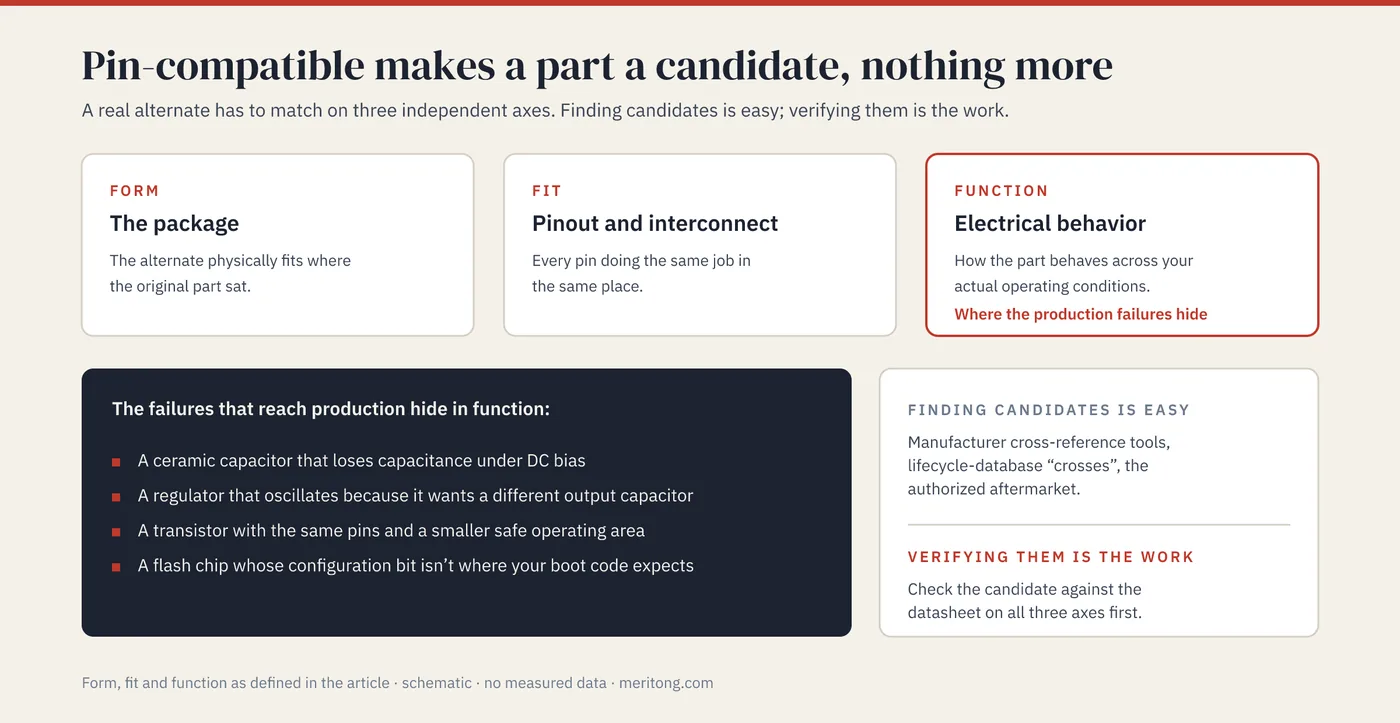
The trap here is treating a "pin-compatible" part as an alternate: a part that drops into the same footprint is a candidate, and nothing more until it has been verified. A genuine alternate has to match on three independent axes: form (the package), fit (the pinout and interconnect), and function (the electrical behavior across your actual operating conditions). The failures that reach production hide in function, which is also the axis that a footprint match leaves unverified: a ceramic capacitor that loses capacitance under DC bias, a regulator that oscillates because it wants a different output capacitor, a transistor with the same pins and a smaller safe operating area, a flash chip whose configuration bit is somewhere other than where your boot code expects it. Finding candidates is easy, since manufacturer cross-reference tools, lifecycle-database "crosses," and the authorized aftermarket all supply them. Verifying the candidates against the datasheet is the actual work, and a companion how-to on finding and verifying a replacement for a discontinued part goes into it in depth.
Step 2: Vet the supplier as well as the part
A qualified part from an unqualified supplier introduces a new risk, and on that account it falls short of a second source. Run the same verification you would run on any new supplier, in China or elsewhere: confirm the legal entity and the business license, establish whether you are dealing with the factory itself or with a trading company, commission a factory audit for anything critical, and, where you can, read the documentation in the supplier's own language, because the tells often do not survive machine translation. A second source you cannot trust to ship consistently does not reduce the risk, which has merely moved from one supplier to the other.
Step 3: Qualify it properly
This is the step at which "we bought a few and they worked" turns into an actual qualification. The disciplined route borrows from the frameworks that safety-critical industries such as automotive and aerospace already use, and what the borrowed frameworks have in common is that each replaces an assumption with evidence:
Samples and a golden sample: approve a physical reference and make the purchase order (PO) refer to it, so that incoming inspection is measured against an agreed standard.
First-article inspection: a formal first-article inspection (the aerospace standard AS9102, currently at revision C of 2023, is a widely used template) verifies that the first production parts meet every drawing and specification requirement, which is a stricter test than whether they look right.
Production-part approval: in automotive, the Production Part Approval Process (PPAP), maintained by the Automotive Industry Action Group (AIAG), whose PPAP manual is in its fourth edition of 2006, is the standard evidence package a supplier submits to prove that it can make the part to specification, repeatably. Even outside automotive, the discipline is the bar to aim for, because it asks for documented process capability and accepts no promise in its place.
A qualification build: run a real build with the second source's parts and test it as a system, at temperature and over your actual duty cycle. Bench-passing one unit is not qualification.
Know your requalification triggers: a change to the part, to its process, or to its site can invalidate the qualification. The Automotive Electronics Council's AEC-Q100 (Rev-J1, March 24, 2026), for instance, requires requalification of an automotive integrated circuit when its supplier "makes a change to the product and/or process that impacts (or could potentially impact) the form, fit, function, quality and/or reliability of the device" (§3.2), and it is a useful mental model even outside automotive. Build the trigger list so that a silent supplier change does not quietly de-qualify your second source.
Step 4: Keep it warm with a split award
A second source you never buy from goes stale: prices drift, capacity is reallocated, and the qualification ages. The way to keep it real is to give it a share of the volume. A common convention is to split the allocation at something like 70/30 or 80/20 between primary and secondary (the consulting network Umbrex describes a primary/secondary split of "80/20 or 70/30" as one that "keeps a credible alternative warm"), and to accept a price premium on the smaller share as the cost of keeping the second source qualified, priced, and motivated. Treat those numbers as a starting convention. They do not amount to a rule, because the right split depends on the part's risk and on your volumes. The principle behind them is firm, however: an unexercised second source is a lapsed insurance policy. Agree in advance, too, how much additional volume the second source could take on if the primary failed, and how quickly, because a minority share does not by itself cover the whole demand.
The second-source checklist
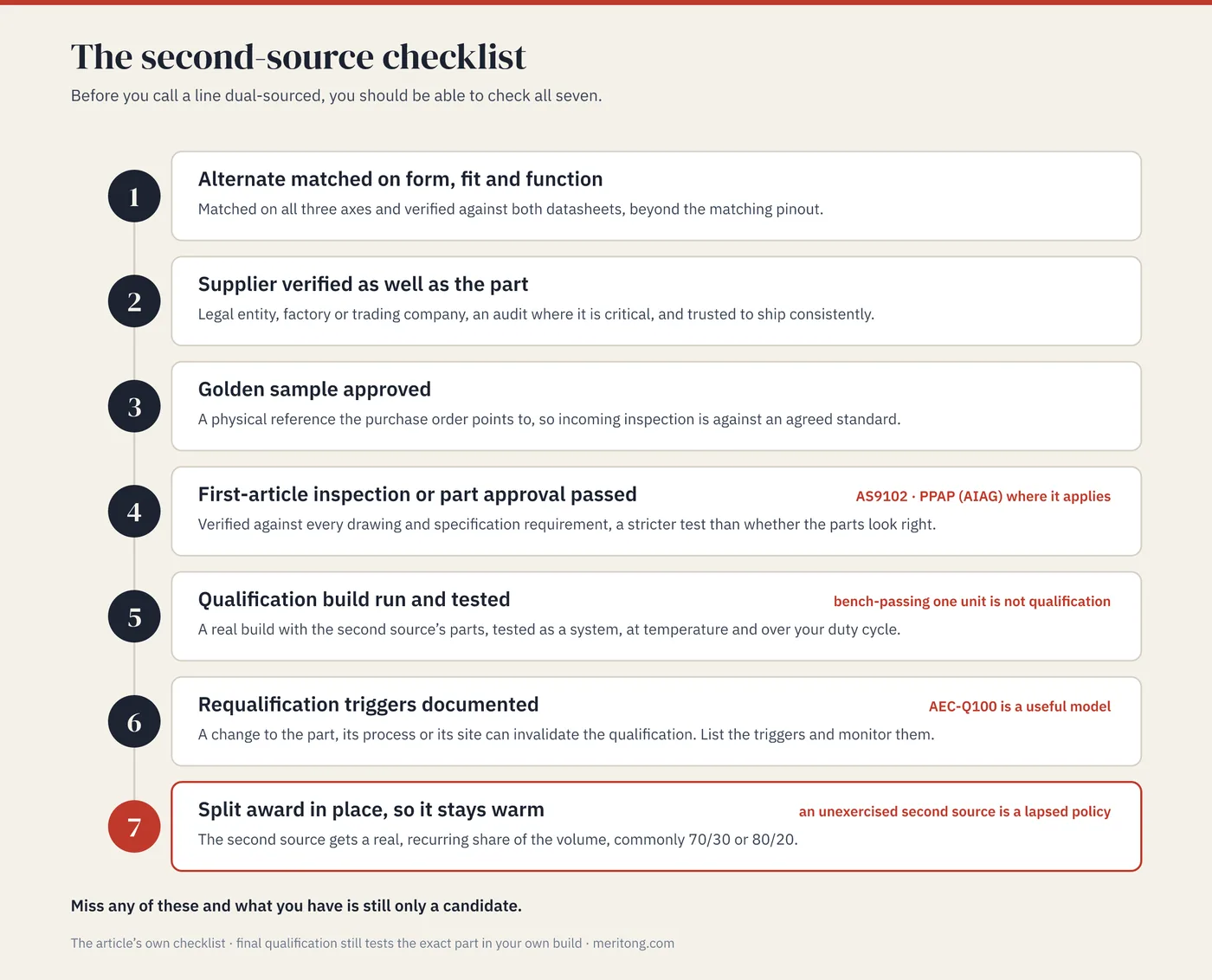
Before you call a line "dual-sourced," you should be able to check all of these:
The alternate is matched on form, fit, and function and verified against both datasheets, which a matching pinout alone does not establish.
The supplier has been verified (legal entity, factory or trader, audit) and is trusted to ship consistently.
A golden sample has been approved and is referenced on the PO.
A first-article inspection, or production-part approval where it applies, has been passed against the full specification.
A qualification build has been run and tested as a system, over real conditions.
The requalification triggers are documented and monitored.
A split award is in place, so that the second source stays warm.
Miss any of these and what you have is still a candidate. The seven identify the principal risks; final qualification still tests the exact part in your own build.
Where dual-sourcing quietly fails
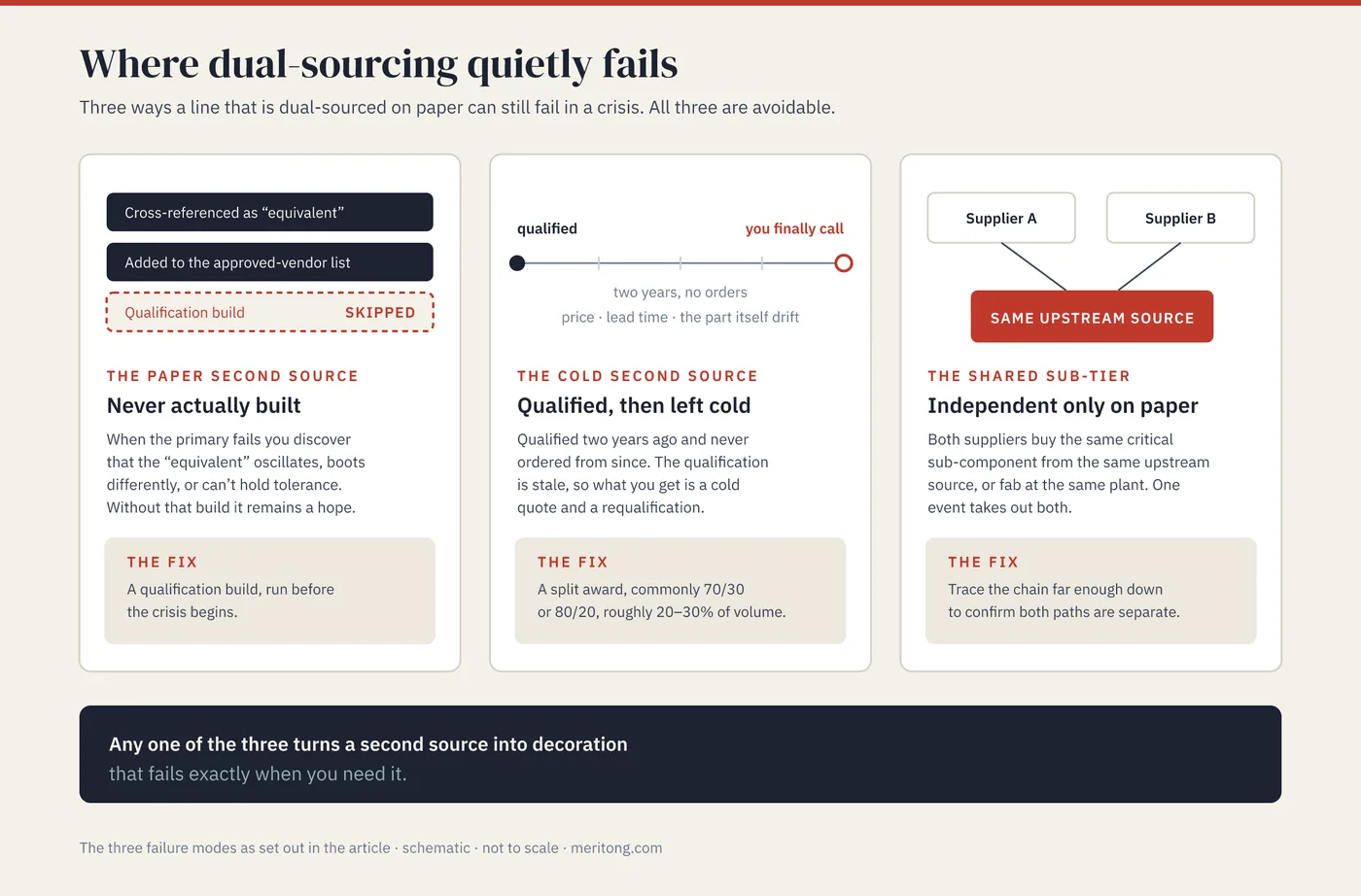
A line that is dual-sourced on paper can still fail in a crisis in three ways, and all three are avoidable.
The paper second source: a part was cross-referenced as "equivalent," added to the approved-vendor list, and never built into a product or tested. When the primary fails, you discover that the "equivalent" oscillates, boots differently, or cannot hold tolerance, and you are now doing the qualification you skipped, under a line-down clock. A second source that has never been through a qualification build remains a hope, because the qualification build that would have made it a source is the step that was skipped.
The cold second source: the alternate was qualified two years ago and has not been ordered from since. In the meantime its price has drifted, its lead time has grown, the part itself may have changed, and your qualification is stale. When you finally call, you get a cold quote and a requalification. This is what the split award prevents.
The shared sub-tier: your two "independent" suppliers both buy the same critical sub-component from the same single upstream source, or both fabricate at the same plant. On paper the line is dual-sourced, whereas in reality a single upstream event takes out both. Real dual-sourcing means tracing far enough down the chain to confirm that the two paths are independent where it counts.
Any one of the three turns a second source into decoration that fails exactly when you need it.
FAQ
Isn't a second source just extra cost?
A second source does cost a premium, and the dual-sourcing premium is real. What it buys is supply security and negotiating leverage, and it trades the risk of a large, unplanned crisis cost (rush qualification, expedite fees, line-down) for a smaller, planned one. It is insurance, and it is priced accordingly.
Do I have to second-source everything?
No, and trying to is how the budget gets wasted. Second-source the lines where a single-source failure would stop your line or fail a compliance check, which means the single-sourced, long-lead, high-risk, or obsolescence-prone parts. Cost the exposure and spend where it reduces real risk.
Can I just keep a pin-compatible part on file as my backup?
No, you cannot, because pin-compatibility establishes only a footprint match, which falls short of a qualified second source. Until the part has been matched on function and put through a qualification build, it remains a candidate, and one you will be scrambling to verify in the exact crisis you were trying to avoid.
How much of the volume should the second source get?
It should get enough to stay warm: a common convention puts that at roughly 20–30%, though the right number depends on the part's risk and your volumes. The rule that matters is that the order be real and recurring; a qualification that exists only on paper keeps nothing warm.
Which parts should I dual-source first?
Rank them by what a failure would cost: single-sourced parts on your highest-revenue products, long-lead and allocation-prone components, parts near end-of-life, and anything whose loss stops the line or fails a compliance check. Do not try to dual-source the whole bill of materials (BOM). Spend the qualification budget where a single-source failure would do real harm.
How long does qualifying a second source take?
It takes longer than you will want it to in a crisis, which is the whole argument for doing it early. How long it takes depends on the part and the industry, because samples, a qualification build, first-article inspection or production-part approval, and any requalification all have to fit into it. Doing it before you need it turns that timeline from an emergency into a planned project.
Does a distributor's "alternate" listing count as a second source?
It does not. A cross-reference or "alternate" flag is a lead, which is to say a candidate to verify. It becomes a second source only after you have matched it on form, fit, and function, run it through a qualification build, and put a real order behind it.
Close
A second source built under a line-down clock costs a rush premium and leaves you with whatever was available, whereas one built on your own schedule buys insurance and negotiating leverage at the price of the dual-sourcing premium and a qualification budget. Whether that exchange pays depends on the line: it earns its cost where a single-source failure would stop production or fail a compliance check, and it wastes budget on parts whose loss you could absorb. The best time to build a second source was at the design stage, when it could have been designed in; the second-best time is before the next allocation, on a schedule you choose.
If you are deciding which of your lines deserve a second source, or whether the alternates already on file would survive a qualification build, I can help you work through it, looking at the part, the firmware that depends on it, and the supplier behind it together, particularly where the sourcing runs through China.
This article is general sourcing and engineering guidance and not legal advice. Qualify any second source against the specific part's datasheet and your own testing.
Typical dependencies by email
Examples from real hardware audits, sent occasionally.
Working through this right now? Free intro call → or write to me →
Is this question on your desk right now?
In the free potential check you tell me the type of components you use. After 30 minutes you know whether an audit is worth it.
Free intro call