Last updated: September 2026. The method here is evergreen; the one duty rate used in the worked example is a July-2026 snapshot and is labeled as such. Verify current rates for your own goods.
The short version
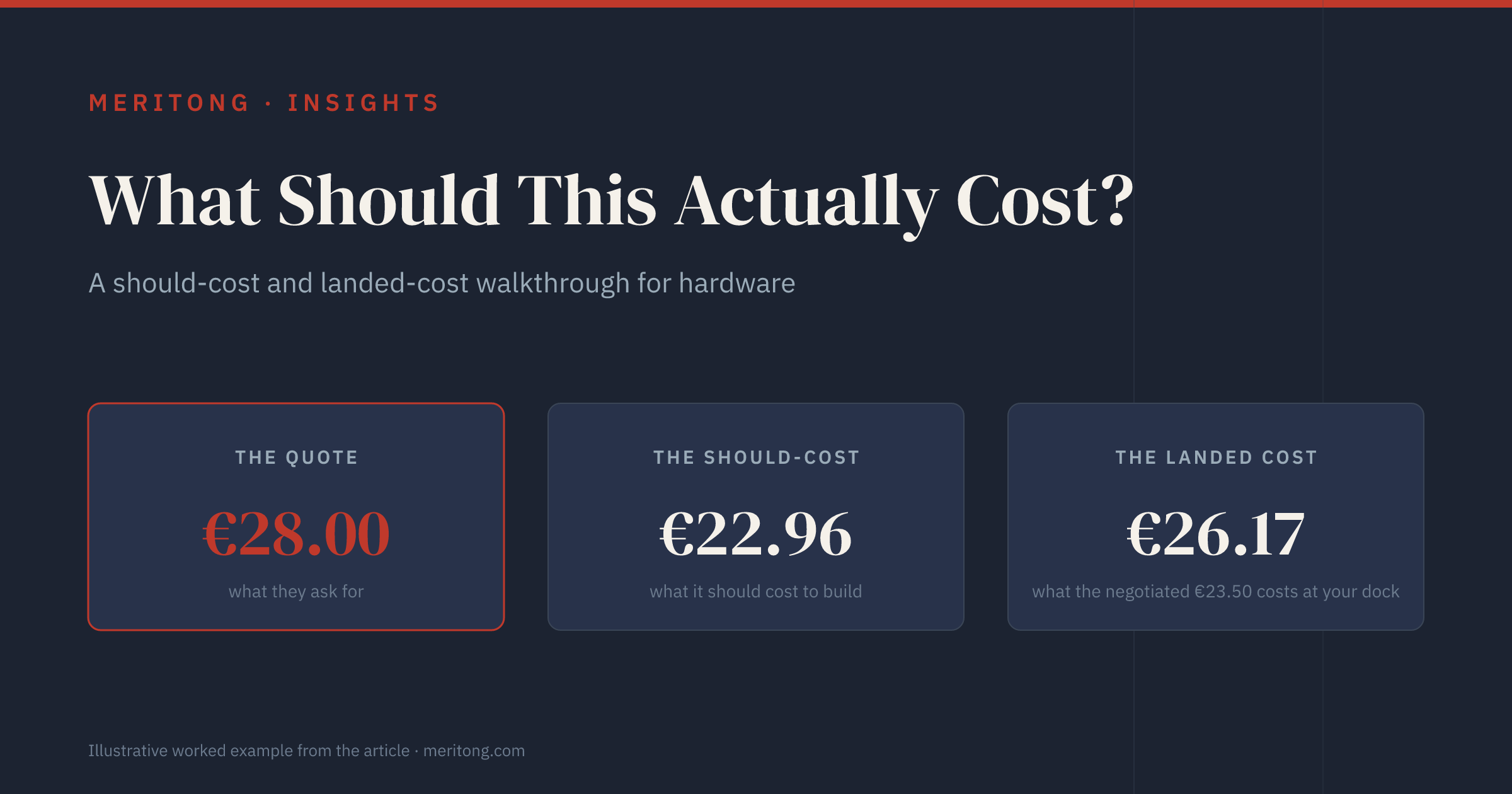
A supplier quote answers one question: what the supplier wants to charge. The two questions that decide your margin, what the part should cost to build and what it will actually cost you landed at your dock, remain open, and each is answered by a number you must build for yourself. Should-cost analysis builds the first from the bottom up (materials, labor, overhead, tooling, margin), so that you can see whether a quote is fair. Landed cost adds everything between the factory and your dock (freight, insurance, duty, fees), so that you can compare offers honestly and know your true unit cost. The first number equips you for the negotiation; the second keeps any comparison between suppliers and Incoterms honest. With both in hand you negotiate from facts instead of hope, and you will spot the trap: duty is charged on a different base than your landed cost, and which costs fall inside that base depends on where you import.
Should-cost: what it should cost to build
Should-cost analysis, also called clean-sheet or bottom-up costing, rebuilds a supplier's price from its parts. The purpose is understanding rather than accusation: knowing where the money goes is what lets you tell a fair quote from a padded one. A workable should-cost model has these lines:
| Should-cost line | What it captures |
|---|---|
| Direct material | The part's own bill of materials: components, PCB, housing, at real market prices |
| Direct labor | Assembly/test labor: cycle time × loaded local labor rate |
| Manufacturing overhead | Equipment, energy, facility, indirect labor allocated to the part |
| Tooling / non-recurring engineering (NRE), amortized | One-time tooling and engineering spread over the expected volume |
| SG&A | The supplier's selling, general & administrative cost |
| Supplier margin | A reasonable profit on top |
| = Should-cost | What the part ought to cost from an efficient supplier |
Populating the lines is less daunting than it sounds. Direct material is your own teardown priced at real market rates; the supplier's blended number is not the honest base. Direct labor is cycle time multiplied by a loaded local wage, and both factors are estimable within a band. Overhead and SG&A are the discretionary lines, the places where a supplier can quietly park margin as "cost," which is why a rough allocation is better than none. Tooling is amortized over the volume you honestly expect rather than the volume you hope for, since an optimistic volume flatters the per-unit number. You will not get every line exactly right, but you will get close enough to see whether a quote is fair, and that is the whole point.
This is where reading the primary documents pays off. In one audit I ran, a QR/NFC scan engine bought at €33.61 through a European reseller traced back to its Guangzhou original manufacturer at roughly €25 ex-works, once I had read the OEM's own datasheet and pricing in Chinese and gone direct. That is about a 25% landed-cost reduction, and it avoided roughly €20,000 of software spend besides, because the module already did what the client was about to rebuild. The basis was a shortlist of 15 suppliers, each vetted directly. The quote was not a lie. Nobody had built the should-cost that would have shown what the part was worth. (That case is my own client experience, shared with the numbers rounded.)
Landed cost: what it actually costs at your dock
Should-cost tells you whether the quote is fair. Landed cost tells you what the part in fact costs you once it arrives, and it is the only basis on which offers under different Incoterms can be honestly compared, because it restates each offer as a full cost at your dock. It is assembled from these components:
| Landed-cost line | Notes |
|---|---|
| Ex-works product price | The goods price, before anything is added for freight, insurance or duty |
| International freight | Ocean/air/road to your country |
| Insurance | Cargo insurance for the shipment |
| Customs duty | Rate × customs value (see the trap below) |
| Customs brokerage / fees | Customs broker, entry, and any processing fees |
| Handling / last-mile | Port, drayage, inland to your dock |
| = Landed cost | True unit cost delivered |
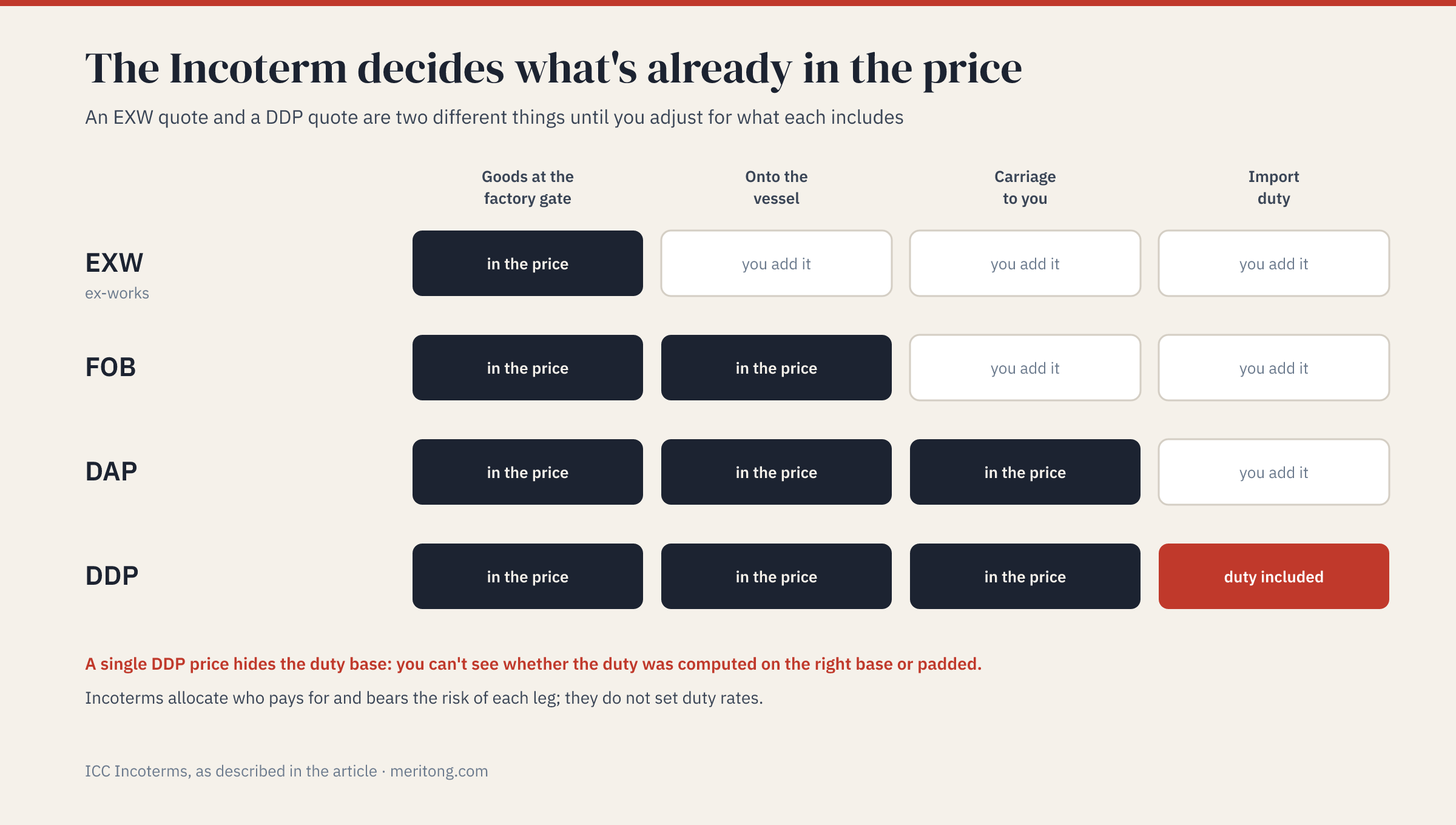
Which of these are already inside the "price" your supplier quoted depends entirely on the Incoterm. Incoterms (the ICC's international commercial terms) allocate who pays for and who bears the risk of each leg; they do not set duty rates. An EXW (ex-works) price is just the goods at the factory gate. An FOB (free on board) price includes getting them onto the vessel; a DAP (delivered at place) or DDP (delivered duty paid) price includes carriage to you; and DDP includes even the import duty. Each term therefore fixes how much of the table above is already inside the quoted number and how much you must still add, which is why comparing an EXW quote to a DDP quote without adjusting is comparing two different things.
Run the two tables above line by line: build your should-cost in the first, then take the ex-works price you negotiate into the second and add the lines beneath it, and you have a defensible number to compare across suppliers and Incoterms. Freight is the line worth a real number rather than a guess: get a per-unit figure from your forwarder rather than a flat percentage, because on low-value, high-volume components, freight and handling together can rival the duty.
The trap: duty isn't charged on your landed cost
Here is the subtlety that trips up otherwise careful spreadsheets. Your landed cost and the customs value on which duty is charged are two different numbers, and which costs fall inside each depends on where you are importing.
What follows is my understanding of the law as it stands at the time of writing. I am not a lawyer or a customs broker, and this is not legal advice.
In the EU, the customs value is the price actually paid or payable supplemented by the cost of transport and insurance up to the point where the goods are brought into the customs territory of the Union, together with the loading and handling charges associated with that transport (Article 71(1)(e) of the Union Customs Code, Regulation (EU) No 952/2013). Carriage after that point stays out (Article 72(a)), and so do your customs brokerage and entry fees. Where you happen to pay a cost is not the test, however: tooling, moulds or materials you supply to the factory free of charge or at reduced cost are added to the customs value under both systems (Article 71(1)(b) of the Union Customs Code; 19 U.S.C. § 1401a(b)(1)(C)). Under US law the base is the transaction value, "the price actually paid or payable" for the goods, and that price is defined as exclusive of the costs of transportation, insurance and related services incident to the international shipment (19 U.S.C. § 1401a(b)(4)(A); 19 CFR § 152.102(f)).
The same shipment can therefore face two different duty bases depending on which border it crosses, and in neither system is that base your landed cost: customs brokerage, entry fees and the inland leg to your own dock fall outside it on both sides.
Duty is therefore normally charged on a smaller number than your landed cost under either system, and a spreadsheet can err in either direction: compute duty on the full landed figure and you will overstate it; assume the quoted "landed" price already had duty in it and you may understate your true cost. The remedy is to build the duty base as a line of its own, under the rules of the country you are importing into, rather than reaching for a total you already have.
The same logic exposes a second mistake. A supplier who hands you a single DDP price with "duty included" leaves you unable to see whether the duty was computed on the right base or simply padded. When the volumes justify it, controlling the customs entry yourself buys you that visibility, which means buying on a term short of DDP. Which term is its own question: EXW hands you the whole stack, export formalities in the seller's country included, and that is more than many buyers want to take on.
Worked example (illustrative)
The example takes one imported electronics module, with the numbers invented to show the method.
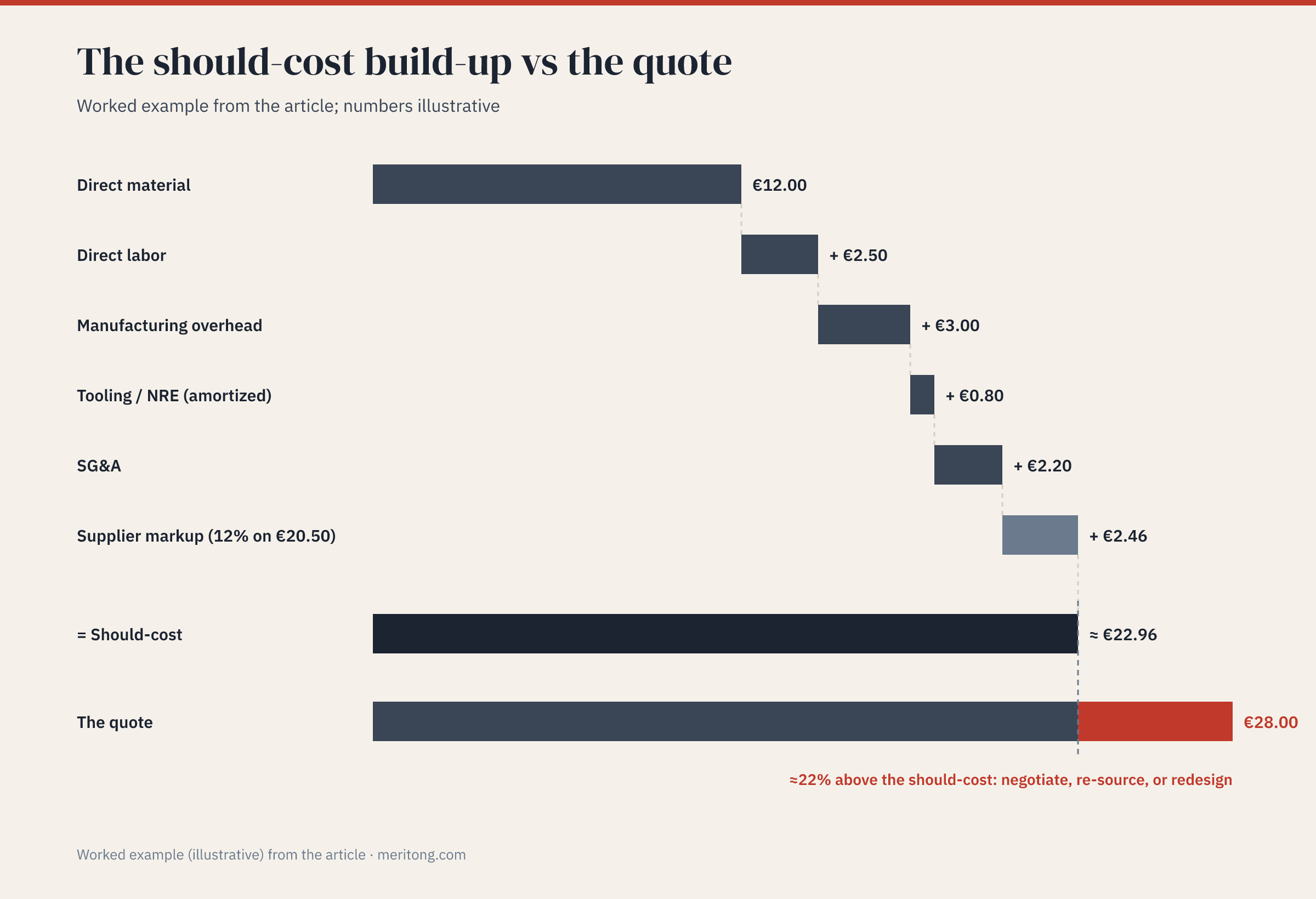
Should-cost: direct material €12.00 + direct labor €2.50 + overhead €3.00 + tooling amortized €0.80 + SG&A €2.20 = €20.50 of cost; add a 12% markup on cost (€2.46) and the should-cost is ≈ €22.96. A quote of €28.00 is ~22% above that, and the gap is grounds to negotiate, to re-source, or to ask what you are missing.
For the landed cost, say you negotiate an EXW price of €23.50:
| Line | Amount (illustrative) |
|---|---|
| Ex-works price | €23.50 |
| International freight (per unit) | €1.20 |
| Insurance | €0.15 |
| = EU customs value | €24.85 |
| Customs duty: EU Combined Nomenclature rate 3.7% × €24.85 | €0.92 |
| Customs brokerage / entry / processing fees | €0.30 |
| Handling / last-mile | €0.10 |
| Landed cost | €26.17 |
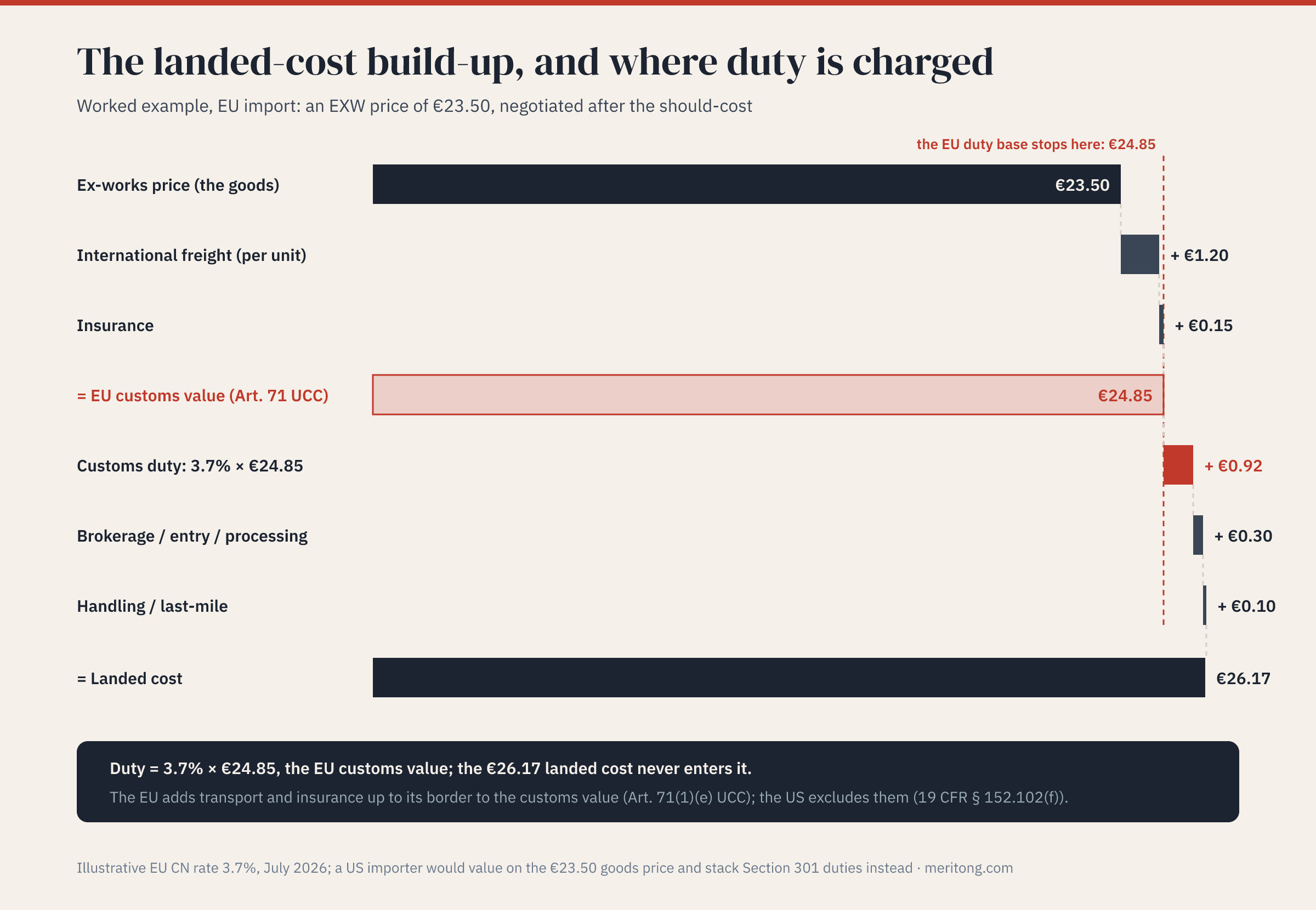
Note the duty line. The 3.7% is applied to the €24.85 customs value, which is the goods price plus the freight and insurance up to the EU border, while the €26.17 landed cost never enters the calculation; the €0.40 of customs brokerage and last-mile falls outside the base. That is the trap in action.
The same module entering the United States would be valued on the €23.50 goods price rather than on the freight-inclusive figure, and would meet a different stack on top: the Column 1 rate for your tariff line, the China Section 301 List rate, and, unless the goods are already subject to a Section 232 duty, the separate Section 301 forced-labor duty in force since 24 July 2026, which puts China at an additional 12.5% (91 FR 47318). The 10% Section 122 surcharge expired on 24 July 2026. That composition changes by proclamation and Federal Register notice, so check the current one against your own tariff line. (The 3.7% is an illustrative rate from the EU Combined Nomenclature (CN) for one product class, as of July 2026. Verify the rates on your own line before you price anything.)
Using the numbers
The two numbers between them license three moves. Where the quote is well above the should-cost, you negotiate with the build-up in hand. Where the quote cannot come down, you re-source, and often a large lever is going closer to the original manufacturer, as in the scan-engine case. Where the part itself is the problem, for instance because it is over-specified or obsolescence-prone, the conversation becomes one about redesign. Landed cost is what makes those comparisons honest across suppliers and Incoterms.
The negotiation itself changes character when you arrive with a build-up. "Your price is high" earns a shrug; "your quote is about 22% above a should-cost of €23, so show me where the difference comes from" earns a real conversation, because now the supplier has to defend a number rather than a feeling. And when you re-source, landed cost is the only fair yardstick: a lower ex-works quote can cost more landed once the air freight needed to hit a schedule, a worse duty classification, or a broker who charges per line is accounted for.
FAQ
What's the difference between should-cost and landed cost?
Should-cost is the bottom-up figure: what the part ought to cost to build, reckoned from materials, labor, overhead, tooling, and margin. Landed cost is the all-in delivered figure: the price plus freight, insurance, duty, and fees to your dock. The first tells you whether the quote is fair; the second tells you your true unit cost.
Is duty charged on the full landed cost?
It is not, and assuming otherwise is a common mistake. Duty is charged on the customs value, which is built under the rules of the country you import into: the EU adds international transport and insurance up to its own border (Article 71(1)(e) of the Union Customs Code), while the US excludes them (19 CFR § 152.102(f)). Neither includes your customs brokerage, entry fees or inland carriage, so in both systems the duty base normally comes out smaller than your landed cost.
Which Incoterm should I quote against?
Quote against whichever term lets you compare like with like. EXW exposes the whole logistics stack, including the export side in the seller's country, which is useful for landed-cost control and more than many buyers want to take on; DDP hands the stack to the supplier, which is simpler although you lose visibility. Do not compare an EXW quote to a DDP quote without adjusting, because Incoterms move which costs are already inside the price.
How accurate can a should-cost really be?
It can be accurate enough to negotiate from, and that is the accuracy that matters. You will not nail every supplier's exact overhead, but a disciplined build-up gets you within a band that exposes padding and tells you when a quote is actually competitive. The goal is a defensible range you can hold across the table rather than a forensic audit, and the range sharpens every time you get a real invoice or teardown to calibrate against.
Does a cheaper unit price mean cheaper landed?
A cheaper unit price does not always mean a cheaper landed cost. A lower ex-works price with worse freight terms, a higher-duty classification, or a worse Incoterm can land dearer than a "pricier" quote, so compare offers on their landed cost; the quoted price is the wrong yardstick.
Do I need customs software to do this?
You do not; a spreadsheet built on the two tables here is enough to start. The discipline of separating should-cost from landed cost, and landed cost from the duty base, matters far more than the tool, and it is exactly the step some suppliers are quietly hoping you will skip.
Close
Neither number is exact, and neither has to be. A should-cost accurate enough to expose padding changes what you can say across the table; a landed cost built on the right duty base changes which offer you accept. What matters is keeping the three numbers apart: what the part should cost to build, what the customs authority taxes, and what you actually pay at your dock.
When a build-up like this does not explain the price, the design is usually the place to look next, and that means taking hardware, firmware and sourcing together, China included. If that question is live at your company, get in touch.
Meritong is a China-sourcing and landed-cost strategy practice. I am not a licensed customs broker or attorney, and this article is general information; it is not legal, customs, or tax advice. Duty rates and customs valuation are jurisdiction- and product-specific and change frequently: verify current rates, obtain binding tariff information for classification questions on your own goods (a binding ruling from CBP in the United States), and take qualified customs advice on valuation.
Get the next pattern by email
One dependency pattern from real hardware audits, occasionally. No schedule promised yet.
Working through this right now? Book a call → or write to me →