Case study
The Scanner Swap: 25% Lower Unit Cost
How a BOM audit cut the landed cost of the most expensive audited component by 25% and avoided around €20k in software cost.
At a glance
| Client | European hardware startup · gym access-control · post-pilot, real deployments |
|---|---|
| Engagement | BOM audit, scanner-swap analysis |
| Hardware unit cost | −25% landed, OEM-direct |
| Software workstream | Scope reduced ~80% against original assumption · around €20k avoided |
| Supply availability | Single European retail SKU → vetted OEM relationship |
Starting conditions
The product worked. The access terminals (“pods”) were in gyms, scanning QR codes and opening doors.
Underneath, the structure was improvised in three ways the team couldn't see from inside the build:
- The QR-code scanner — the most expensive single component in the BOM after the compute board — was sourced through a single direct purchase from a European retail vendor at €33.61/unit, flagged in the BOM itself as "always limited availability." No second source. No relationship with the manufacturer. The price was retail.
- Integrating a different, cheaper scanner was already on the roadmap, and the incumbent software contractor had submitted an estimate. The number was substantial enough to gate the decision, and nobody had pressure-tested the assumptions underneath it.
- The existing scanner driver, a single Python file of 1,266 lines, was written tightly against one specific vendor protocol. From the outside it looked like swapping scanners meant rewriting all of it.
Three separate conversations, three separate counterparties, no single layer responsible for asking whether the assumptions stacked up.
The hardware path
The audit started with the BOM and the question: if your current vendor couldn't supply this scanner next month, what would it cost you?
The answer, traced through:
- Source identified. The retail SKU was a relabel of an embedded NFC + 2D scan engine made by a Guangzhou OEM. The path from factory to gym wall was: factory → European importer → European retail listing → BOM. Two re-sellers, full retail markup, no volume discount, no committed lead time.
- Shortlist built. Fifteen candidate suppliers vetted across two scanner families — the incumbent's supplier and a comparable alternative. Pricing, MOQ, monthly capacity, lead time, OEM-vs-trader status, and the quality of the technical documentation in Chinese, all reviewed first-hand.
- Direct OEM contact established. Conversations with the actual manufacturer — in Mandarin, no intermediary. Bulk pricing at 100+ units came in at around €25 per unit OEM-direct versus the €33.61 retail baseline.
Net effect: ~25% landed cost reduction, considerably better supply availability, and a direct OEM relationship designed to scale past 100 pods without renegotiation.
The software path
The original quote rested on a single unspoken assumption: that integrating the new scanner meant porting the existing driver — same protocol, new bytes.
Reading the existing 1,266-line driver against the new scanner's 105-page manufacturer manual produced a different finding.
The new scanner does not speak the old protocol at all. It is not configured by writing to registers over the serial line. It is configured by physically scanning a printed page of setup barcodes — interface, baud rate, prefix/suffix, NFC on/off, the lot. There is no host-to-scanner command set. There is nothing to port.
Translated into the codebase:
| Driver component | Old scanner | New scanner |
|---|---|---|
| Vendor protocol framing & CRC | ~70 LOC, mandatory | deleted |
| Register-write configuration | ~150 LOC | deleted — moves to a printed setup sheet |
| Vendor enum / type tables | ~25 constants | deleted |
| Serial port lifecycle | kept | kept verbatim — defaults match |
| Scan-monitor loop & callbacks | ~250 LOC | kept, simplified |
Roughly 80% of the existing driver can be deleted, not ported. The work that remains is small: a serial-frame parser, a Code-ID lookup table, and a one-page printed setup procedure for installation.
Defensible cost for the full swap, including architectural cleanup and rollout: €6k–€12k offshore, €10k–€16k European freelancer. The gap between that range and the original estimate isn't a pricing question — it's a structural one. Scanner integrations almost always require porting a vendor protocol; this one didn't, but that fact lived in a single paragraph of the manufacturer manual. Recognising the work was 80% deletion rather than 80% port meant reading the manual and the existing driver in the same week — which is not what an external contractor working from a written spec is usually paid to do.
Why it wasn't caught earlier
This is the part of the case that generalises.
The hardware sourcing decision and the software contracting decision belonged to different conversations with different counterparties. Neither side had an incentive to question the other's framing. The supplier saw an order. The contractor saw a spec.
The single fact that collapsed the original quote — this scanner is configured by barcode, not by protocol — lived in one paragraph on page 14 of the manufacturer's manual, in dense technical English next to a diagram. It was nobody's job to read it.
Hardware companies almost always have a version of this. The structural cost is paid where two layers meet and nobody owns the seam.
What the audit surfaced
| Layer | Finding | Outcome |
|---|---|---|
| Hardware sourcing | Single-source retail SKU, retail markup, supply-constrained | ~25% landed cost reduction; direct OEM relationship; vetted alternates |
| Software architecture | New scanner's configuration model meant ~80% of the existing driver could be deleted, not ported | Scope reduced sharply against the original estimate · around €20k avoided |
| Supplier visibility | One distributor of record, no shortlist, no leverage | 15 candidates evaluated; OEM-direct path open at scale |
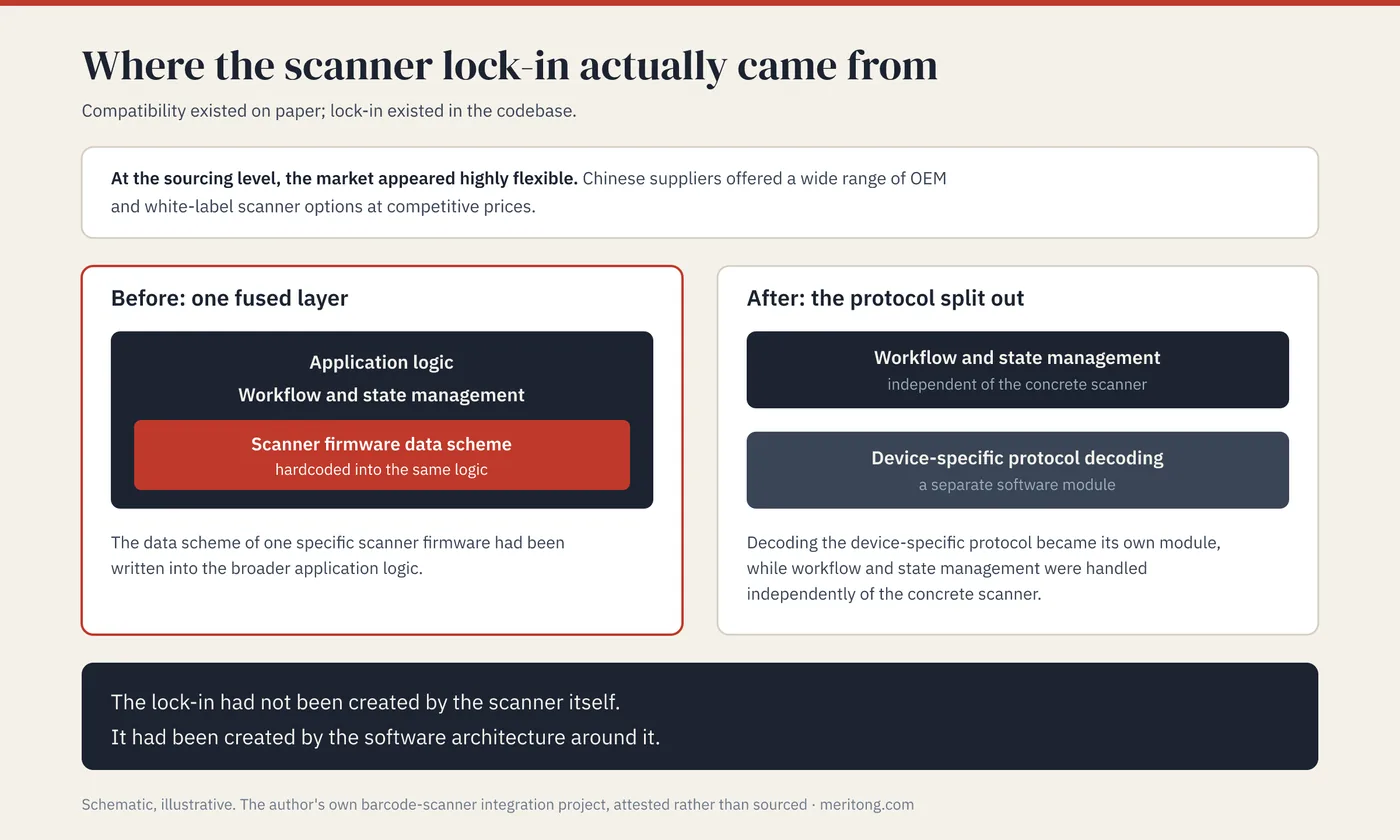
| Architectural by-product | Vendor coupling concentrated in one file with three identifiable leaks into the workflow layer | A clean Scanner Protocol seam — the next scanner swap is considerably smaller |
What made the work possible
- Fluent Mandarin. The OEM's product page, datasheets and price lists were read in the Chinese original, without translation losses and without a trader in between. The relationship was opened in the OEM's language.
- Architecture reading. Opening the codebase and the manufacturer manual side by side, and seeing what was actually vendor-coupled vs reusable. Not theoretical — line-by-line.
- Cross-layer view. Sourcing and software live in different rooms in most companies. They belong in the same conversation. The €20k saving lived in that conversation, not in either room.
Outcome
- Hardware unit cost down ~25%, supply available at scale.
- Around €20k avoided on a single software workstream, and the company now has a defensible scope to negotiate against.
- A clean architectural seam in the codebase, so the next scanner swap (or NFC reader, or any serial-attached peripheral) is considerably smaller.
The value to the client sat well above the audit fee.
What this kind of case usually looks like
You probably have a version of this in your own product. It tends to live in one of three places:
A component that is single-sourced or sourced through a re-seller because that's how it was sourced for the first prototype, and it never got revisited.
A scope of work that was estimated against one set of assumptions, where the underlying assumption is wrong but no one has the cross-layer view to see it.
An architectural seam where vendor-specific code has leaked into workflow code, so changing one supplier feels like rewriting the product.
A BOM audit is usually enough to surface these. The output is a named list of dependencies and what each one would cost to break.
Typical dependencies by email
Examples from real hardware audits, sent occasionally.
Working through this right now? Free intro call → or write to me →
Is this question on your desk right now?
In the free potential check you tell me the type of components you use. After 30 minutes you know whether an audit is worth it.
Free intro call