Components
Choosing a BLDC / FOC Motor-Control IC: Integrated Controller vs MCU-Plus-Library, and What Actually Drives the Decision
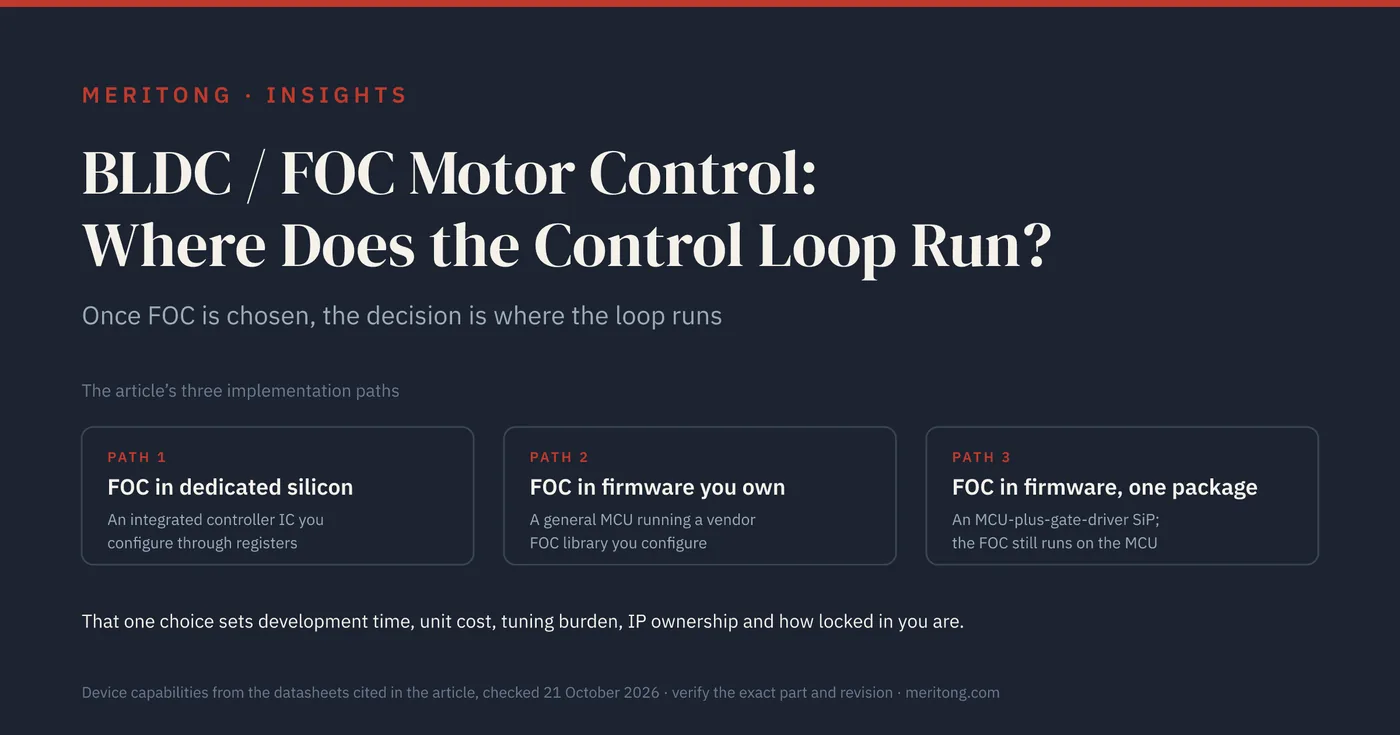
Once you choose field-oriented control for a brushless motor, the decision that shapes the project is where the FOC loop runs: in a controller IC you configure, or as firmware on a general-purpose MCU. This guide shows how that choice sets development time, unit cost, tuning burden and vendor lock-in.
Last updated: October 2026. Device capabilities come from the datasheets and vendor pages named in the text, at the revisions given there, checked on 21 October 2026. Verify them against the exact part and revision before you design one in.
The short version
Field-Oriented Control (FOC) is a common choice for a brushless motor in a pump, fan, appliance or e-mobility product that must run with low noise and high efficiency. ST describes FOC and vector control as "widely used in high-performance drives". FOC gives a brushless DC (BLDC) or permanent-magnet synchronous motor (PMSM) quiet, efficient operation with smooth torque. Simpler trapezoidal control remains an option where cost outweighs noise: TI's MCT8316A, for instance, is a sensorless trapezoidal driver rated for 8 A peak. Once you choose FOC, the decision that shapes your project is where the FOC loop runs. It can run in a dedicated controller integrated circuit (IC) that you configure, or as firmware that you write on a general-purpose microcontroller (MCU) from a vendor library. That one choice sets your development time, your unit cost and your tuning burden. It also sets how much control and intellectual property (IP) you own, and how locked in you are to one vendor.
No answer is right for every product. An integrated controller can get a fan spinning "code-free". A full MCU-plus-library stack can extract the last few percent of efficiency, and it is yours to own and port. Throughout, two values pull against each other. Time-to-market favors a loop that somebody else has already implemented and proven; ownership favors a loop that you can tune and extend yourself, and in principle port. The lock-in that comes with the first is the price of its speed, so the sensible course is to price it at the outset, before an allocation reveals it.
The decision at a glance
| Decision | What can fail | When it applies | Who owns it | How to verify |
|---|---|---|---|---|
| Sensored or sensorless | Sensorless control struggles with high torque at zero and very low speed | Servo, positioning, traction from standstill | Motor-control engineering | Test start-up and low-speed torque under load |
| Integrated or external field-effect transistors (FETs) | An integrated-FET part reaches its current or thermal limit | More power, voltage or heat than the part is rated for | Hardware design | Compare worst-case current and thermal budget with the datasheet limits |
| Integrated controller or MCU plus library | Lock-in to one vendor's part and registers, or a firmware project the team cannot staff | Whether motor control is your differentiator | Engineering management | Estimate the firmware effort and the cost of a forced re-tune |
| Production tuning | Factory and field re-tuning depend on one vendor's tool | Motor variants and production spread | Manufacturing and test | Tune a sample motor through the production interface |
| Fallback part | A forced part change means re-selection and re-tuning | Allocation, a price increase or end-of-life | Sourcing with engineering | Name a fallback part before you commit |
The three paths
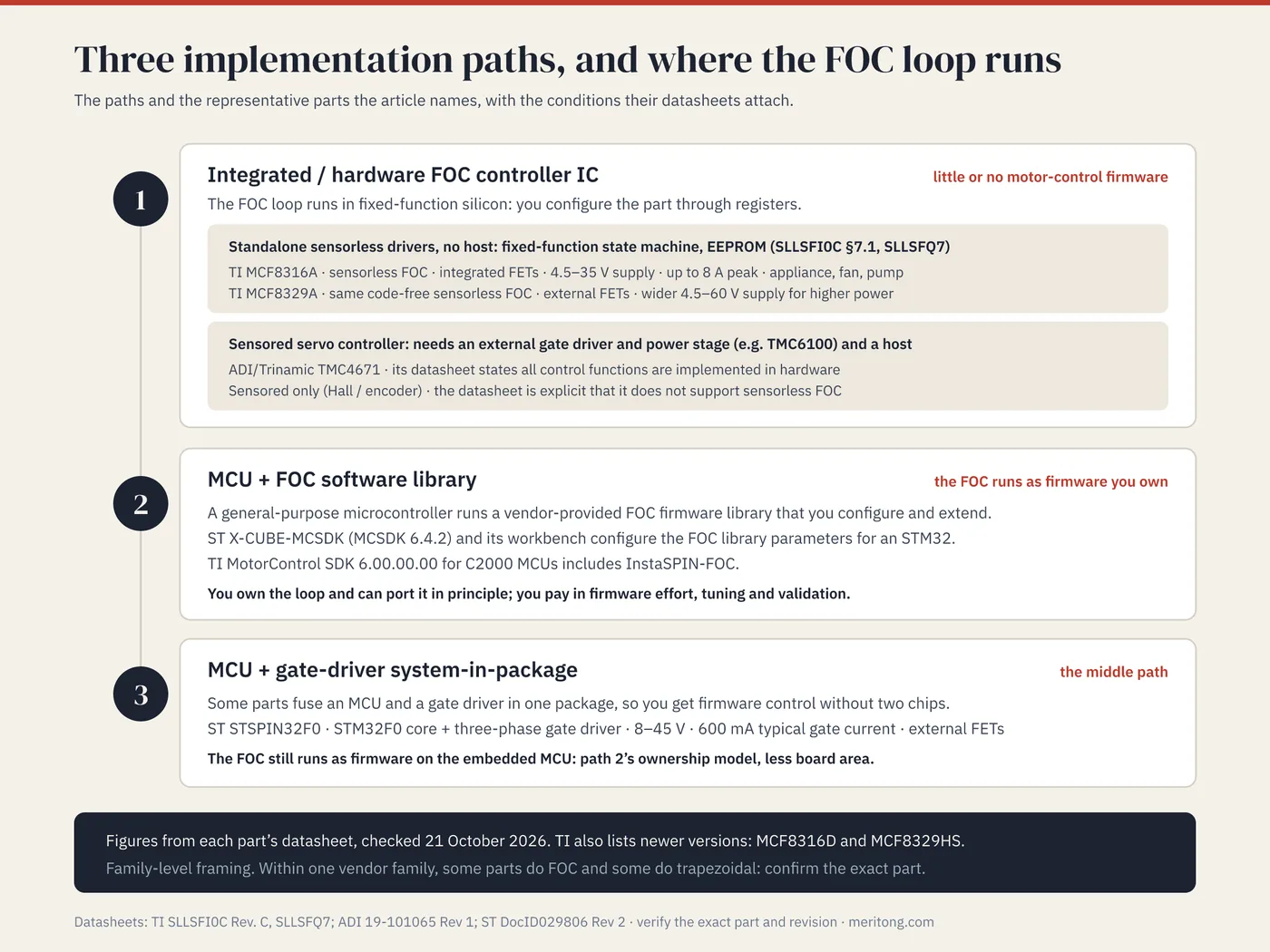
1. Integrated / hardware FOC controller IC: the FOC loop runs in fixed-function silicon that you configure through registers, and you write little or no motor-control firmware. The parts on this path differ in what they need around them: some run stand-alone without a host, others need a host and a separate power stage.
Standalone sensorless drivers run without a host or firmware, using a fixed-function state machine with settings in electrically erasable programmable read-only memory (EEPROM). They come with integrated FETs (MCF8316A) or as gate drivers for external FETs (MCF8329A). Texas Instruments' (TI) MCF8316A, for example, is a code-free sensorless FOC driver with integrated FETs. Its datasheet (SLLSFI0C Rev. C of June 2023 §7.1) says that "the algorithm is implemented in a fixed-function state machine, so no coding is needed." The register settings can be stored in on-chip EEPROM, so the device runs stand-alone once it is configured (§7.1). The datasheet's Features list (§1) rates it for a 4.5–35 V supply and up to 8 A peak. The same datasheet lists fans, pumps and blowers among its applications. The part suits appliance designs that want a motor spinning without a motor-control software project. Its sibling, the MCF8329A (SLLSFQ7 of November 2023), performs the same code-free sensorless FOC but is a gate driver for external FETs. Its Features list (§1) gives a wider 4.5–60 V supply for higher-power designs. Both parts are active on TI's product pages (MCF8316A, MCF8329A) as of 21 October 2026. Those pages also list a newer version of each, the MCF8316D and the MCF8329HS, under the label "drop-in replacement with upgraded functionality". Read the newer datasheet before you choose between the old and the new version.
Sensored servo controllers run the FOC loop in hardware but leave the power stage outside the chip. Analog Devices' (ADI) Trinamic TMC4671 is one example, and its datasheet (19-101065 Rev 1 of February 2024 for IC version V1.3) states on page 1 that "all control functions are implemented in hardware." The TMC4671 needs an external gate driver and power stage, such as ADI's TMC6100. A host processor configures its registers over a Serial Peripheral Interface (SPI). The part is a servo controller for robotics and automation work with encoder and Hall feedback. The datasheet also states, "The TMC4671 does not support sensorless FOC," so the part is for sensored applications.
The appeal of this path is time-to-market and a small firmware footprint; its cost is that you tune, and then keep working, inside one vendor's registers and tools.
2. MCU + FOC software library: a general-purpose microcontroller runs a vendor-provided FOC firmware library that you configure and extend. STMicroelectronics' (ST) X-CUBE-MCSDK is a Motor Control software development kit (SDK) for STM32 MCUs (product page for MCSDK 6.4.2). Its workbench configures the parameters of the FOC firmware library. TI's MotorControl SDK for C2000 MCUs includes InstaSPIN-FOC (version 6.00.00.00 of March 2026). These two are the reference examples for this path. Here you own the firmware. You can implement any control refinement, diagnostic or application logic on the same chip, and you can in principle port it to another MCU. The cost is that FOC on an MCU is a real firmware effort: you tune the loops, you handle the corner cases, and you have the validation burden.
3. The middle path, an MCU-plus-driver system-in-package (SiP): some parts fuse an MCU and a gate driver in one package, so that you get firmware control without two chips. ST's STSPIN32F0 is one such system-in-package: it combines an STM32F0 core with a three-phase gate driver (DocID029806 Rev 2 of March 2017). The datasheet gives an 8–45 V operating range (Table 3) and 600 mA sink and source gate current (Table 5, typical at 25 °C). The FOC still runs as firmware on the embedded MCU. The package saves board space and integrates the driver while keeping path 2's model, in which you own the firmware.
The three paths differ in who holds the loop. On the first, the vendor holds it and you adjust its parameters; on the second and third, you hold it and the vendor supplies a starting point. The consequences discussed below, from tuning access to switching cost, follow from that difference.
The table lists representative parts across the three paths, with figures from their datasheets.
| Part | Path | FETs | Supply | Sensing | Notes |
|---|---|---|---|---|---|
| TI MCF8316A | Standalone sensorless FOC driver (code-free) | Integrated | 4.5–35 V | Sensorless | Up to 8 A peak; appliance/fan/pump |
| TI MCF8329A | Standalone sensorless FOC gate driver (code-free) | External | 4.5–60 V | Sensorless | Higher-power counterpart |
| ADI/Trinamic TMC4671 | Sensored FOC servo controller (needs gate driver and host) | External | 5 V, 3.3 V (logic) | Sensored only (Hall/encoder) | Servo/robotics; no sensorless FOC |
| ST STSPIN32F0 | MCU+driver SiP (FOC in firmware) | External | 8–45 V | Per firmware | STM32F0 + 3-phase driver, 600 mA typical gate current |
| Fortior FU6812x2/FU6861x2 | MCU-embedded controller | External | 5–24 V (high-voltage single-supply mode) | Per firmware | Possible cost option; compare quotes at your volume; datasheet in English and Chinese |
| Fortior FD6288 | Gate driver (companion) | External | up to 250 V | n/a | 3-phase pre-driver |
(Figures from each part's datasheet, at the revision cited in the text. The TMC4671 figures are its logic supplies; the motor voltage depends on the external gate driver and FETs. On 21 October 2026 TI and ST listed their parts as active, and ADI listed the TMC4671 as recommended for new designs. Fortior listed the FU6812x2 series and the FD6288 on its product pages. Confirm against the exact part and revision.)
What actually drives the decision
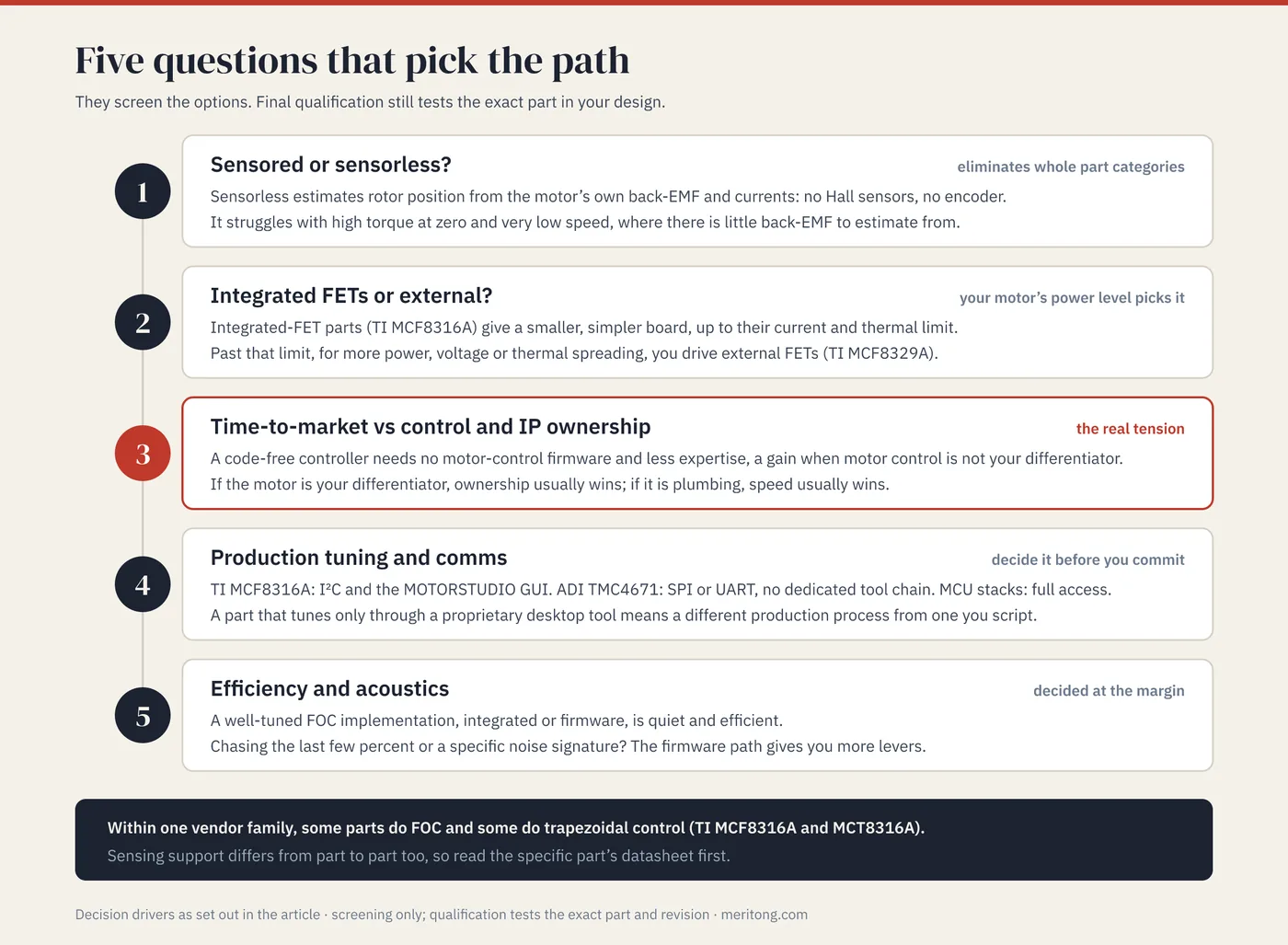
Five engineering questions decide between the three paths. They screen the options, and final qualification still tests the exact part in your design.
Sensored or sensorless? Sensorless FOC estimates rotor position from the motor's own back electromotive force (back-EMF) and currents, so it needs no Hall sensors or encoder. That saves cost and wiring. Sensorless FOC suits applications that spin up and then run at speed. Fans, pumps, compressors and blowers are examples. Sensorless control struggles with high torque at zero and very low speed, where there is little back-EMF to estimate from. ADI's TMC4671 datasheet states that no sensorless FOC method currently works "in a general purpose way as a sensor down to velocity zero." Applications such as precise servo, traction from standstill and positioning want Hall sensors or an encoder. This question alone eliminates whole categories of part. If you need sensored servo precision, a sensorless code-free controller is out; if you are spinning a pump, paying for an encoder interface is waste. Within one vendor family, some parts do FOC and some do simpler trapezoidal control: TI's MCT8316A is a sensorless trapezoidal part. Sensing support also differs from part to part: the MCF8316A is sensorless only and the TMC4671 sensored only. Read the specific datasheet before you assume that the family does it all.
Integrated FETs or external? Integrated-FET controllers such as the MCF8316A give you a smaller, simpler board, and they suit designs up to their current and thermal limit. Past that limit you move to a controller that drives external FETs, such as the MCF8329A or a gate-driver-plus-MCU design. Such a move answers a need for higher power, higher voltage or better thermal spreading. It costs more board work but scales. Your motor's power level picks this for you.
Time-to-market vs control and IP ownership: this is the real tension between path 1 and path 2. TI says its MOTORSTUDIO graphical user interface (GUI) for tuning lets users "quickly spin up their motors" (MCF8316A product page). A code-free controller needs less motor-control expertise and leaves no firmware project to staff or schedule. An MCU-plus-library stack takes longer and needs those skills, but in return you own the control loop. You can tune it for the last increment of efficiency or acoustics. You can fold your application logic onto the same MCU, and you do not depend on one controller's feature set. If the motor is your differentiator, path 2's ownership usually wins; if it is plumbing, path 1's speed usually wins.
Production tuning and comms: however you implement FOC, you tune it to the specific motor, and you may need to re-tune across motor variants or production spread. TI's MCF8316A takes its configuration over Inter-Integrated Circuit (I²C), and its EEPROM can be read and written over that bus (§7.6). TI's tool for tuning it is the MOTORSTUDIO GUI. ADI's TMC4671 uses SPI, with a universal asynchronous receiver-transmitter (UART) debug port, and its datasheet says no dedicated tool chain is needed to access its registers. MCU stacks give you full programmatic access. Decide before you commit how you will tune at the factory and support units in the field. A part that tunes only through a proprietary desktop tool makes for a different production process from one you script over a serial link.
Efficiency and acoustics: at the margin, a well-tuned FOC implementation is quiet and efficient, whether it runs in an integrated controller or in firmware. TI markets its code-free sensorless FOC drivers on "best-in-class acoustics and efficiency for home appliances" (motor drivers overview). If you are chasing the last few percent or a specific noise signature, the firmware path gives you more levers. A good integrated controller can still get a design where it needs to be.
What a forced controller change costs
This is where a motor-control decision becomes a supply decision, and where it connects to how you source a product manufactured in China. The placement of the loop decides what a forced part change will cost, because it decides who owns the tuning. The first path answers that question differently from the other two.
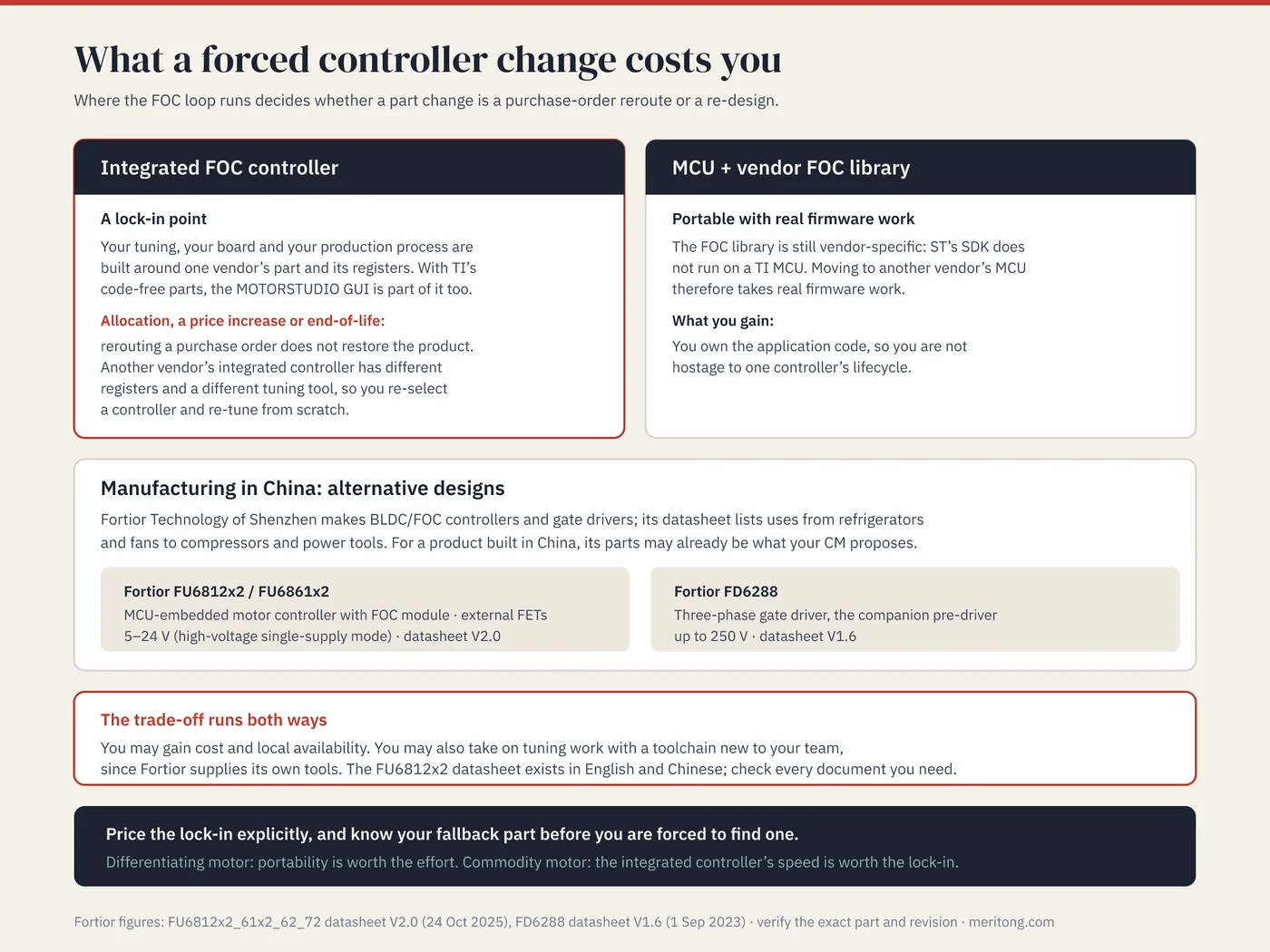
An integrated FOC controller is a lock-in point: your tuning, your board and your production process are built around one vendor's part and its registers. With TI's code-free parts, TI's own MOTORSTUDIO GUI is part of that dependency. Suppose that part goes on allocation, gets a price increase or reaches end-of-life. Rerouting a purchase order will not restore your product, because another vendor's integrated controller has different registers and a different tuning tool. You re-select a controller and re-tune from scratch. That is a deep dependency to take on for a part central to your product.
An MCU-plus-library path is more portable. The FOC library remains vendor-specific; ST's SDK, for instance, does not run on a TI MCU. So "portable" here means portable with real firmware work. In return you own the application code, so you are not hostage to one controller's lifecycle.
Manufacturing in China adds a cost question to the choice. Fortior Technology of Shenzhen makes BLDC/FOC controllers and gate drivers. Its FU6812x2 and FU6861x2 are MCU-embedded motor controllers with an FOC module, built for external FETs (datasheet V2.0 of 24 October 2025). In their high-voltage single-supply mode they run from 5–24 V (§1.1, power supply). Its FD6288 is a three-phase gate driver for operation up to 250 V (datasheet V1.6 of 1 September 2023 §1.3). The FU6812x2 datasheet lists applications from refrigerators and fans to compressors and power tools. Against a part from a US or European maker, these parts can be an alternative design-in and a possible cost option (compare quotes at your volume). They can also be a fallback design option. For a product built in China, they may already be what your contract manufacturer (CM) proposes. The trade-off runs in both directions. You may gain cost and local availability. You may also take on a tuning effort with a toolchain that is new to your team: Fortior supplies its own development tools, such as FTM8ForgeIDE and MotorSim (Fortior website). Fortior publishes the FU6812x2 datasheet in English and Chinese; its revision history dates the first English edition to February 2023, translated from the Chinese. Check the language of every document you will rely on, application notes included. The toolchain and documentation work is real and manageable: weigh it against the cost and availability gain, and take it on knowingly.
For a differentiating motor, the firmware path's portability and ownership are worth the effort; for a commodity motor, an integrated controller's speed is worth the lock-in. In either case, price that lock-in explicitly, and know your fallback part before you are forced to find one. An unpriced lock-in returns later as a re-selection and a re-tune, on the vendor's timetable.
FAQ
Do I need FOC, or is trapezoidal control enough?
FOC gives smoother, quieter, more efficient operation and better low-speed torque than simple trapezoidal (six-step) control. ST describes FOC and vector control as "widely used in high-performance drives" for applications that include air conditioning and home appliances. Trapezoidal control is simpler and can be fine for cost-driven, noise-tolerant fans. Some controller ICs do one or the other and some do both, so check the specific part's datasheet before you assume either.
Sensorless or sensored: how do I decide?
Sensorless control uses no Hall sensors or encoder, so it costs less. It suits motors that spin up and then run at speed, such as fans, pumps and compressors. Choose sensored control (Hall or encoder) when you need high torque at zero or low speed, or precise positioning. Servo drives and traction from standstill are examples. Sensorless position estimation is weakest where there is little back-EMF. Your speed and torque profile decides it.
Is a "code-free" integrated controller really no firmware?
It means no motor-control firmware. You configure a proven FOC implementation through registers and a tuning GUI, and you write no control loops. You will still tune it to your motor, and you may write application-level logic elsewhere. It is a real time-to-market win when motor control is not your differentiator, and it is also a vendor lock-in that you should price.
When is the MCU-plus-library path worth the extra effort?
It is worth it when the motor is part of what makes your product good. That applies when you want to own and tune the control loop, or fold application logic onto the same MCU. It also applies when you chase specific efficiency or acoustic targets, or want to avoid depending on one controller's lifecycle. You pay in firmware effort and motor-control expertise; you gain control and IP ownership.
Can I just second-source my integrated FOC controller like a jellybean part?
You cannot. Integrated controllers differ in registers, tuning tools and behavior. Replacing one therefore means re-selecting and re-tuning. That is why the controller choice is a lock-in decision. Identify a fallback part and understand the switching cost before you commit, especially for a part central to your product.
What about Chinese motor-control ICs like Fortior?
Fortior lists its FU6812x2 series of motor-control MCUs and its FD6288 gate driver on its current product pages. For a China-built product your CM may propose them, and they can be an alternative design-in and a possible cost option (compare quotes at your volume). Weigh the cost and availability benefit against the work of learning a new toolchain and checking the language of each document you need. Evaluate one as you would any controller: against your sensing, power and tuning needs, using its own datasheet.
Integrated FETs or external: where's the line?
Integrated-FET controllers are the simplest choice up to their current and thermal ceiling. The MCF8316A, for example, is rated for up to 8 A peak on a 4.5–35 V supply. Move to external FETs when you need more power, higher voltage or better thermal management. It is a power-level decision; let your motor's worst-case current and your thermal budget draw the line.
Checks before you commit
These steps identify the main risks in a controller choice. Final qualification still tests the exact part in your design, on real hardware.
- Download the current datasheet revision for the exact orderable part number, and check the maker's lifecycle status and any newer version it lists.
- Confirm that the part supports the sensing mode your speed and torque profile needs, then test start-up and low-speed torque under load.
- Compare your motor's worst-case current and supply voltage with the part's limits, and run a thermal test at your highest ambient temperature.
- Tune a sample motor through the interface you will use in production, and repeat the tuning across motor variants and production spread.
- Name a fallback part, and estimate the re-selection and re-tuning effort that a forced change would cost.
- Confirm that every document you will rely on, application notes included, exists in a language your team reads.
Record what these steps leave unproven, such as untested speed or temperature corners. Resolve it before you commit to production.
Close
Choosing a BLDC/FOC part turns on where the control loop runs and on what that placement costs you downstream. Decide between sensored and sensorless from your need for torque at low speed. Decide between integrated and external FETs from your power level. Decide between an integrated controller and MCU-plus-library from whether the motor is your differentiator or your plumbing. Neither option in that last decision is the safe choice in itself: the integrated controller trades ownership for speed, and the MCU-plus-library stack trades speed for ownership. Each trade is sound for the product that needs it. Then price the lock-in of whatever you pick, and know your fallback part.
If you are deciding where your FOC loop runs and want a forced controller change priced first, I help with product-architecture and hardware-component problems of this kind. I look at the hardware, the firmware and the sourcing together, particularly where China sourcing is involved.
This article quotes the datasheets and vendor pages named in the text, at the revisions given there, for device capabilities and the framing of the implementation paths. It is general engineering guidance. Verify the exact part, its revision and your motor's requirements, and confirm the design with qualified engineers.
Typical dependencies by email
Examples from real hardware audits, sent occasionally.
Working through this right now? Free intro call → or write to me →
Is this question on your desk right now?
In the free potential check you tell me the type of components you use. After 30 minutes you know whether an audit is worth it.
Free intro call